


Lentils are the one legume you can cook without planning ahead. There’s no soaking and no overnight decision, so you can decide at six o’clock that dinner is lentils and be eating within the hour.
Once they’re in the pot, one thing decides everything: is the skin still on? Red and yellow lentils are split and hulled, so nothing holds them together and they collapse into a puree. Brown, green, Puy and beluga keep their skin, so they hold their shape. Which bag to buy, how long to give it, and why yours turned to mush all come back to that one fact.
The short answer: No lentil needs soaking, though a soak will shorten the cooking a little. Rinse them, cover with about three times their volume of water, and simmer. Red split lentils take 15 to 20 minutes, brown and green 25 to 30, and Puy and beluga about 25.
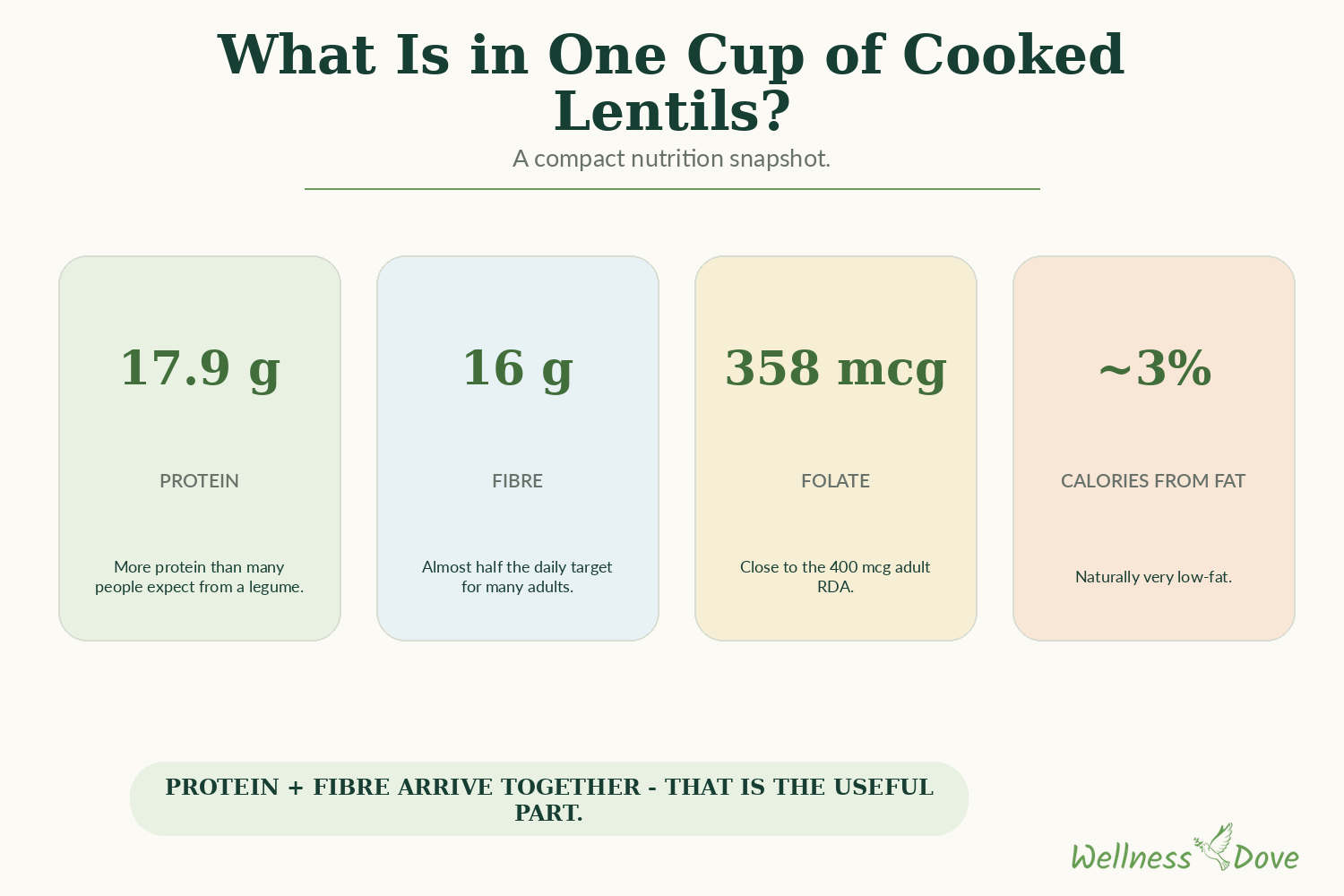
A cup of cooked lentils gives you 17.9 g of protein and 16 g of fiber. Acid goes in at the end, never at the start, because it keeps lentils firm. Salt doesn’t, so season whenever suits you.
Which Lentil to Buy
The color on the bag tells you what the lentil will do in the pot, and that’s really the only thing you need to know at the store. Red and yellow are always the split ones. Brown, green, Puy and beluga are always whole. Bags rarely say split or whole on them, so the color is what you have to go on.
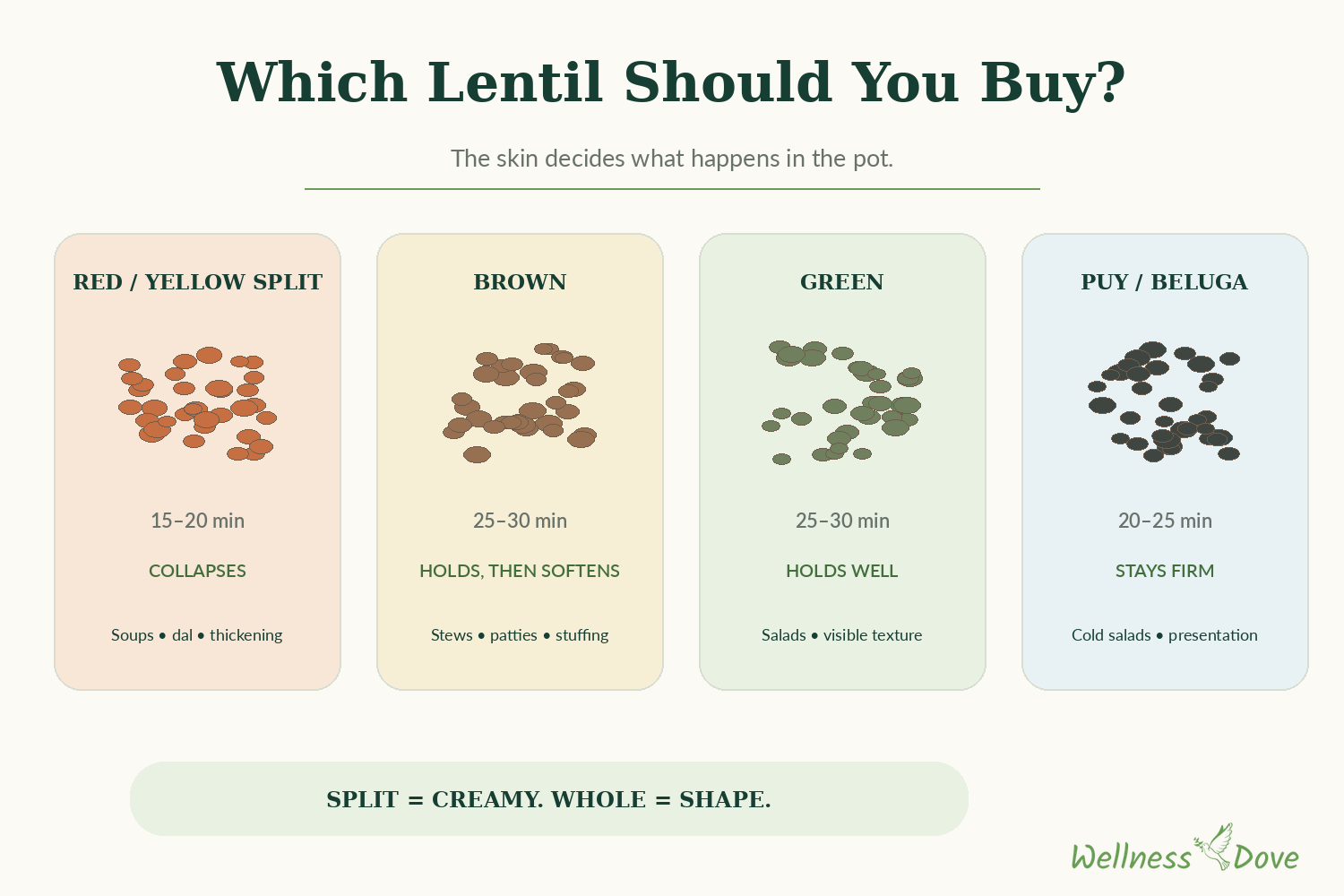
| Lentil | Cooking time | What it does | Use it for |
|---|---|---|---|
| Red or yellow split | 15 to 20 minutes | Collapses completely | Soups, dal, anything you want thick without cream |
| Brown | 25 to 30 minutes | Holds, then softens | The everyday one. Stews, patties, stuffed vegetables |
| Green | 25 to 30 minutes | Holds its shape well | Salads, and anything where you still want to see them |
| Puy or French | 20 to 25 minutes | Stays firm and peppery | Cold salads. The most expensive and the least necessary |
| Black beluga | 20 to 25 minutes | Stays firm, turns glossy | When the dish needs to look like something |
If you only ever keep one kind, keep red split. They’re the cheapest and the fastest, and they thicken a pot by themselves, which means no flour, no cream and no blender. Our red lentil cream soup is fifteen minutes from a cold pan to a bowl and there’s no cream in it anywhere. If you want the case for red lentils, that recipe makes it better than we can here.
How to Cook Lentils
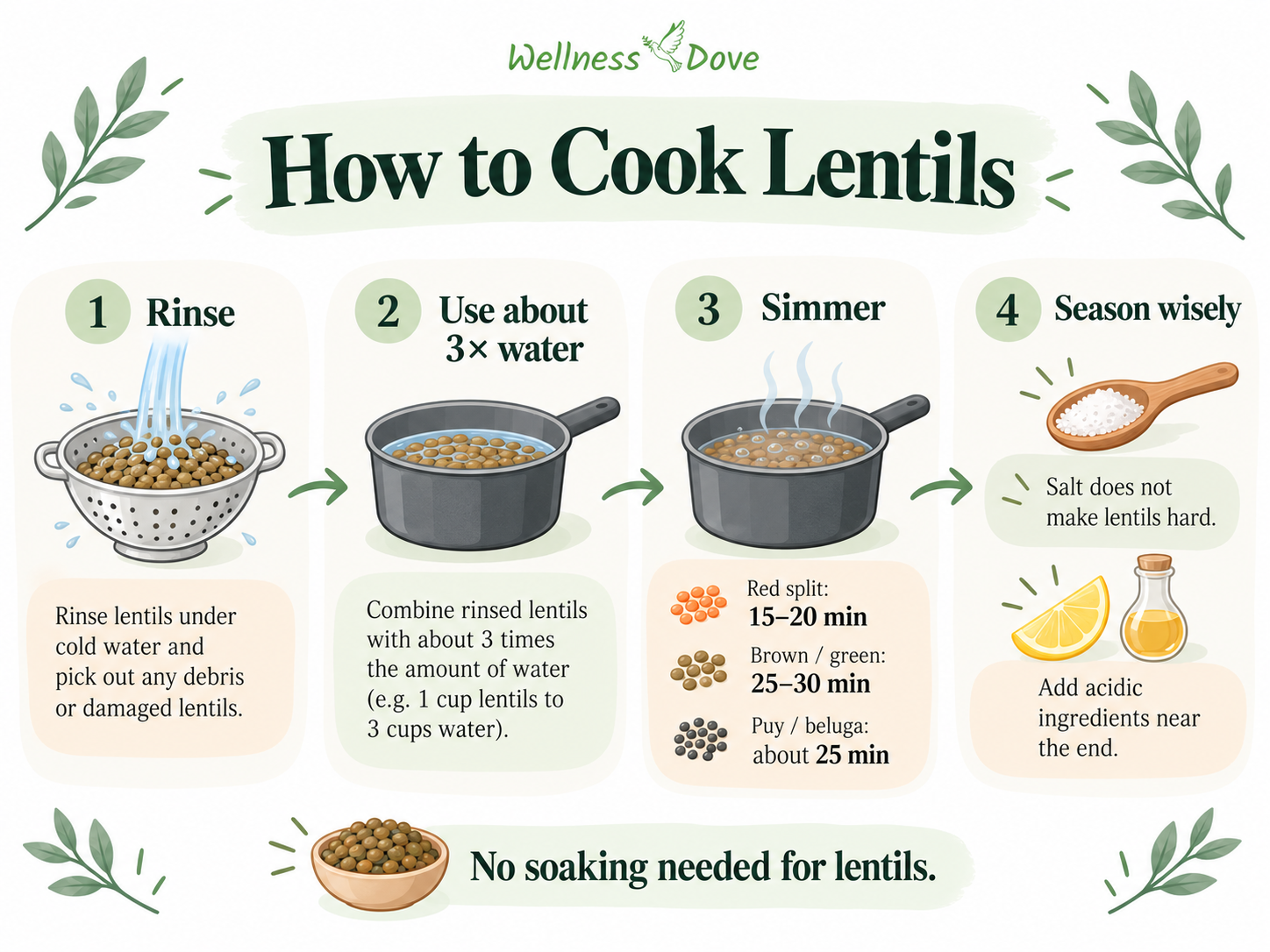
- Rinse them and pick them over. Lentils are harvested straight from the field, and a small stone gets through now and again. Tip them into a sieve, run water over them, and have a quick look at what’s there.
- 3 parts water to 1 part lentils. More if you want soup, less if you want them to stay separate. They don’t need the precision that rice does.
- Simmer, uncovered, and skim the foam. 15 to 20 minutes for red split, 25 to 30 for the whole ones. Start tasting early, because a lentil goes from firm to collapsed faster than you’d expect.
- Acid at the end. Not the start. Tomatoes, lemon and vinegar keep lentils firm, and this is the one rule that decides the texture.
Why lentils need no soaking
A chickpea or a kidney bean is large, dense and thick-skinned, so water takes hours to reach the middle. A lentil is thin and small, and water gets to the center of one in minutes.
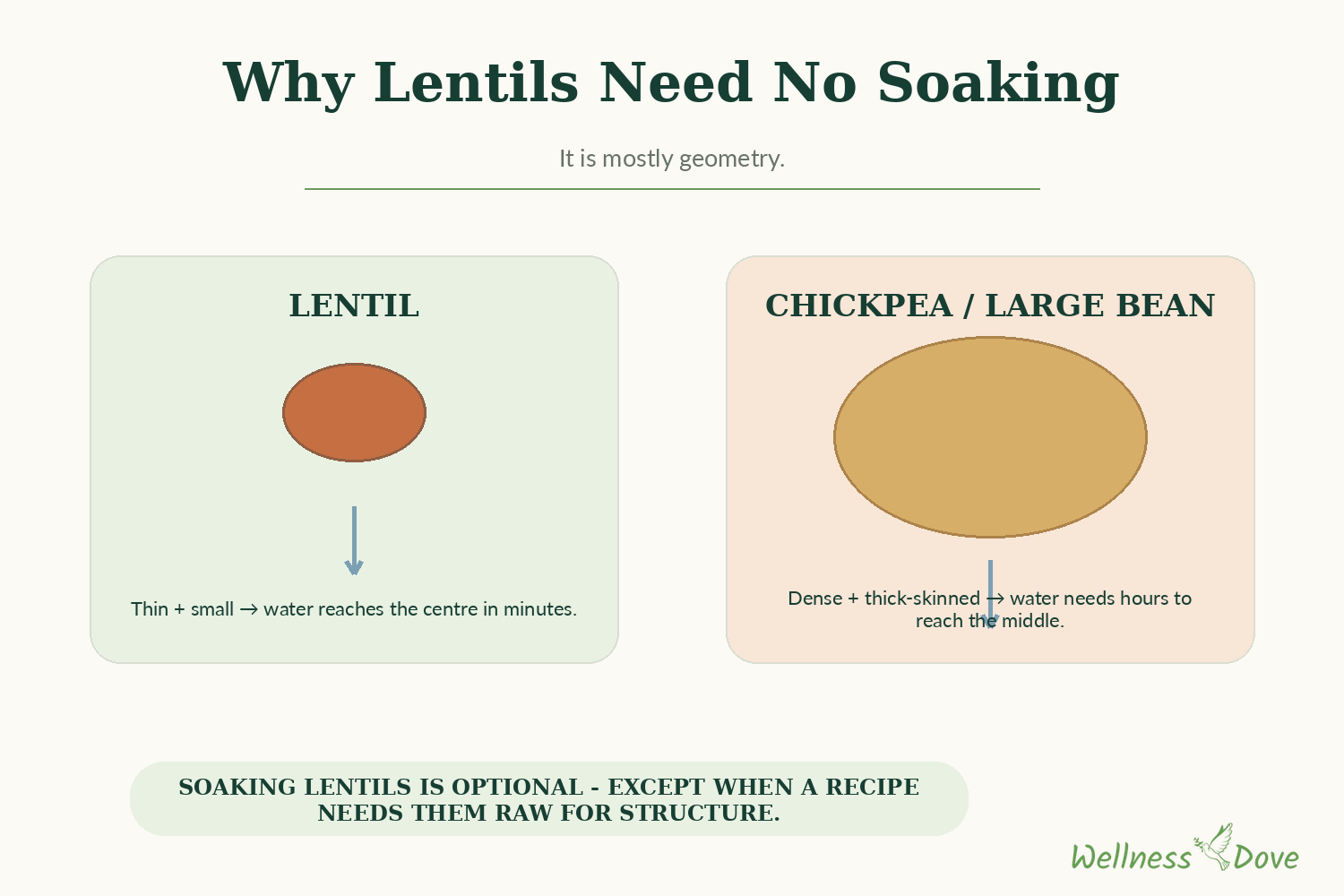
That’s the whole difference. Lentils aren’t a different sort of food from the other legumes, just a thinner one. You can soak them if you want to, and it’ll take a few minutes off the cooking time and a little off the gas that legumes cause, but it isn’t required and in our kitchen we mostly don’t bother.
The exception is when the soaking is doing structural work rather than softening. Our lentil bread needs them soaked and still raw, because boiled lentils have already gelatinized and can’t set again in the oven. There’s more on that in the flourless bread guide.
The rule that decides the texture
Acid firms a legume up from the inside, in the cell walls that hold it together. Added early, it keeps lentils chalky long past the point where they should have softened.
Salt, despite its reputation, doesn’t. In studies on beans, salted soaking water actually shortened the cooking time.
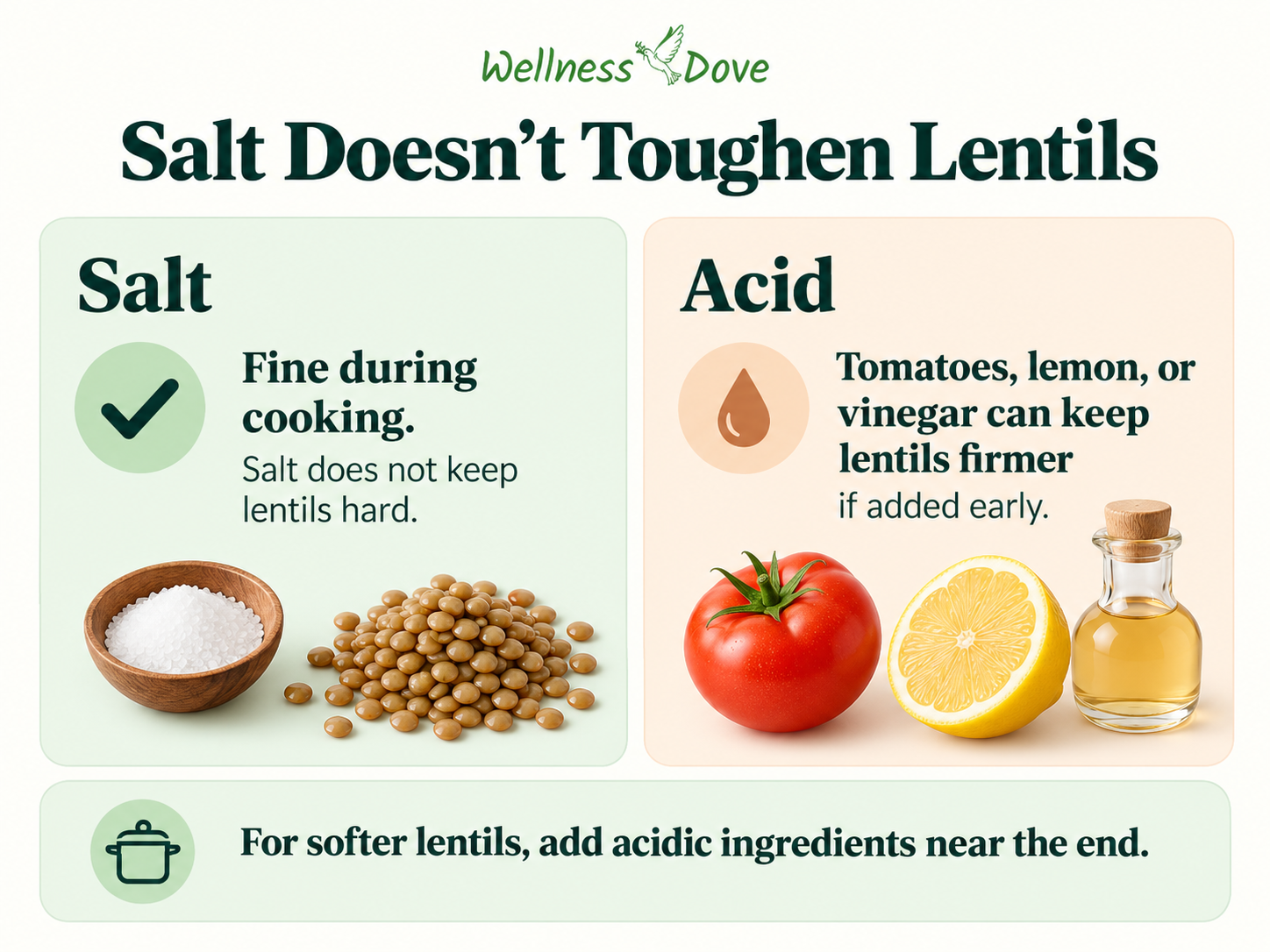
This is the usual reason lentils cooked in a tomato sauce never seem to get there. The tomatoes are the problem, not the lentils, and no amount of extra simmering will rescue them. So cook them in plain water first, then add the tomatoes and the lemon once they’re as soft as you want them. In our red lentil stew the lemon goes in off the heat at the very end, and it’s what keeps a pot of lentils from tasting flat.
The Lentil Effect: Why Tonight’s Dinner Changes Tomorrow’s Breakfast
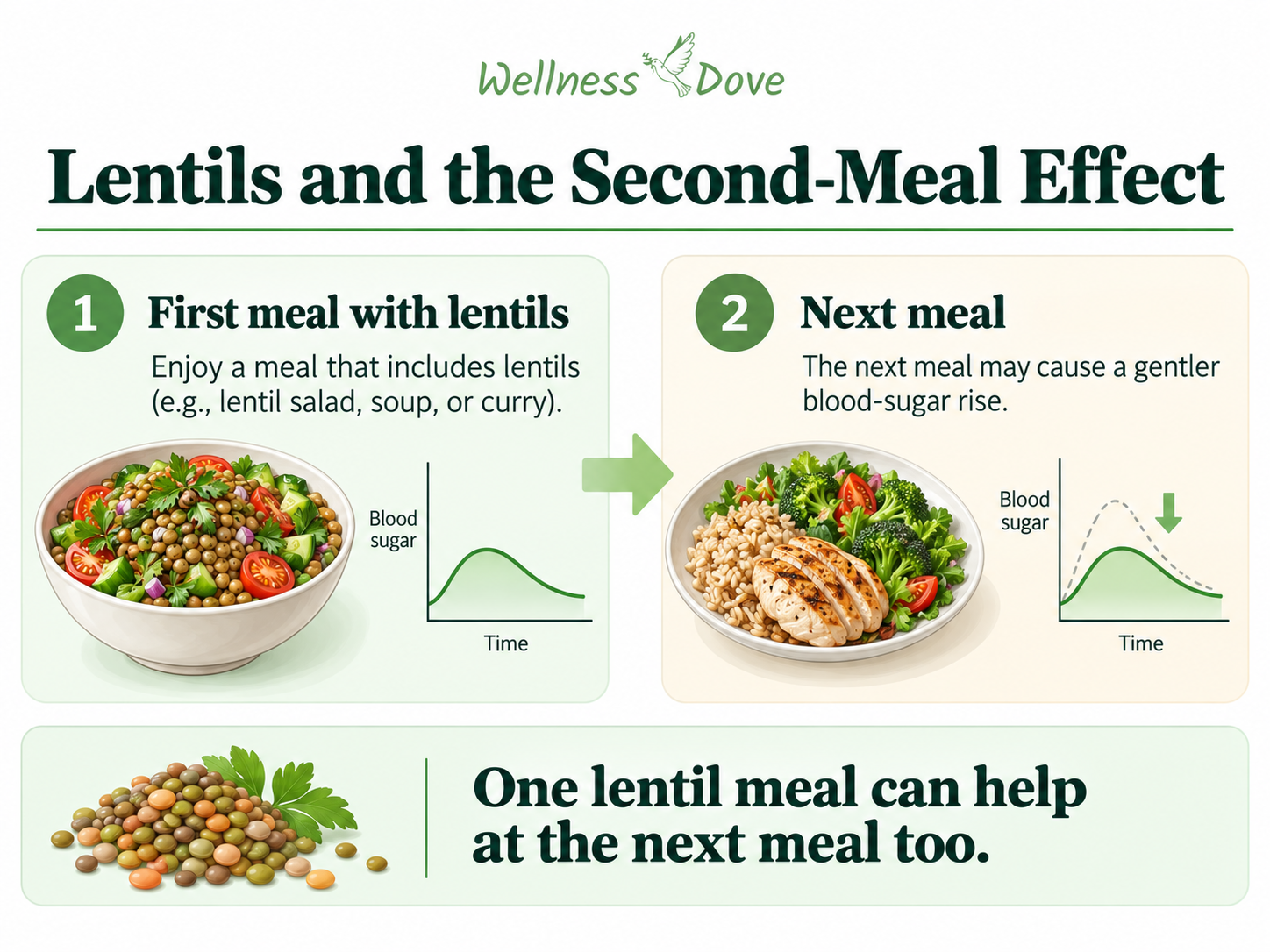
There’s a phenomenon in nutrition research called the second-meal effect, and lentils sit at the center of its history, which is why you’ll sometimes hear it called the lentil effect.
In 1982, researchers in Toronto gave people lentils for breakfast and then an identical lunch four hours later. The rise in blood sugar after that lunch was 38 percent smaller than after a breakfast of bread.
In 1988 the same group showed a version that works overnight. A dinner of slowly digested foods improved the blood sugar response to the next morning’s breakfast, even though the breakfast itself was identical in both arms of the study.
Why it happens
The best explanation for the overnight version is your gut bacteria. A large part of the carbohydrate in lentils never reaches your bloodstream at all. The fiber and resistant starch travel down to the colon, and the bacteria there ferment them into short-chain fatty acids.
Those enter the blood, slow gastric emptying and improve insulin sensitivity at the next meal. In a Swedish study, a dinner of brown beans left blood sugar 15 percent lower and insulin 16 percent lower at the following morning’s breakfast.
Blending doesn’t undo it. This is the part that surprises people, and it matters because it decides whether a smooth soup is a compromise.
Blend rice into a slurry and its blood sugar response rises to match a potato’s. Blend lentils and the response barely moves. Whole, pureed and powdered all come out close to the same, because legume cell walls are tough enough to survive the processing.
So a creamy dal gives you just as flat a curve as a bowl of whole lentils, and our red lentil soups aren’t the lesser version of the food.
It’s the reason we put lentils at lunch when the afternoon matters, and the reason a bowl of lentil soup holds us for about 5 hours where a salad doesn’t.
What’s Really in a Cup of Lentils
| Per cup, cooked | |
|---|---|
| Protein | 17.9 g |
| Fiber | 16 g |
| Folate | 358 mcg, against an RDA of 400 |
| Fat | About 3 percent of the calories |
The protein figure deserves a closer look, because it’s the one people get wrong in both directions. A cup of cooked lentils carries 17.9 g of protein. Gram for gram, meat still carries more, so the protein on its own isn’t the argument. What makes the difference is that the lentils arrive with 16 g of fiber and almost no fat, and meat doesn’t. We go through the whole question, including how much protein you need in the first place, in our guide to vegan protein.
One cup also puts you most of the way to the folate you need for the day.
What legumes do over a lifetime
In a study of 785 people aged 70 and over, in five groups across Japan, Sweden, Greece and Australia, legumes came out as the strongest dietary predictor of survival: about 7 to 8 percent lower risk of death for every 20 grams eaten a day.
That meant soy in Japan, brown beans and peas in Sweden, and lentils and chickpeas in Greece. It’s one observational study, but the pattern held across very different kitchens.
In an eight-week trial of 40 adults, one group was asked to add 5 cups of pulses a week to their usual diet, and the other to cut 500 calories a day. Both ended with smaller waists and better blood sugar, and only the pulse group’s HDL cholesterol rose. Nobody told the pulse group to cut anything.
Lentils and Iron
Lentils are a good source of iron, and the iron in them behaves differently from the iron in meat, in a way that’s usually reported only as a disadvantage. Your body adjusts how much plant iron it takes in. If you’re low, you absorb more of it. If you have plenty, you absorb less. It regulates the iron in meat as well, but less sharply.
So if you want to absorb more of it, the answer isn’t more lentils. It’s what you put next to them.

- Vitamin C in the same meal. An orange alongside raises absorption substantially. A squeeze of lemon helps a little, but an orange or a raw pepper carries far more vitamin C.
- Tomatoes and peppers count. Convenient, since they were going in anyway.
- Tea and coffee with the meal work against you. Have them at least an hour before the meal, or well over an hour after.
Venny: One thing I want to say plainly, because food writing gets it wrong and the error isn’t harmless.
If you’re a man, or a woman past menopause, and a blood test shows you’re iron deficient, the cause is often not your diet. It can be blood loss from the gut, and the list of possible causes includes bowel cancer.
Being told to eat more lentils and pair them with vitamin C isn’t just unhelpful in that situation. It can delay a diagnosis. Take a low iron result to your doctor and let them find out why, rather than treating it in the kitchen.
Venny is a medical doctor and a specialist in Nutrition and Dietetics; Andy holds a master’s degree in psychology. This is general information rather than medical advice.
If Lentils Upset Your Stomach
Lentils are a gentle place to start. In an eight-week trial, 87 percent of people eating lentils at lunch five days a week reported no gut symptoms or only mild ones.
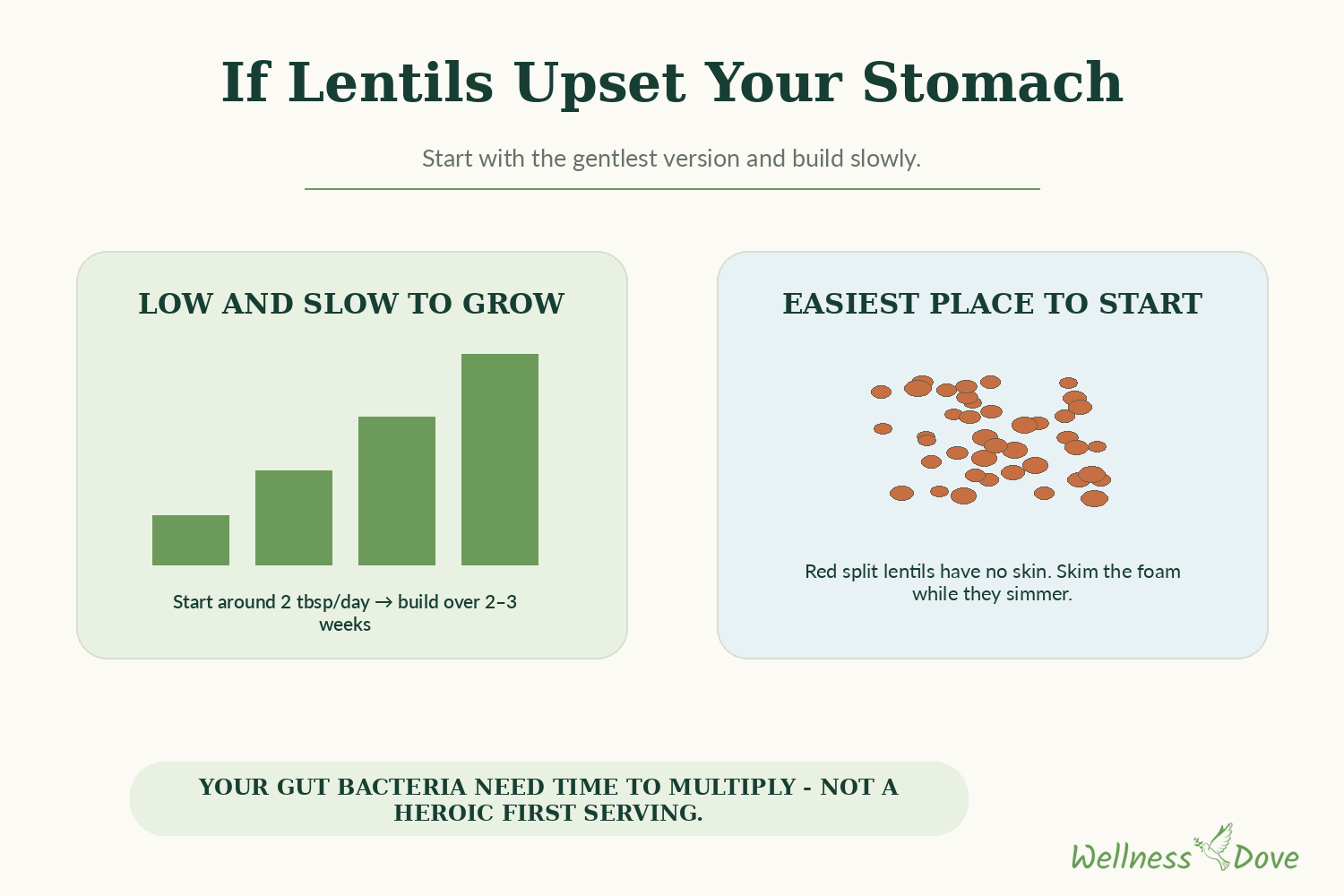
If beans have historically been a problem for you, start with 2 tablespoons a day rather than a bowlful, and build up over 2 or 3 weeks. The phrase we use is low and slow to grow. In one set of feeding studies, more than 70 percent of the people who noticed extra gas said it had faded by the second or third week. In our kitchen, red split lentils are the easiest of the easy, and we skim the foam off the top while they simmer.
The full explanation, and the research behind the ramp, is in our guide to bean patties.
Lentil Troubleshooting
They won’t soften
Almost always there’s acid in the pot. Tomatoes, lemon or vinegar added at the start will keep them firm no matter how long you simmer. If that’s not it, check how old the bag is. Lentils don’t spoil, but ones that have sat in the cupboard for a couple of years take much longer to soften and sometimes never quite get there.
They turned to mush
You bought split ones, or you cooked whole ones too long. Red split lentils can’t hold their shape, and no technique will make them. If you want lentils you can still see, buy green or brown and start testing them at 20 minutes.
The pot foamed over
That’s normal. Cook them uncovered and skim the foam off with a spoon for the first few minutes.
They taste of nothing
Lentils are a carrier rather than a flavor, and they need more seasoning than feels reasonable. Most people use about half of what the pot wants. Finish with acid, too. A squeeze of lemon at the end does more for a pot of lentils than another pinch of salt will.
There was a stone in it
It happens, and it’s the one real argument for tipping them out and looking before they go in the pan. It takes ten seconds.
What to Make With Them
Roughly in the order we cook them, most often first.
- Easy Red Lentil Soup: the one we make most. It thickens itself and nothing needs adding.
- Vegan Lentil Bread: the most read recipe on this site. Soaked and raw, never boiled.
- Quick Red Lentil Cream Soup: fifteen minutes, and the allspice is the part nobody expects.
- Lentil Bread Rolls: the same idea as the loaf, and quicker because rolls bake faster.
- Eastern Red Lentil Stew: thick enough to stand a spoon in, finished with lemon.
- Lentil Meatballs in Tomato Sauce: brown lentils, because these have to hold together.
- Sweet Potato Red Lentil Soup: closer to a dal, and fenugreek is the spice worth buying for it.
- Creamy Coconut Lentil Curry: the richest thing we make with them.
- Lentil Stuffed Peppers: whole lentils, for when you want to see them.
- Red Lentil Peanut Butter Casserole: an odd-sounding combination that works.
- Bean and Lentil Soup: both in one pot, and no oil anywhere near it.
Where to Start With Lentils
Buy a bag of red split lentils this week. They cost very little and they keep for a year. Then make the red lentil soup on a weeknight when you haven’t planned anything, because that’s the whole point of them: nothing had to happen yesterday for tonight’s dinner to work.
Have it again at lunch the following day, and pay attention to what four in the afternoon feels like.
And, always, seek health consciously.
Read Next
- Chickpeas: Canned or Dried, and How to Cook Them
- Bread Without Flour: How It Works, and Which Loaf to Make
- Vegan Meatballs, Patties and Burgers: What Holds Them Together
- The Four Numbers That Make Plant Food Filling
Sources (25)
- U.S. Department of Agriculture. Lentils, mature seeds, cooked, boiled, without salt. FoodData Central, SR Legacy, FDC 172421. View
- Didinger C, Cichy K, Urrea CA, Scanlan M, Thompson H. The effects of elevation and soaking conditions on dry bean cooking time. Legume Science. 2023;5(4):e207. View
- Zhu L, Che AJC, Kyomugasho C, Chen D, Hendrickx M. Effect of bio-chemical changes due to conventional ageing or chemical soaking on the texture changes of common beans during cooking. Food Research International. 2023;173(Pt 2):113377. View
- Avezum L, Ollier L, Siguemoto E, Rajjou L, Mestres C. Hydrolysis and diffusion of raffinose oligosaccharides family products in chickpeas, lentils, and beans under different pH and temperature steeping conditions. Food Research International. 2024;191:114732. View
- Jenkins DJ, Wolever TM, Taylor RH, et al. Slow release dietary carbohydrate improves second meal tolerance. American Journal of Clinical Nutrition. 1982;35(6):1339-1346. View
- Wolever TM, Jenkins DJ, Ocana AM, Rao VA, Collier GR. Second-meal effect: low-glycemic-index foods eaten at dinner improve subsequent breakfast glycemic response. American Journal of Clinical Nutrition. 1988;48(4):1041-1047. View
- Nilsson A, Johansson E, Ekström L, Björck I. Effects of a brown beans evening meal on metabolic risk markers and appetite regulating hormones at a subsequent standardized breakfast: a randomized cross-over study. PLoS One. 2013;8(4):e59985. View
- Crapo PA, Henry RR. Postprandial metabolic responses to the influence of food form. American Journal of Clinical Nutrition. 1988;48(3):560-564. View
- Jenkins DJ, Thorne MJ, Camelon K, et al. Effect of processing on digestibility and the blood glucose response: a study of lentils. American Journal of Clinical Nutrition. 1982;36(6):1093-1101. View
- Anguah KO, Wonnell BS, Campbell WW, McCabe GP, McCrory MA. A blended- rather than whole-lentil meal with or without α-galactosidase mildly increases healthy adults’ appetite but not their glycemic response. Journal of Nutrition. 2014;144(12):1963-1969. View
- Anderson GH, Liu Y, Smith CE, et al. The acute effect of commercially available pulse powders on postprandial glycaemic response in healthy young men. British Journal of Nutrition. 2014;112(12):1966-1973. View
- Würsch P, Del Vedovo S, Koellreutter B. Cell structure and starch nature as key determinants of the digestion rate of starch in legume. American Journal of Clinical Nutrition. 1986;43(1):25-29. View
- NIH Office of Dietary Supplements. Folate: fact sheet for health professionals. View
- Darmadi-Blackberry I, Wahlqvist ML, Kouris-Blazos A, et al. Legumes: the most important dietary predictor of survival in older people of different ethnicities. Asia Pacific Journal of Clinical Nutrition. 2004;13(2):217-220. View
- Mollard RC, Luhovyy BL, Panahi S, Nunez M, Hanley A, Anderson GH. Regular consumption of pulses for 8 weeks reduces metabolic syndrome risk factors in overweight and obese adults. British Journal of Nutrition. 2012;108(Suppl 1):S111-S122. View
- DellaValle DM, Glahn RP, Shaff JE, O’Brien KO. Iron absorption from an intrinsically labeled lentil meal is low but upregulated in women with poor iron status. Journal of Nutrition. 2015;145(10):2253-2257. View
- Hallberg L, Hultén L, Gramatkovski E. Iron absorption from the whole diet in men: how effective is the regulation of iron absorption? American Journal of Clinical Nutrition. 1997;66(2):347-356. View
- Ballot D, Baynes RD, Bothwell TH, et al. The effects of fruit juices and fruits on the absorption of iron from a rice meal. British Journal of Nutrition. 1987;57(3):331-343. View
- U.S. Department of Agriculture. Lemon juice, raw (FDC 167747); Oranges, raw, all commercial varieties (FDC 169097). FoodData Central, SR Legacy. View
- Morck TA, Lynch SR, Cook JD. Inhibition of food iron absorption by coffee. American Journal of Clinical Nutrition. 1983;37(3):416-420. View
- Ahmad Fuzi SF, Koller D, Bruggraber S, Pereira DI, Dainty JR, Mushtaq S. A 1-h time interval between a meal containing iron and consumption of tea attenuates the inhibitory effects on iron absorption. American Journal of Clinical Nutrition. 2017;106(6):1413-1421. View
- Snook J, Bhala N, Beales ILP, et al. British Society of Gastroenterology guidelines for the management of iron deficiency anaemia in adults. Gut. 2021;70(11):2030-2051. View
- Wilson SMG, Peterson EJ, Gaston ME, Kuo WY, Miles MP. Eight weeks of lentil consumption attenuates insulin resistance progression without increased gastrointestinal symptom severity: a randomized clinical trial. Nutrition Research. 2022;106:12-23. View
- Winham DM, Hutchins AM. Perceptions of flatulence from bean consumption among adults in 3 feeding studies. Nutrition Journal. 2011;10:128. View
- Liu K. Cellular, biological, and physicochemical basis for the hard-to-cook defect in legume seeds. Critical Reviews in Food Science and Nutrition. 1995;35(4):263-298. View