


There is a bag of dried chickpeas at the back of most cupboards that has been there for two years.
Cheaper than the cans next to it, and better food. Nobody uses it, because using it means deciding twelve hours before dinner that you wanted chickpeas.
So here is the settled version: what the price difference actually is, how to cook them, and the one recipe on this site where a can will not work.
The short answer: Keep both. Dried chickpeas cost roughly half the price of canned once cooked, and you control what goes in them, which is nothing. Soak them 12 hours, then simmer for an hour to an hour and a half. 2 cups dried gives you 5 cups cooked, which is about three cans.
Cans are for the evenings when dinner was not planned, and draining and rinsing them takes close to half the sodium away. The only recipe on this site where a can will not do is the chickpea bread, because that one needs them soaked and still raw.
Canned or Dried Chickpeas: The Honest Answer
Venny has written the same sentence into four different recipes on this site over the years: I always prefer to boil my beans at home. It takes time but there will be no added chemicals, salt, sugar, or preservatives.
That is true. It is also not the whole picture, because the shopping list on our budget page says chickpeas, dried and a few cans. Both live in this kitchen.
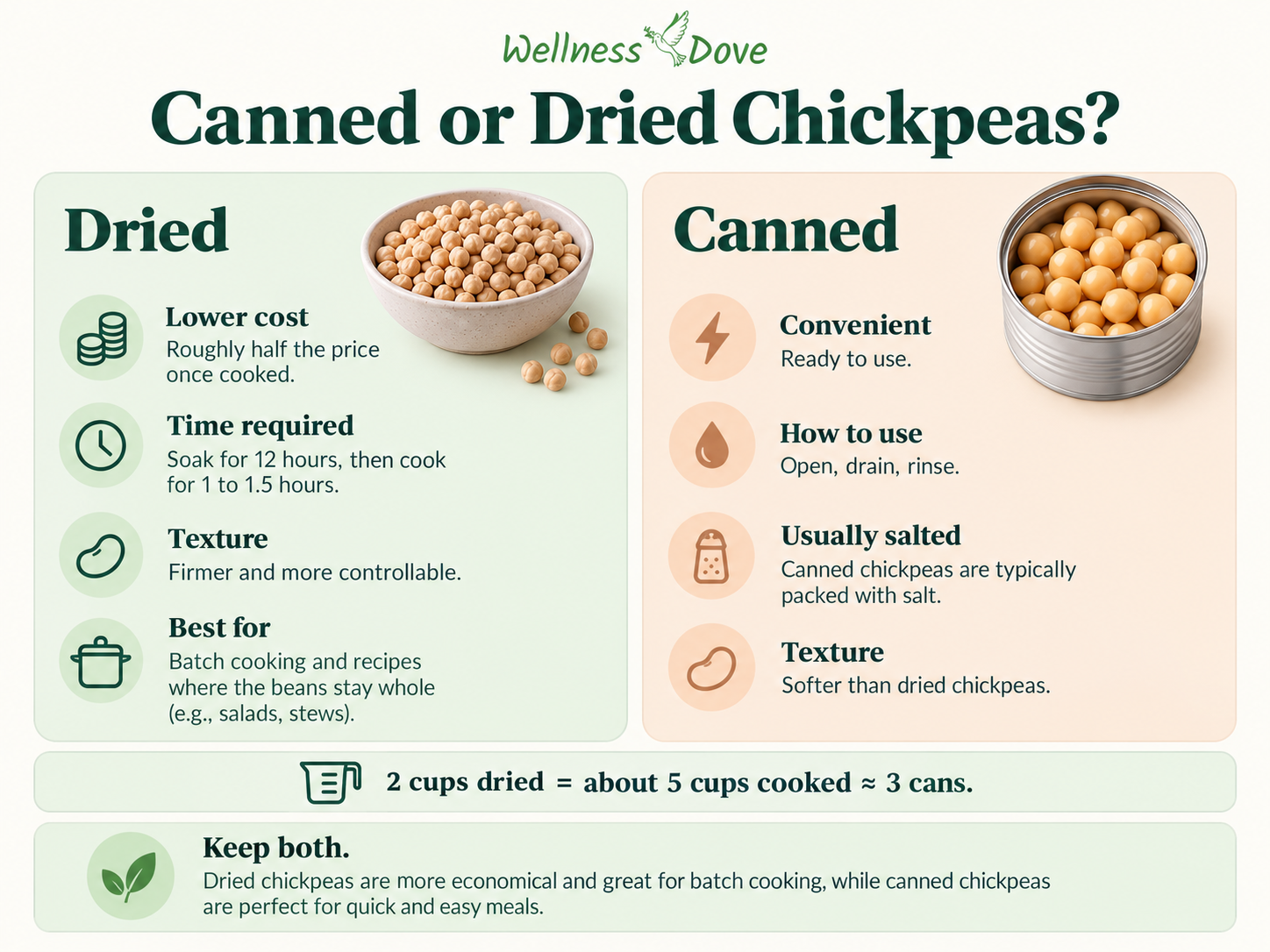
| Dried | Canned | |
|---|---|---|
| Cost | About half the price once cooked | About twice as much for convenience |
| Time | 12 hours soaking, 1 to 1.5 hours cooking | Open, drain, rinse |
| Salt | None unless you add it | Usually added. Rinsing removes much of it |
| Texture | Firmer, and you decide how soft | Softer, sometimes mushy |
| Best for | Batch cooking, salads, anything where they stay whole | Tuesday |
The honest position is that the can is not the compromise people think it is. A rinsed can is still whole beans with nothing taken out of them. And a dinner made with a can beats a dinner not made, because the dried ones needed soaking yesterday.
Where dried chickpeas genuinely win
Where dried genuinely wins is cost and control. Twice the chickpeas for the same money adds up quickly when beans are the center of how you eat.
And they are worth making the center of it. A cup of cooked chickpeas carries about 14.5 g of protein, and a large share of the carbohydrate in beans never reaches your bloodstream at all. Between the fiber, the resistant starch and the oligosaccharides, a good part of it walks straight past the small intestine and feeds your gut bacteria instead. Across five populations, legumes turned out to be the most important dietary predictor of survival in older people, which we go into properly in the bean patties guide.
Always rinse a can, and rinse it properly. Under running water, in a sieve, until the foam stops. In one test on canned chickpeas, draining alone took off 38 percent of the sodium, and draining plus a quick rinse took off 47 percent. The liquid is also the part people most often tip straight into the pan. The exception is hummus, where a spoonful of the can liquid makes it smoother. Choose one or the other, and know which you are doing.
How to Cook Dried Chickpeas
There is no trick to it. There is only a decision made the night before.
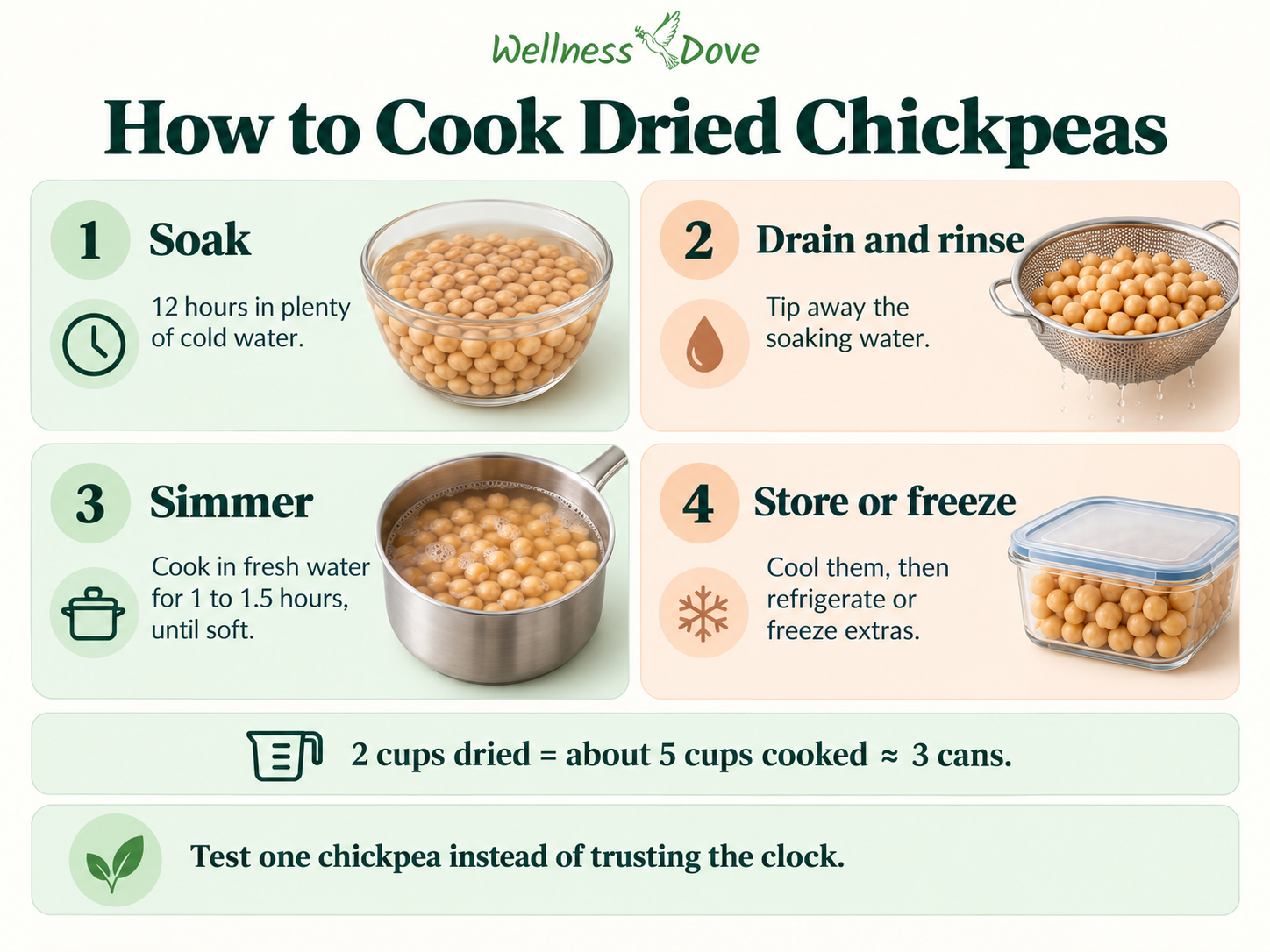
- Soak, 12 hours. Cover them with plenty of cold water and leave them overnight. They roughly double in size, so give them room and more water than looks necessary.
- Drain and rinse. Tip the soaking water away instead of cooking in it.
- Simmer, an hour to an hour and a half. Fresh water, plenty of it, cooked until soft. Older chickpeas take longer, and nothing on the bag tells you their age, so test one instead of trusting the clock.
- Keep the cooking water if you want a stock. It is worth more than can liquid and has no salt in it. The one exception is if you changed the water to make them easier on the stomach, in which case the whole point was that those sugars went down the sink.
Two cups of dried chickpeas gives you roughly five cups cooked, which is about three cans. That is the batch we make. What we will use in the next few days goes in the fridge, and the rest goes in the freezer.
Cook once, freeze the rest
This is what makes dried chickpeas practical rather than aspirational, and it is the step that turns the bag at the back of the cupboard into something you actually use.
Cook the whole bag. Cool them, drain them well, then freeze them spread out on a tray first so they stay separate, and bag them once they are solid.
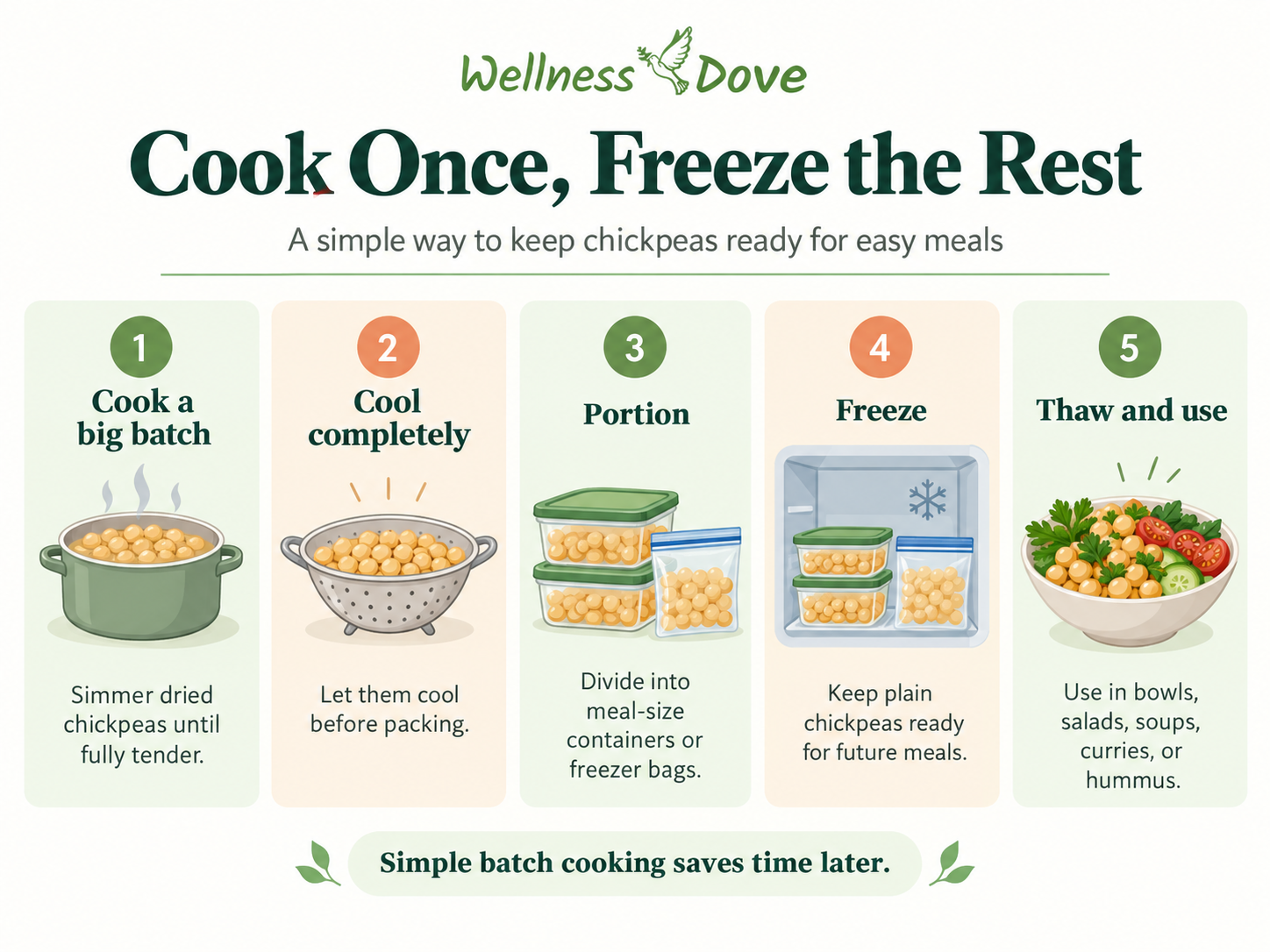
Frozen that way they pour, so you take out a handful instead of chipping at a block. They go straight into a soup or a stew from frozen, and they thaw in cold water in about ten minutes for a salad.
A can costs you a trip to the shop. A freezer bag costs you nothing, and it removes the only real argument for buying cans in the first place.
The one thing worth doing differently
On a few of our bean recipes we suggest changing the water partway through boiling to make them easier on the stomach. The sugars that cause the trouble, raffinose and stachyose, leach into the water, and one study found their drop was smaller when the cooking water was kept. The cost is some of the polyphenols, which leach out too.
If beans have historically been a problem for you, it is worth doing while your digestion adjusts.
The Recipe Where a Can Will Not Work
Our chickpea bread is the exception, and readers ask about it often enough that it belongs here.
That loaf needs chickpeas soaked but still raw. Raw soaked chickpeas still have starch and protein that set in the oven and soak up the batter’s water. Cooked ones have already done that in the pot, so a can gives you a wet paste rather than bread.
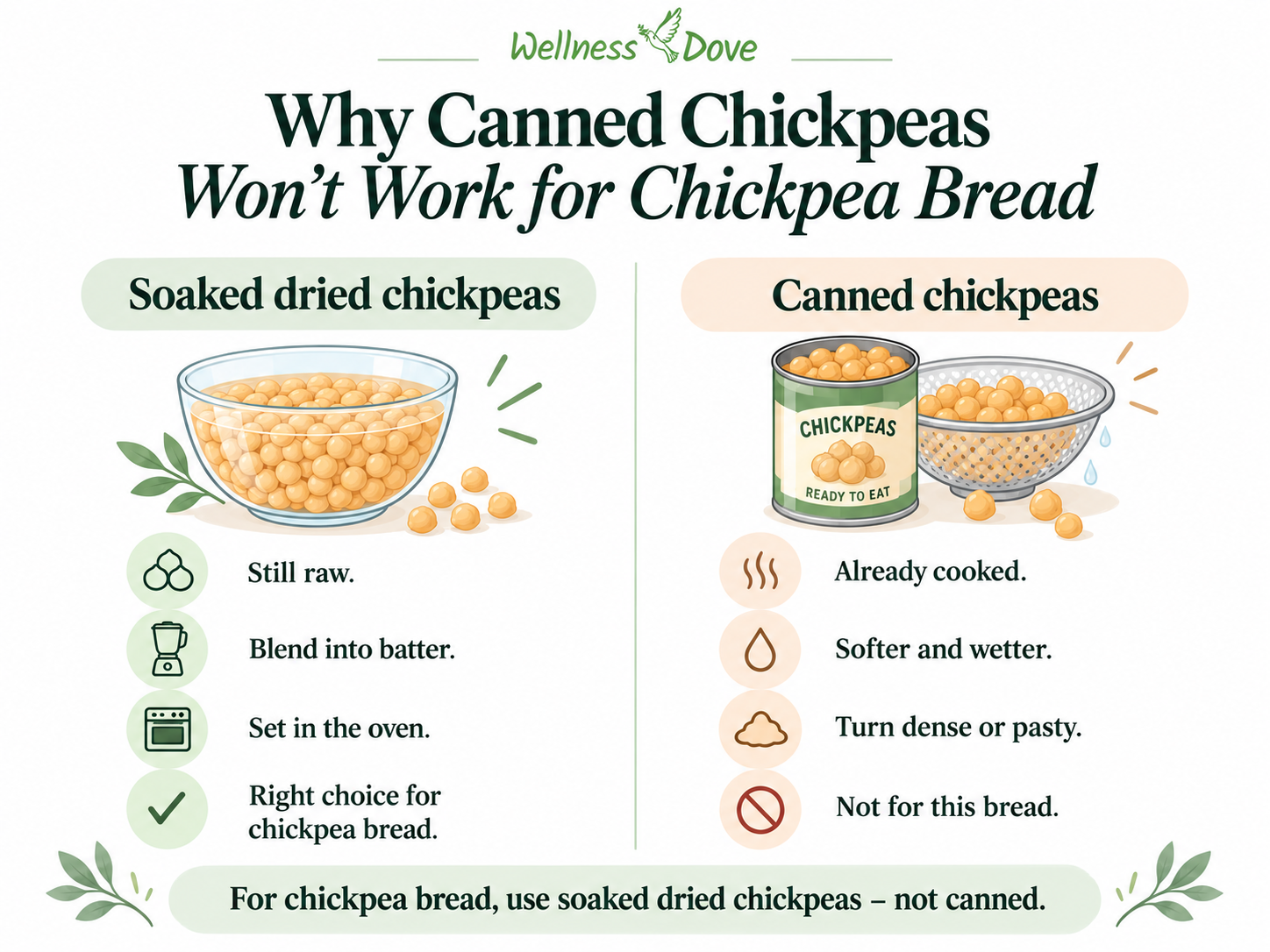
The bread then bakes for a full hour, which cooks them through properly. That question comes up in the comments and it is a reasonable one to ask.
The same rule applies to our soaked-legume patties. If a recipe tells you to soak and not boil, the soaking is doing structural work and a can cannot stand in. One limit on that. It works because chickpeas are low in the lectin that makes undercooked beans a problem. Never do it with kidney beans, which need a hard boil. There is more on that in the bread guide.
Chickpea Flour Is a Different Ingredient
Also sold as gram flour or besan, and it is not interchangeable with the beans in any recipe.
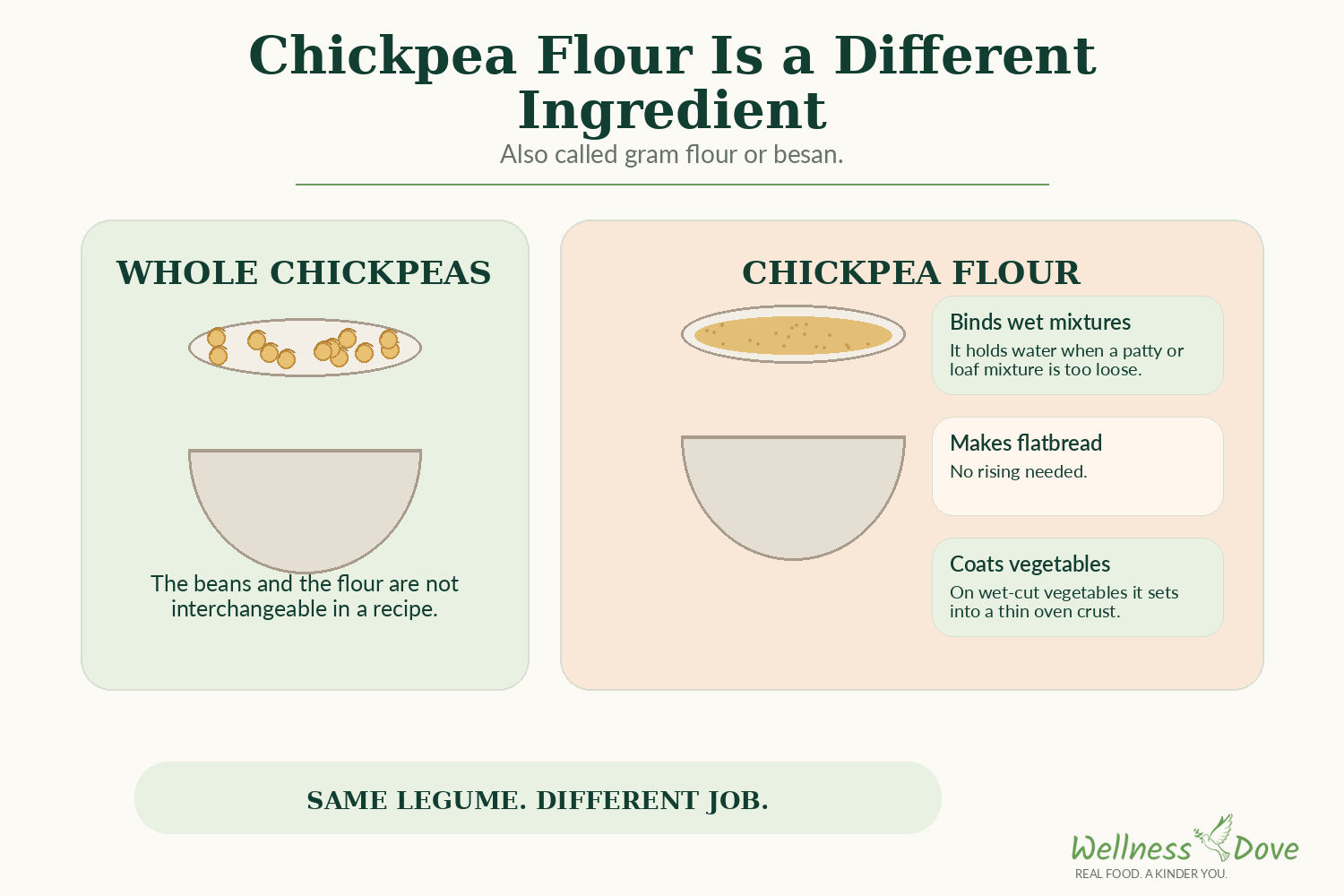
What it is good at is holding water. That makes it the thing we reach for when a mixture is too wet to shape, and the base of a flatbread that needs no rising and no pan.
It also makes a surprisingly good coating. Tossed over wet-cut vegetables with spices it sets into a thin crust in the oven, which is how we get baked zucchini to behave like something battered without any oil.
If Chickpeas Upset Your Stomach
Common, usually temporary, and we have answered it properly elsewhere rather than repeating it here.
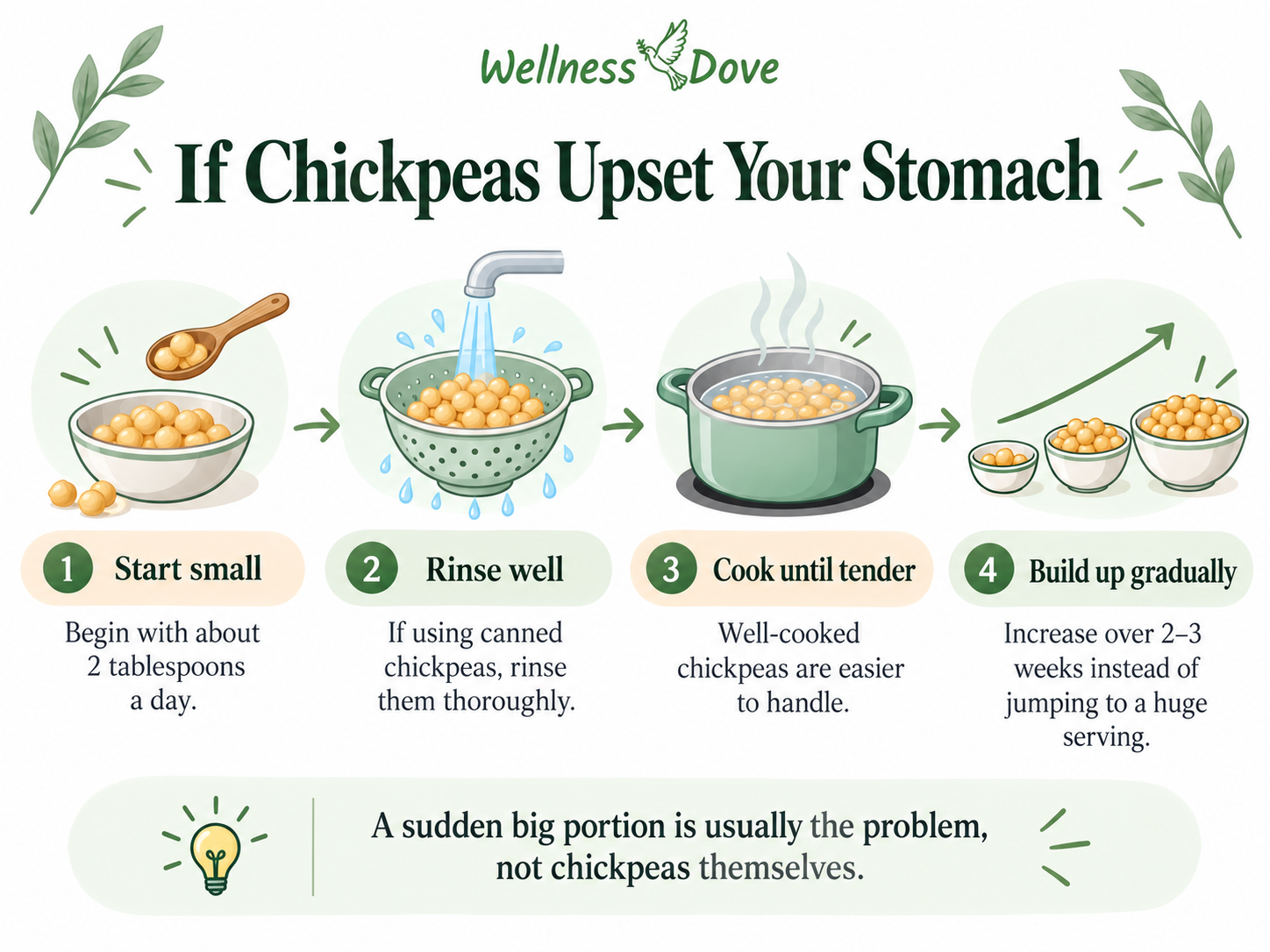
The short version: start with two tablespoons a day instead of a bowlful, rinse cans well, change the water partway through boiling dried ones, and give it two or three weeks. Canned, well-rinsed legumes are a gentle place to start, because canning lowers the sugars that cause the gas. The full explanation, and the research behind it, is in our guide to bean patties.
Venny: One question we were asked in the comments years ago and never answered properly, so let me answer it now. A reader on a low FODMAP protocol said she was only allowed canned legumes. That is a case where the can is not the lesser option.
It is also a case where your dietitian’s instruction beats anything on a recipe site, ours included.
Low FODMAP is a few weeks of strict restriction, then a reintroduction to find your personal triggers. It is not meant to be permanent, and it should be run with someone who can supervise the reintroduction. If that is you, follow their protocol and treat everything above as a description of the food, not advice about your condition.
Venny is a medical doctor and a specialist in Nutrition and Dietetics; Andy holds a master’s degree in psychology. This is general information rather than medical advice.
Chickpea Troubleshooting
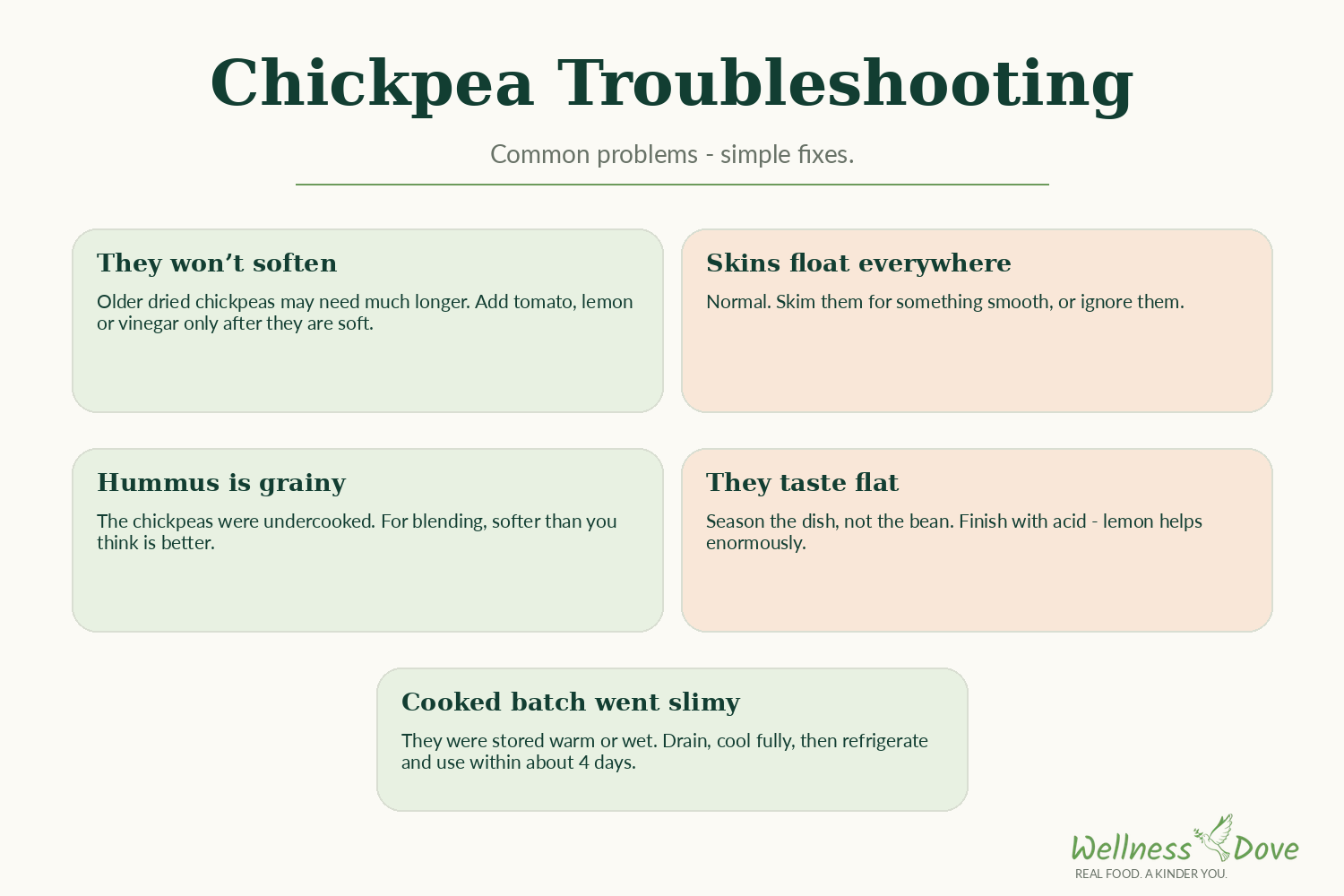
They will not go soft
Usually age, or a bag stored somewhere warm and humid. Dried chickpeas do not spoil, but the older they are the longer they take, and a bag that has been in the cupboard for two years can simply refuse.
Give them another twenty minutes before you give up. If they are still chalky after an hour and a half, they may never soften properly.
Add acid only once they are soft. Tomatoes, lemon or vinegar going in early will keep them firm for a long time. This is the usual reason chickpeas in a tomato stew never seem to soften.
The skins float everywhere
Normal, and mostly harmless. Skim them off with a slotted spoon if you are making something smooth, and ignore them entirely otherwise.
My hummus came out grainy
The chickpeas were undercooked. A food processor cannot rescue a bean that is still firm in the middle, and running it for longer just warms the bowl.
Softer than you think you need is the right target for anything blended.
They taste of nothing
They are a carrier, not a flavor. Season the dish, not the bean, and finish with acid, because lemon does more for a bowl of chickpeas than salt does.
The cooked batch went slimy
They were stored warm, or stored wet. Drain them properly, let them cool before the lid goes on, and use them within about four days.
What to Make With Them
Roughly in the order we actually cook them.
- Five-Ingredient Hummus: canned is fine, no peeling, no oil.
- Chickpea “Tuna” Salad: the sandwich filling that converts people.
- Baked Chickpea Balls: the easiest thing to shape, and the place to start.
- Chickpea Bread: dried only, soaked and raw. Our most-read chickpea recipe.
- Roasted Chickpeas: the snack, and the one where drying them properly matters.
- Chickpea Meatloaf: whole chickpeas and chickpea flour working together.
- Baked Falafel: under thirty minutes, no frying.
- Mediterranean Chickpea Salad: the one that carries a dry-weight conversion if you are cooking your own.
- Creamy Chickpea Curry: where cooking dried ones is written in as a step you can skip.
Where to Start With Chickpeas
Put two cups of dried chickpeas in a bowl of water tonight. Boil them tomorrow while you do something else.
You will have three cans’ worth in the fridge and about half of dinner already decided for the next few days.
And, always, seek health consciously.
Read Next
- Vegan Meatballs, Patties and Burgers: What Holds Them Together
- Oil-Free Salad Dressing: The Ratio That Makes It Work
- Healthy Eating on a Budget: What It Actually Costs Us
Sources (15)
- Zanovec M, O’Neil CE, Nicklas TA. Comparison of nutrient density and nutrient-to-cost between cooked and canned beans. Food and Nutrition Sciences. 2011;2(2):66-73. View
- U.S. Department of Agriculture. Chickpeas, mature seeds, cooked, boiled, without salt (FDC 173757); raw (FDC 173756). FoodData Central, SR Legacy. View
- Duyff RL, Mount JR, Jones JB. Sodium reduction in canned beans after draining, rinsing. Journal of Culinary Science and Technology. 2011;9(2):106-112. View
- Siva N, Thavarajah P, Thavarajah D. Prebiotic carbohydrate concentrations of common bean and chickpea change during cooking, cooling, and reheating. Journal of Food Science. 2020;85(4):980-988. View
- Darmadi-Blackberry I, Wahlqvist ML, Kouris-Blazos A, et al. Legumes: the most important dietary predictor of survival in older people of different ethnicities. Asia Pacific Journal of Clinical Nutrition. 2004;13(2):217-220. View
- Vidal-Valverde C, Frias J, Valverde S. Changes in the carbohydrate composition of legumes after soaking and cooking. Journal of the American Dietetic Association. 1993;93(5):547-550. View
- Njoumi S, Amiot MJ, Rochette I, Bellagha S, Mouquet-Rivier C. Soaking and cooking modify the alpha-galacto-oligosaccharide and dietary fibre content in five Mediterranean legumes. International Journal of Food Sciences and Nutrition. 2019;70(5):551-561. View
- Xu B, Chang SK. Effect of soaking, boiling, and steaming on total phenolic content and antioxidant activities of cool season food legumes. Food Chemistry. 2008;110(1):1-13. View
- Grant G, More LJ, McKenzie NH, Stewart JC, Pusztai A. A survey of the nutritional and haemagglutination properties of legume seeds generally available in the UK. British Journal of Nutrition. 1983;50(2):207-214. View
- Noah ND, Bender AE, Reaidi GB, Gilbert RJ. Food poisoning from raw red kidney beans. British Medical Journal. 1980;281(6234):236-237. View
- Winham DM, Hutchins AM. Perceptions of flatulence from bean consumption among adults in 3 feeding studies. Nutrition Journal. 2011;10:128. View
- Tuck C, Ly E, Bogatyrev A, et al. Fermentable short chain carbohydrate (FODMAP) content of common plant-based foods and processed foods suitable for vegetarian- and vegan-based eating patterns. Journal of Human Nutrition and Dietetics. 2018;31(3):422-435. View
- Whelan K, Martin LD, Staudacher HM, Lomer MCE. The low FODMAP diet in the management of irritable bowel syndrome: an evidence-based review of FODMAP restriction, reintroduction and personalisation in clinical practice. Journal of Human Nutrition and Dietetics. 2018;31(2):239-255. View
- Reyes-Moreno C, Paredes-López O. Hard-to-cook phenomenon in common beans: a review. Critical Reviews in Food Science and Nutrition. 1993;33(3):227-286. View
- U.S. Department of Agriculture, Food Safety and Inspection Service. Leftovers and food safety. View