

You spend twenty minutes making the mixture. You shape it. It looks like a burger.
Then you lift it off the board and it sags in half.
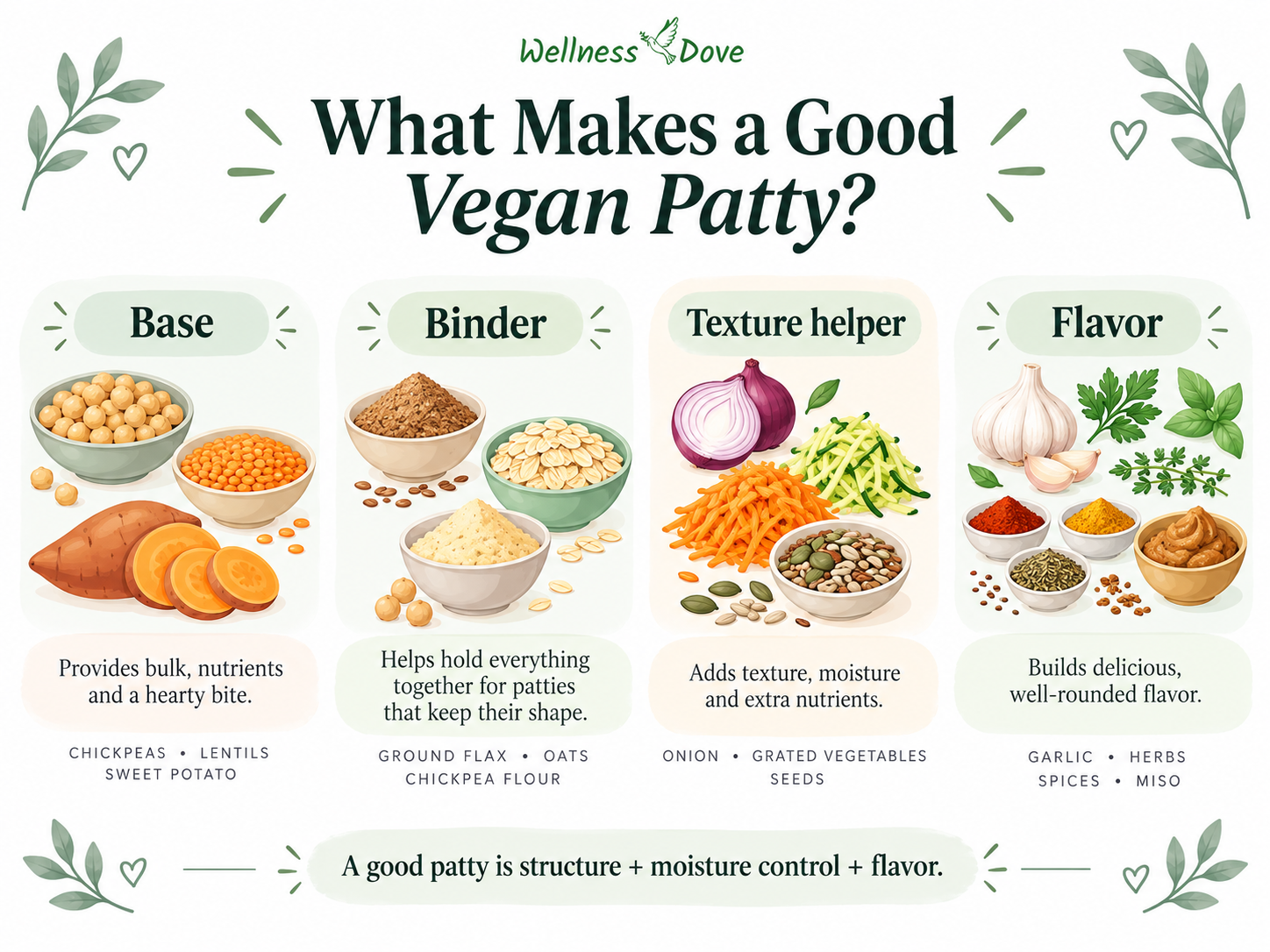
There is no egg in a vegan patty, no oil, and in ours no breadcrumbs either. Something still has to do the job all three of those were doing, and almost nobody tells you what.
We have nineteen recipes on this site that are some version of this: balls, patties, burgers, nuggets, meatballs, one loaf. Not one of them chills the mixture before shaping. That is the opposite of the advice you will read almost everywhere else.
The short answer: Ground flaxseed is the binder in most of our balls and patties. It soaks up loose liquid and sets into a gel, which is what egg used to do. If flax alone will not carry the water, a spoonful of chickpea flour finishes the job. And the rule that matters most: these firm up as they cool out of the oven, not in the fridge beforehand. Shape them straight away and judge them once they have cooled.
Why Vegan Meatballs and Patties Fall Apart
A meat patty holds itself together. The proteins in it coagulate in the heat and knit into a solid.
Beans do not do that. Mashed chickpeas in a pan are still mashed chickpeas after thirty minutes, only hotter. Nothing has knitted.
So a vegan patty needs something added whose entire job is to grab the free water and turn it into a solid. Conventional recipes reach for egg, or breadcrumbs, or a slick of oil to seal the outside. We use none of those.
Ground flaxseed is what does the binding
Ground flaxseed carries a mucilage, a soluble fiber that turns gluey within a few minutes of meeting water and holds many times its weight in it. Stir it through a wet mixture and it takes up the loose liquid, then sets into a soft gel around everything else.
That gel is the structure of the patty. The job is mechanical, not nutritional, so the quantity matters and you can always add more when a mixture is too loose.
It is the same principle as the psyllium in our flourless bread, on a smaller scale. A fiber that gels is standing in for a protein that sets.
Ground, not whole. This is the line we put in the zucchini and potato burgers: use ground flaxseed, not whole flax seeds, it helps to bind the patties. Whole seeds bind poorly, because the gel comes off the hull slowly. Most of them also pass through you intact: in trials, whole seed gave no significant rise in blood omega-3, and only about a quarter of the lignans ground seed gave. If all you have is whole seed, grind it in a coffee grinder first.
There are three ways to bind, and your mixture picks one
Read back through our own recipes and they fall into three groups. Which one you are in depends entirely on how much water is in the base.
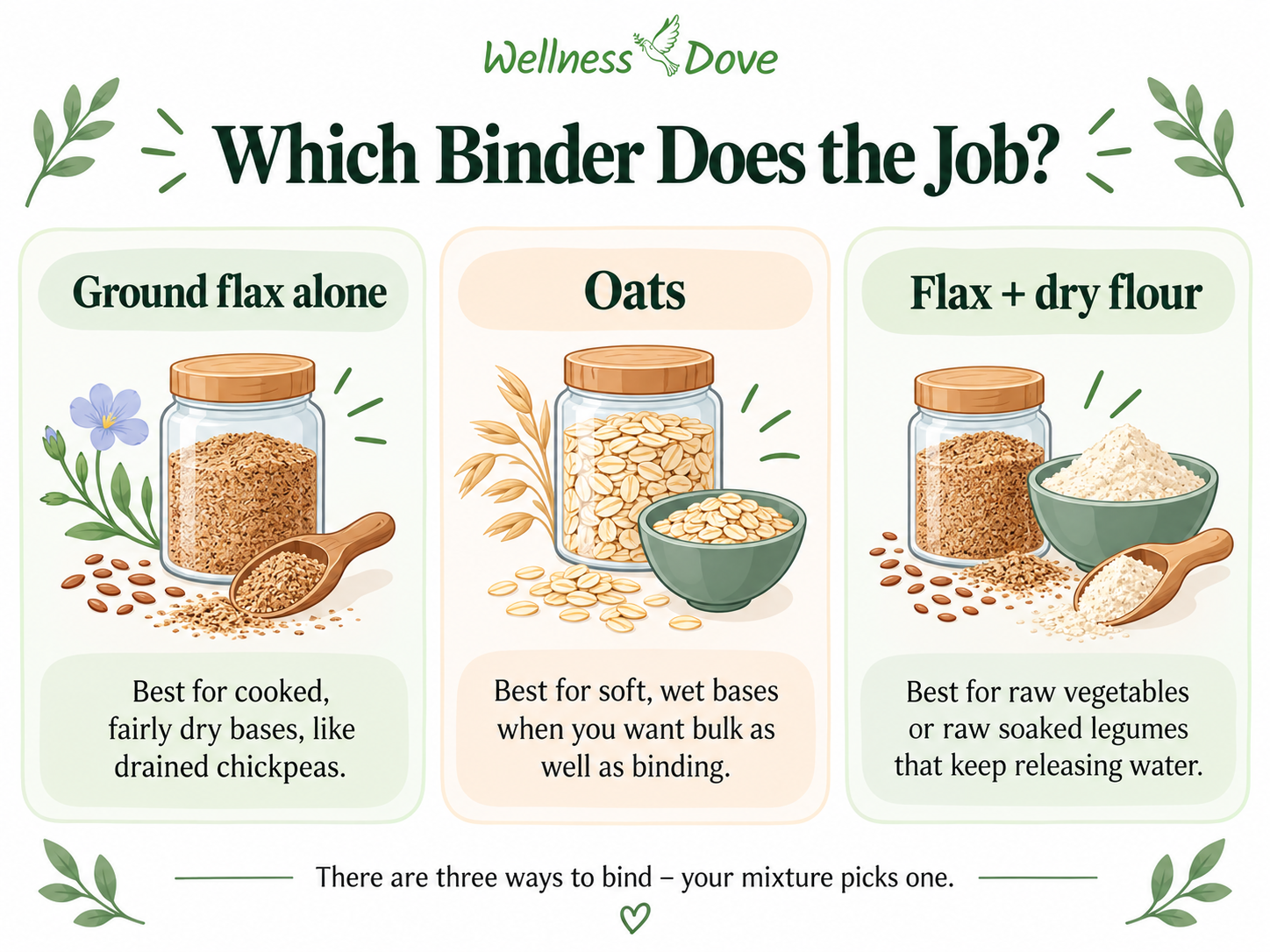
| Binder | Used when | Example |
|---|---|---|
| Ground flax alone | The base is cooked and fairly dry, like drained chickpeas | Chickpea balls, falafel |
| Oats | The base is soft and wet, and you want bulk as well as binding | Lentil meatballs, sweet potato and black bean burgers |
| Flax plus a dry flour | Raw vegetables or raw soaked legumes, which keep releasing water | Zucchini and potato burgers, the chickpea loaf |
The flour we reach for is chickpea flour, because it holds a lot of water and tastes of the thing it is already in. Cornstarch works. So does a whole grain flour if gluten is not an issue for you.
The Rule That Decides Whether Your Patties Hold Together
If you take one thing from this page, take this.
They firm up as they cool, after baking. Not in the fridge before.
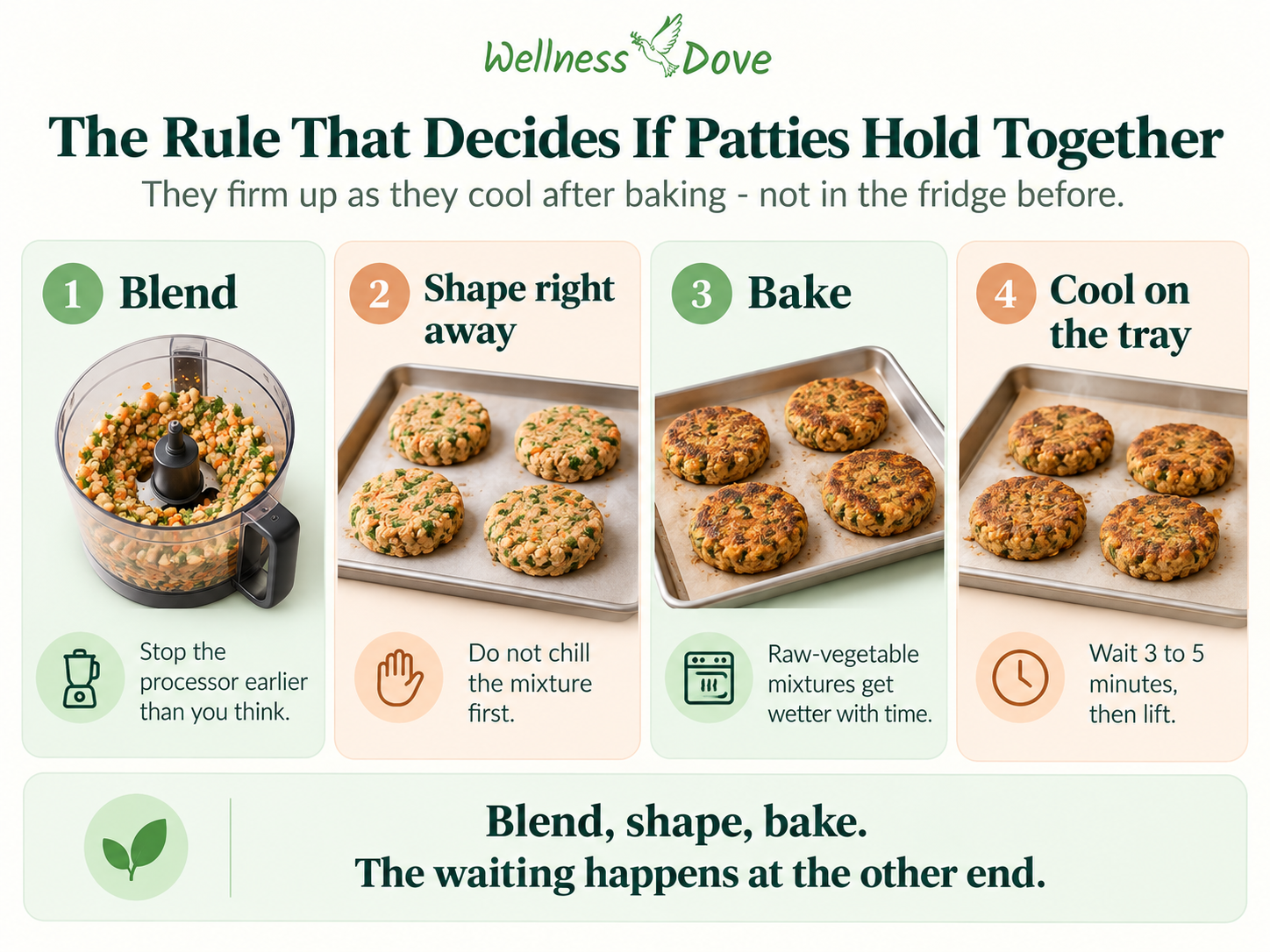
We say it in recipe after recipe because it keeps catching people out. From the cauliflower patties: they will be soft first but firm up once they cool a little. From the sweet potato and black bean burgers: let them cool for a few minutes until firm. From the chickpea loaf: the longer it sits, the firmer it gets. If you slice it too soon, it may be a little moist.
A patty lifted straight off a hot tray will bend. That is not a failed patty. It is a patty you are handling three minutes too early.
Which is why we do not chill the mixture
Most veggie burger recipes online tell you to refrigerate the mix for half an hour so it holds its shape. Ours do the opposite, and one of them says so outright: you have to shape the patties right after you prepare the mixture as it becomes more watery with time.
That line is from the zucchini and potato burgers, and it is about raw vegetables. Salt and time pull water out of them. An hour in the fridge does not firm that mixture up, it floods it.
Chilling mainly helps when there is solid fat in the mix, because cold fat is firm. There is no solid fat in ours, and with raw vegetables the water that salt pulls out over time outweighs any benefit.
Blend, shape, bake. The waiting happens at the other end.
How Wet Should a Bean Patty Mixture Be?
There is no single answer, and pretending otherwise is how recipes lose people. The target genuinely differs by what you are making.
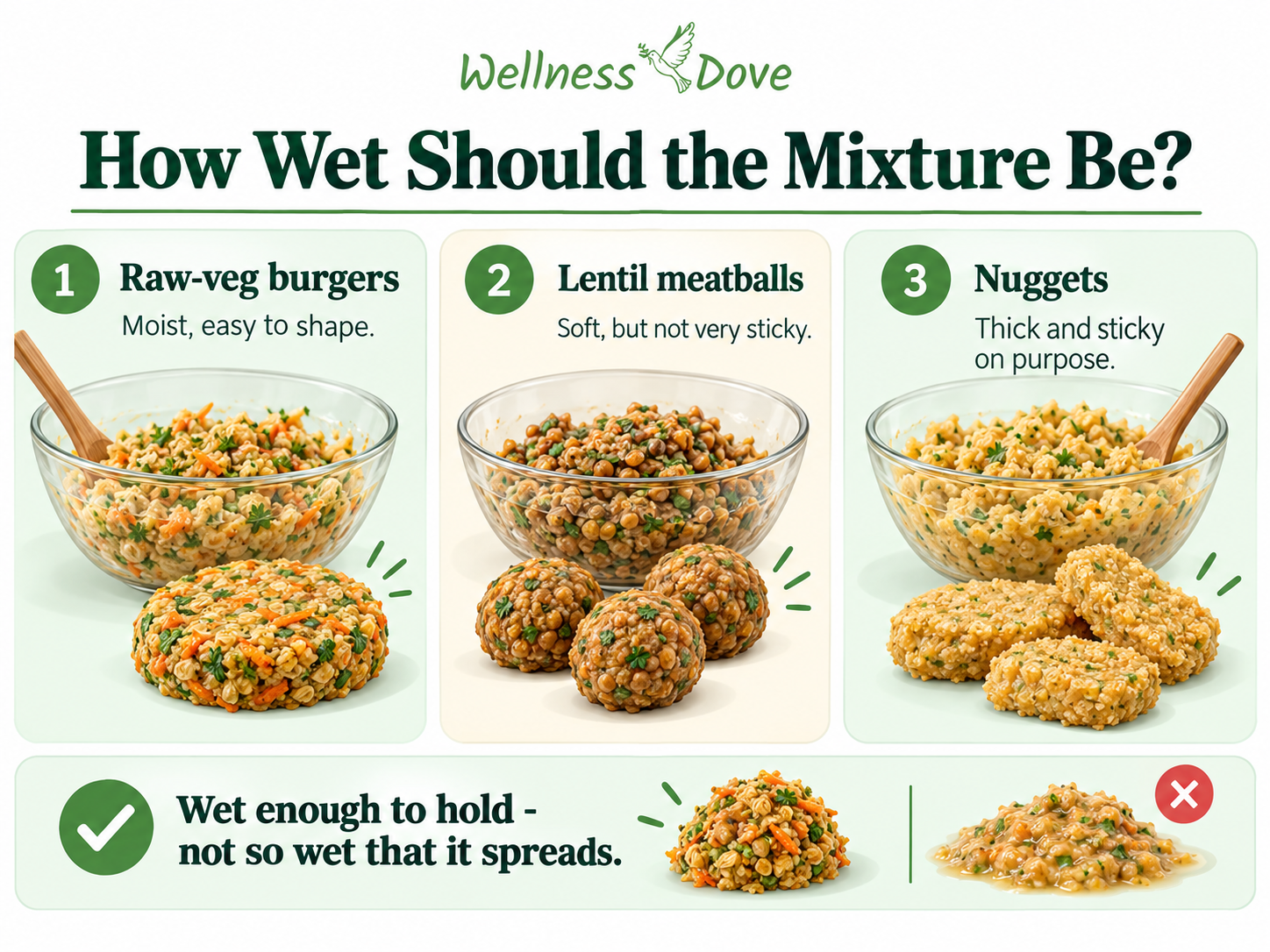
- Burgers from raw vegetables: moist, but easy to shape.
- Lentil meatballs: soft, but not very sticky.
- Bean nuggets and grain nuggets: thick and sticky, deliberately.
If it will not hold a shape in your palm, it needs more flax. If it will not come together at all, it needs a splash of water first and then more flax.
Stop the food processor earlier than you think
The most common mistake is not the binder. It is the blending.
Our falafel recipe puts it bluntly: don’t over mix as you will make hummus. And with raw vegetables the damage is worse, because if you chop the veggies into very little pieces, they will release more water. Over-processing creates the wetness problem that then needs solving.
Pulse. Scrape down. Pulse again. Leave visible pieces of bean in there.
Venny: There is a second reason to stop the machine early, and it has nothing to do with texture. Beans have unusually tough cell walls, so puréeing them does not spike your blood sugar the way puréeing a grain does. That part survives blending.
That protection is not unconditional. When researchers milled dry chickpeas into a fine flour, breaking the cells, and fed it as hummus to 15 healthy adults, insulin and the gut hormone GIP came out higher than with intact-cell hummus. Blood sugar itself did not differ significantly. And the intact-cell hummus in that trial was made in an ordinary kitchen blender, so stop your food processor early for texture, not for blood sugar.
Which Vegan Meatballs or Patties Should You Make First?
They are not variations on one recipe. The base changes how the whole thing behaves.
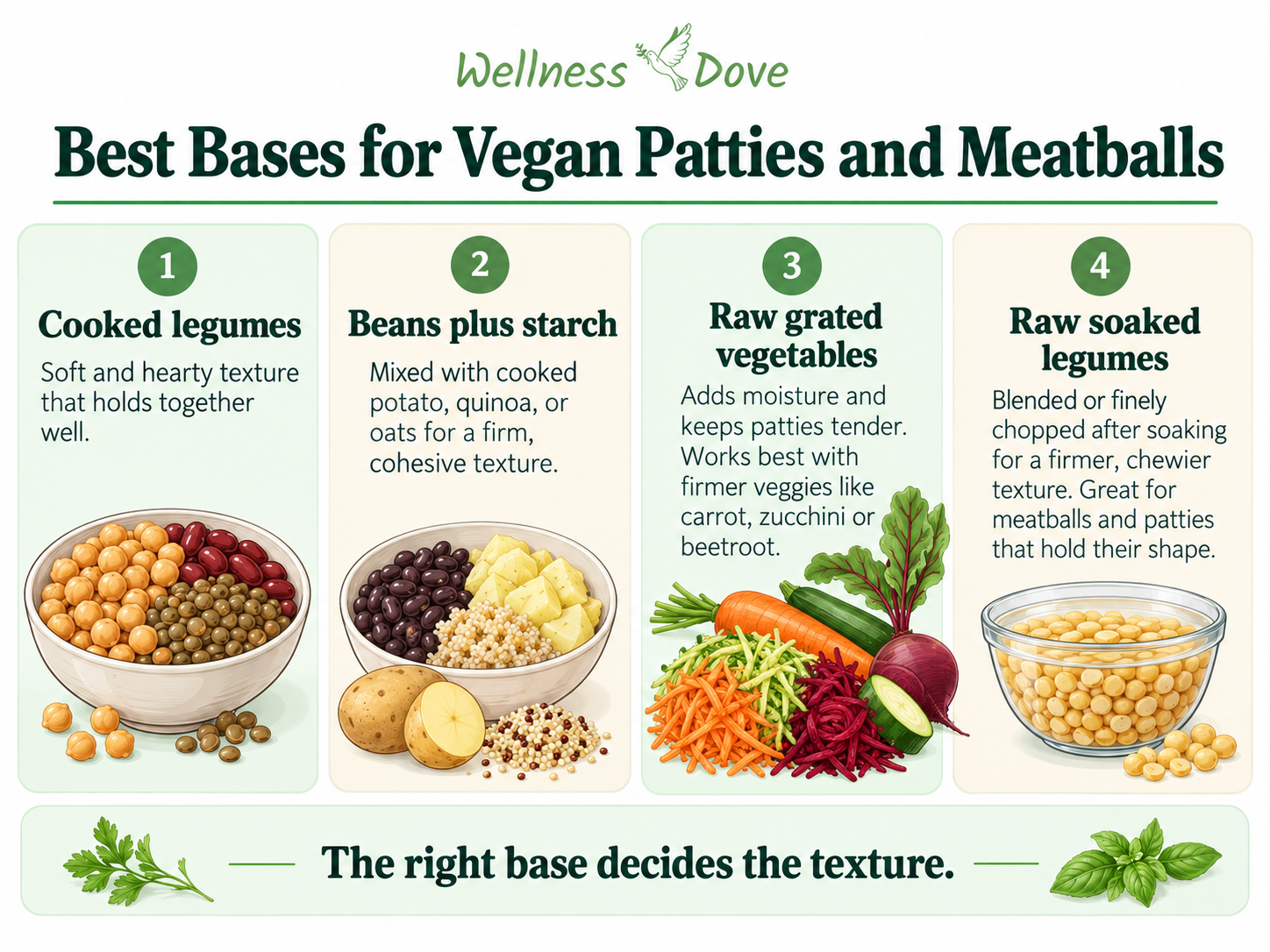
| Base | Handles like | Best for | Note |
|---|---|---|---|
| Cooked chickpeas | Easiest. Dry enough to forgive you | A first attempt | Rinse canned ones well |
| Boiled lentils and oats | Soft, holds a round shape | Pasta night | Bake first, then simmer in sauce |
| Sweet potato with beans or quinoa | Sweet, dense, properly burger-like | An actual bun | Mash the potato while hot |
| Raw grated vegetables | The wettest and least forgiving | Using up a glut | Shape immediately, no waiting |
| Raw soaked legumes | Firmest and meatiest of all | Meal prep, freezing | Soaked overnight, never boiled |
Start with the chickpea balls. Cooked chickpeas, ground flax, twenty minutes in the oven. If your first attempt is going to work, that is the one.
- Baked Chickpea Balls: the forgiving one. Chickpeas, vegetables, flax.
- Homemade Falafel: baked, not fried, and ready in under thirty minutes.
- Lentil Meatballs in Tomato Sauce: oats do the binding here. Baked, then simmered.
- Sweet Potato and Black Bean Burgers: the one that behaves most like a burger.
- Zucchini and Potato Veggie Burgers: raw vegetables, so shape them straight away.
- Baked Arabic Bean Patties: soaked raw legumes, and the firmest result on the site.
- Chickpea Meatloaf: the same idea in a loaf pan, with a glaze.
- White Bean Nuggets and Cauliflower Burger Patties: two smaller ones worth knowing.
Vegan Patties and Burgers Troubleshooting
Most of these are already written into our recipes, because we hit the problem first and put the answer in the notes.
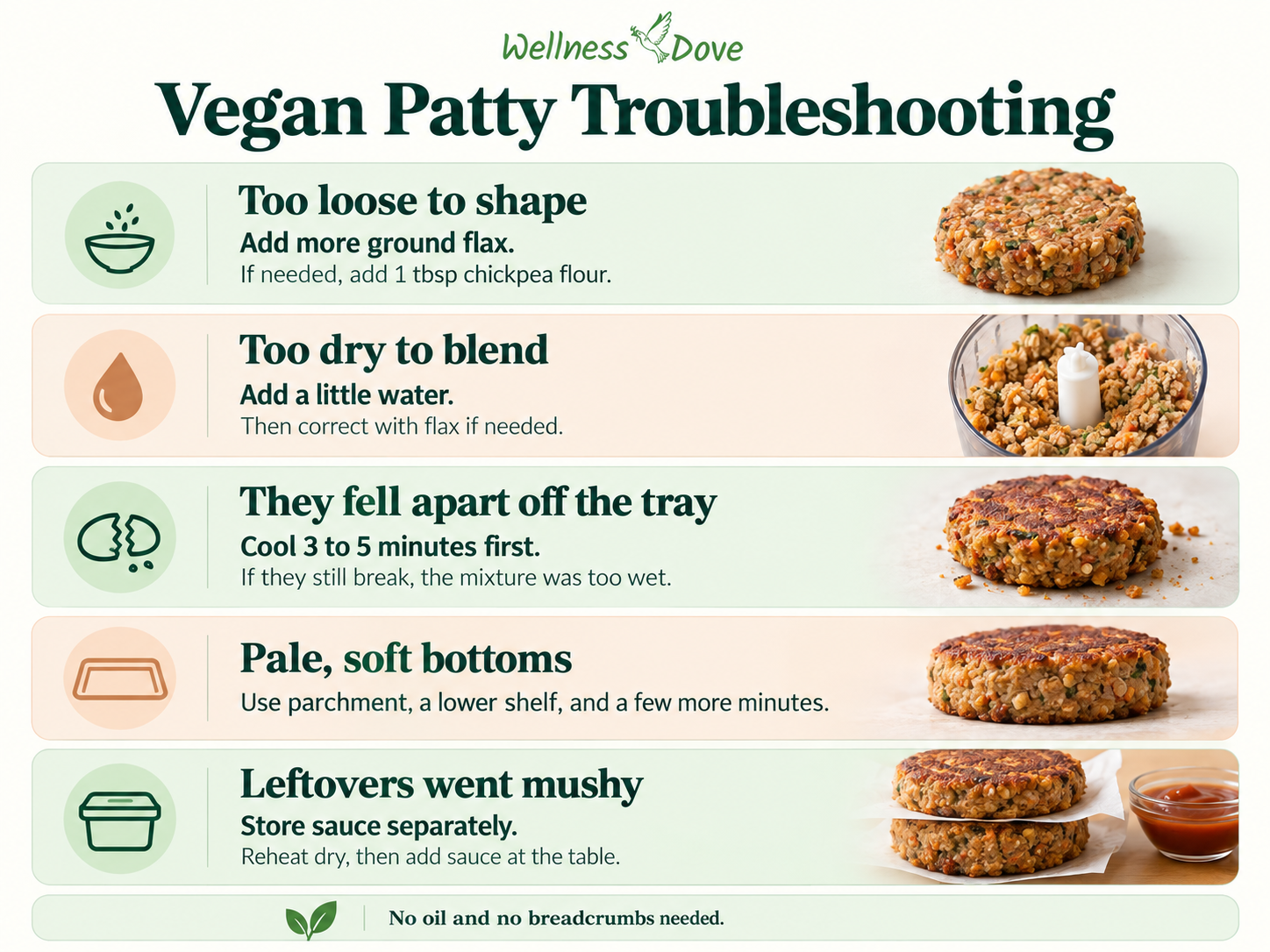
The mixture will not hold a shape
- Add more ground flax, a tablespoon at a time. It soaks the excess liquid. This is the first move every time.
- Then a tablespoon of chickpea flour if flax alone is not enough, which happens with raw vegetables.
- Drain the vegetables if they have pooled liquid. Tip the bowl and pour it off before adding anything.
- Or just wait two minutes. Flax does not gel on contact. A mixture that looks hopeless the moment you stir it in is often fine by the time you have washed your hands.
The mixture is too dry to blend
Add water, a little at a time, until the processor can actually move it. Then correct with flax if you overshoot. Dry is a much easier problem than wet.
They fell apart when I lifted them off the tray
You lifted too early. Give them three to five minutes on the tray and try again with a thin spatula.
If they still break, the mixture was too wet going in, not underbaked.
The bottoms are pale and soft
Without oil, less of the base touches the hot tray, so it steams instead of browning. Bake on parchment, not a silicone mat, put the tray on a lower shelf, and give them a few more minutes than you think.
Leftovers went mushy
If they were sitting in sauce, that is why. Our lentil meatball recipe says it plainly: store any leftover meatballs and sauce in the refrigerator separately or the balls will become mushy.
Reheat dry, in the oven or a dry pan, and add the sauce at the table.
They taste flat
Beans are mild and there is no fat carrying flavor around, so an oil-free patty needs more seasoning than a conventional one, not less. Onion, garlic, cumin, plenty of fresh herbs, and lemon juice at the end.
Taste the mixture before you shape it and correct it then, as long as the base is cooked. The few recipes built on soaked raw legumes should be seasoned by eye and tasted after baking.
Are Homemade Bean Burgers Better Than Shop-Bought?
On the food itself, yes, and the reasons are worth stating plainly.
A homemade patty is beans. In five groups of people aged 70 and over, in Japan, Sweden, Greece and Australia, legumes were the strongest dietary predictor of survival. A 7 to 8 percent lower death rate for every 20 grams eaten a day. Twenty grams is two tablespoons. One patty clears that several times over. That is population data, not a trial. Treat it as a strong signal, not a promise.
The protein question answers itself. A cup of cooked lentils carries about 17.9 grams of protein. A fried chicken drumstick carries about 12.5. The patty is not the compromise in that comparison.
And the fat arithmetic is not close. Lentils get about 3 percent of their calories from fat and navy beans about 4 percent. Beef sold as “90 percent lean” gets about half its calories from fat, because 10 percent fat by weight is a much bigger number once you count calories instead of grams.
Even beef meeting the stricter “extra lean” rule still runs around 30 percent. Percentages by weight on a packet flatter the product, because water and protein make up most of the weight. Calories are the honest denominator.
What about the burgers in the freezer aisle?
We do not keep them, and we are not going to be sniffy about people who do.
What is actually in a shop-bought one
A shop-bought vegan burger is usually built on isolated protein rather than whole beans, and usually carries oil and a fair amount of salt. In a 2017 study of 450 American adults, salt added before food reached the home, in factories and restaurants, supplied about 71 percent of the sodium people ate. Salt added at home, at the stove and at the table together, supplied about 10 percent. So the packet is where the salt problem actually lives.
If you want a rule you can use in the aisle: the milligrams of sodium per serving should not exceed the calories per serving. Most of them fail it. Read the one in your hand rather than trusting us on it.
That said, a frozen burger that gets someone through a week without meat is doing a job. Treat it as a bridge rather than the destination.
Andy: When a patty falls apart, almost nobody concludes “that mixture was too wet.” They conclude “I cannot cook this kind of food.” One is a fixable fact about a bowl, the other is a verdict about themselves, and the second one is what makes people stop trying. If your first batch collapsed, you learned the mixture needed another spoon of flax. That is genuinely all that happened.
A note on beans and digestion
If beans currently disagree with you, that is common, and for most people it settles within a few weeks.
When researchers added half a cup of beans a day to people’s diets, half or fewer noticed more gas in the first week, and with black-eyed peas it was only 19 percent. Among the people who did get gassy, 70 percent or more said it settled by the second or third week. The researchers concluded that concerns about flatulence from beans may be exaggerated.
Start with two tablespoons a day rather than a plateful, rinse canned beans well, and build up over a few weeks. Lentils are a gentle place to begin: in an eight-week trial, 87 percent of people eating lentils at lunch five days a week reported no gut symptoms or only mild ones.
Venny is a medical doctor and a specialist in Nutrition and Dietetics; Andy holds a master’s degree in psychology. This is general information rather than medical advice. If you have diagnosed IBS or another bowel condition, increase fiber with your own doctor or dietitian rather than on your own.
How to Store Vegan Patties and Meatballs
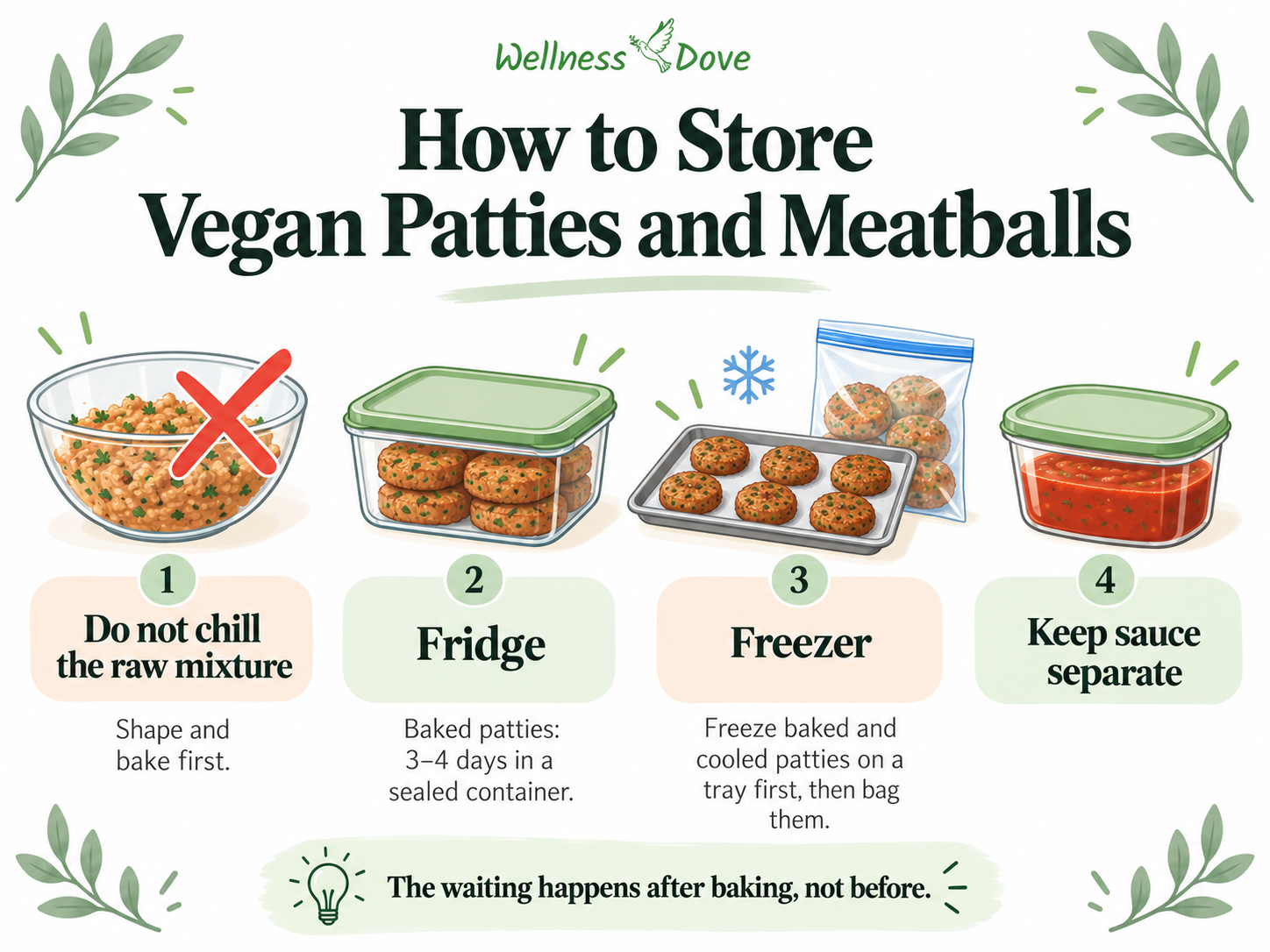
- Fridge: three to four days in a sealed container, in the fridge within two hours of baking, which is the USDA guidance for any cooked leftover. Sauce stored separately.
- Freezer: freeze them baked and cooled, spread out on a tray first so they do not fuse, then bag them.
- Reheating: dry heat, oven or a dry pan. A microwave makes them soft.
These are the best meal-prep food we make. A tray on Sunday is lunches until Wednesday.
Where to Start With Vegan Meatballs and Patties
Open a can of chickpeas and rinse it. Make the chickpea balls tonight.
Pulse, do not purée. Shape straight away. Let them cool before you judge them.
And, always, seek health consciously.
Read Next
- Bread Without Flour: How It Works, and Which Loaf to Make
- The Four Numbers That Make Plant Food Filling
- Lunch Is Where Plant-Based Eating Falls Apart
Sources (15)
- Sun XD, Holley RA. Factors influencing gel formation by myofibrillar proteins in muscle foods. Comprehensive Reviews in Food Science and Food Safety. 2011;10(1):33-51. View
- Puligundla P, Lim S. A review of extraction techniques and food applications of flaxseed mucilage. Foods. 2022;11(12):1677. View
- Kuijsten A, Arts IC, van’t Veer P, Hollman PC. The relative bioavailability of enterolignans in humans is enhanced by milling and crushing of flaxseed. Journal of Nutrition. 2005;135(12):2812-2816. View
- Austria JA, Richard MN, Chahine MN, et al. Bioavailability of alpha-linolenic acid in subjects after ingestion of three different forms of flaxseed. Journal of the American College of Nutrition. 2008;27(2):214-221. View
- Alshaalan RA, Charalambides MN, Edwards CH, et al. Impact of chickpea hummus on postprandial blood glucose, insulin and gut hormones in healthy humans combined with mechanistic studies of food structure, rheology and digestion kinetics. Food Research International. 2024;188:114517. View
- Heaton KW, Marcus SN, Emmett PM, Bolton CH. Particle size of wheat, maize, and oat test meals: effects on plasma glucose and insulin responses and on the rate of starch digestion in vitro. American Journal of Clinical Nutrition. 1988;47(4):675-682. View
- Darmadi-Blackberry I, Wahlqvist ML, Kouris-Blazos A, et al. Legumes: the most important dietary predictor of survival in older people of different ethnicities. Asia Pacific Journal of Clinical Nutrition. 2004;13(2):217-220. View
- U.S. Department of Agriculture. FoodData Central, SR Legacy: lentils, boiled (FDC 172421); chicken drumstick, fried (172374, 172375, 173611); navy beans, boiled (173746); ground beef 90%, 95% and 97% lean (174030, 174031, 171790, 173111). View
- Code of Federal Regulations. 9 CFR 317.362 (“lean” and “extra lean”) and 9 CFR 319.15 (ground beef). View
- Harnack LJ, Cogswell ME, Shikany JM, et al. Sources of sodium in US adults from 3 geographic regions. Circulation. 2017;135(19):1775-1783. View
- Curtain F, Grafenauer S. Plant-based meat substitutes in the flexitarian age: an audit of products on supermarket shelves. Nutrients. 2019;11(11):2603. View
- Winham DM, Hutchins AM. Perceptions of flatulence from bean consumption among adults in 3 feeding studies. Nutrition Journal. 2011;10:128. View
- Wilson SMG, Peterson EJ, Gaston ME, Kuo WY, Miles MP. Eight weeks of lentil consumption attenuates insulin resistance progression without increased gastrointestinal symptom severity: a randomized clinical trial. Nutrition Research. 2022;106:12-23. View
- U.S. Department of Agriculture, Food Safety and Inspection Service. Leftovers and food safety. View
- Mattes RD, Donnelly D. Relative contributions of dietary sodium sources. Journal of the American College of Nutrition. 1991;10(4):383-393. View