


The first time you see the batter, you will not believe it turns into bread.
There is no flour in it. No yeast. No kneading, no proving, no starter. It is soaked lentils blitzed into a thick, sticky paste, and it looks nothing like bread dough.
An hour later it comes out of the oven as a loaf you can slice, toast and build a sandwich on.
We have been baking these for years now and they have quietly replaced bought bread in our house. This is everything we know about them: why they work, which one to make first, and every way we have managed to ruin one.
The short answer: Flourless bread works because whole psyllium husk does the job gluten does. Soak a legume or grain (2 hours is enough for red lentils; chickpeas and quinoa need overnight), blend it, add psyllium, a leavening agent and an acid, and bake it for 45 minutes to an hour. Four ingredients, no kneading. The single most important rule is that it must cool completely before you cut it, and that rule is the reason most first attempts fail.
Why Bread Without Flour Works at All
Ordinary bread holds together because of gluten. When you knead wheat dough, gluten proteins link into an elastic net that traps the gas the yeast produces. That net is the entire structure of a loaf.
Take the flour out and you have removed the net. Something has to replace it.
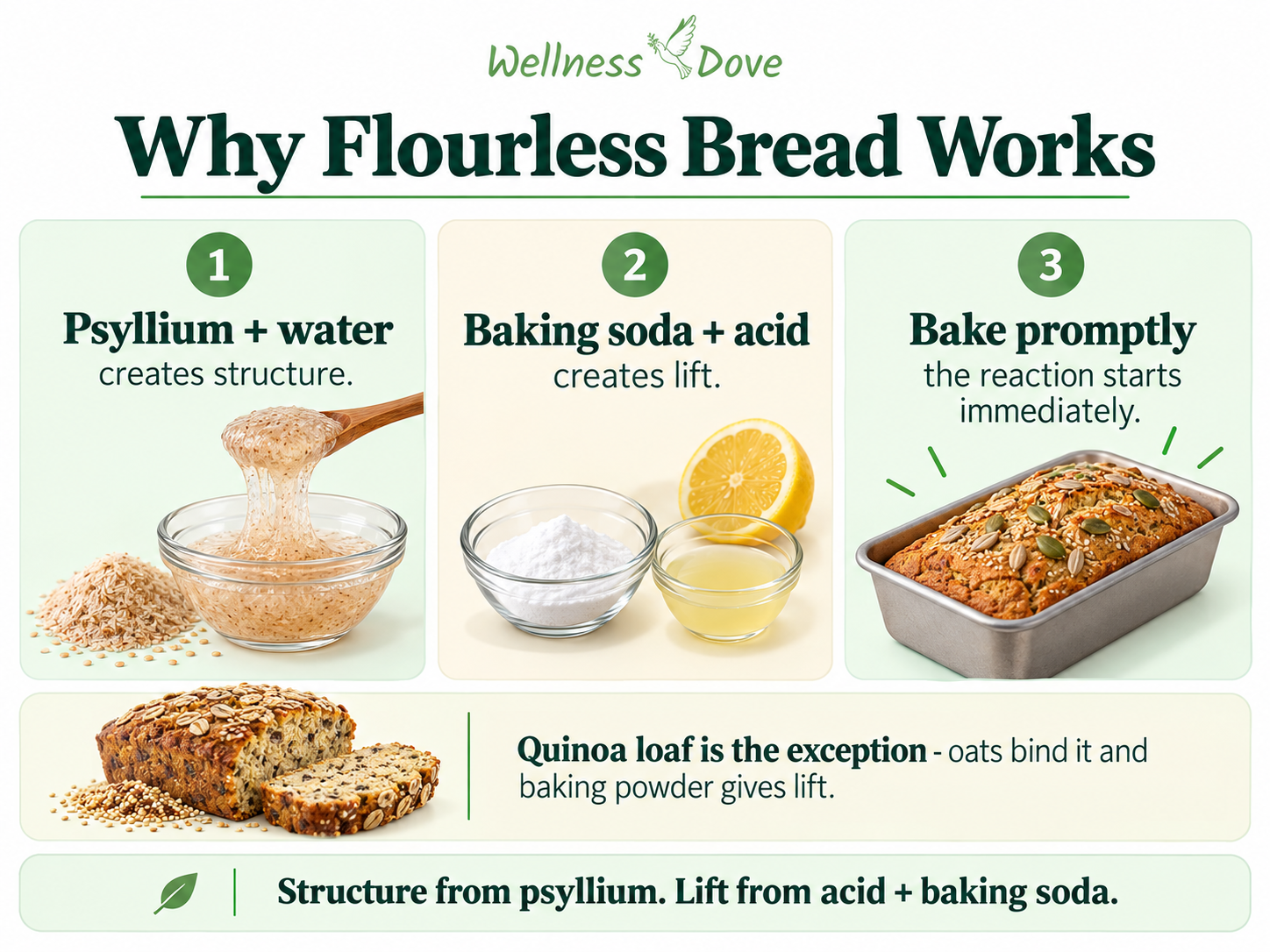
Psyllium husk is the substitute
Psyllium husk is the outer coating of the seed of Plantago ovata. It is about 85 to 90 percent fiber, most of it the soluble, gel-forming kind. When it meets water it forms a gel.
That gel is what holds a flourless loaf together. It gives the batter enough elasticity to trap the gas from the leavening, and enough structure to keep the shape once the heat sets it.
Its job in the loaf is mechanical, which is why you cannot leave it out or swap it for ground flax or chia and expect the same result. The quinoa loaf is the exception: oats do the binding there, so it has no psyllium.
Buy whole psyllium husk, not psyllium powder. They are not interchangeable. The powder is ground finer, packs far more densely into a spoon, and absorbs differently. Measuring powder by volume where a recipe calls for husk will give you a heavy, wet loaf. This is the most common shopping mistake and it ruins the bake before you start.
The lift comes from a chemical reaction, not yeast
There is no proving because there is nothing alive in the batter.
Instead you get baking soda (or baking powder) meeting an acid, usually apple cider vinegar. The reaction releases carbon dioxide, the psyllium gel traps it, and the loaf rises in the oven.
That reaction starts the moment the two meet and it does not wait for you. (That is the baking soda loaves. The quinoa loaf uses baking powder, which saves most of its lift for the oven, and its 5-minute rest is there so the oats can soak up the water.) Which is why the batter goes into the pan and into the oven promptly, and why a loaf left standing on the counter for twenty minutes before baking comes out flat.
And the legume has to be soaked, not cooked
This catches people out. The lentils or chickpeas go into the blender soaked but raw.
Soaking overnight softens them enough to blend smooth and starts to reduce the sugars behind the gas, which is why you drain the soaking water. The baking then cooks them through properly, for an hour, at temperature.
Raw soaked lentils still have starch and protein that set in the oven and soak up the batter’s water. Cooked lentils have already done that in the pot, so a cooked purée bakes into a wet paste, not a crumb.
Which Flourless Bread Should You Make First?
They are not interchangeable. Each base behaves differently and is good at something different.
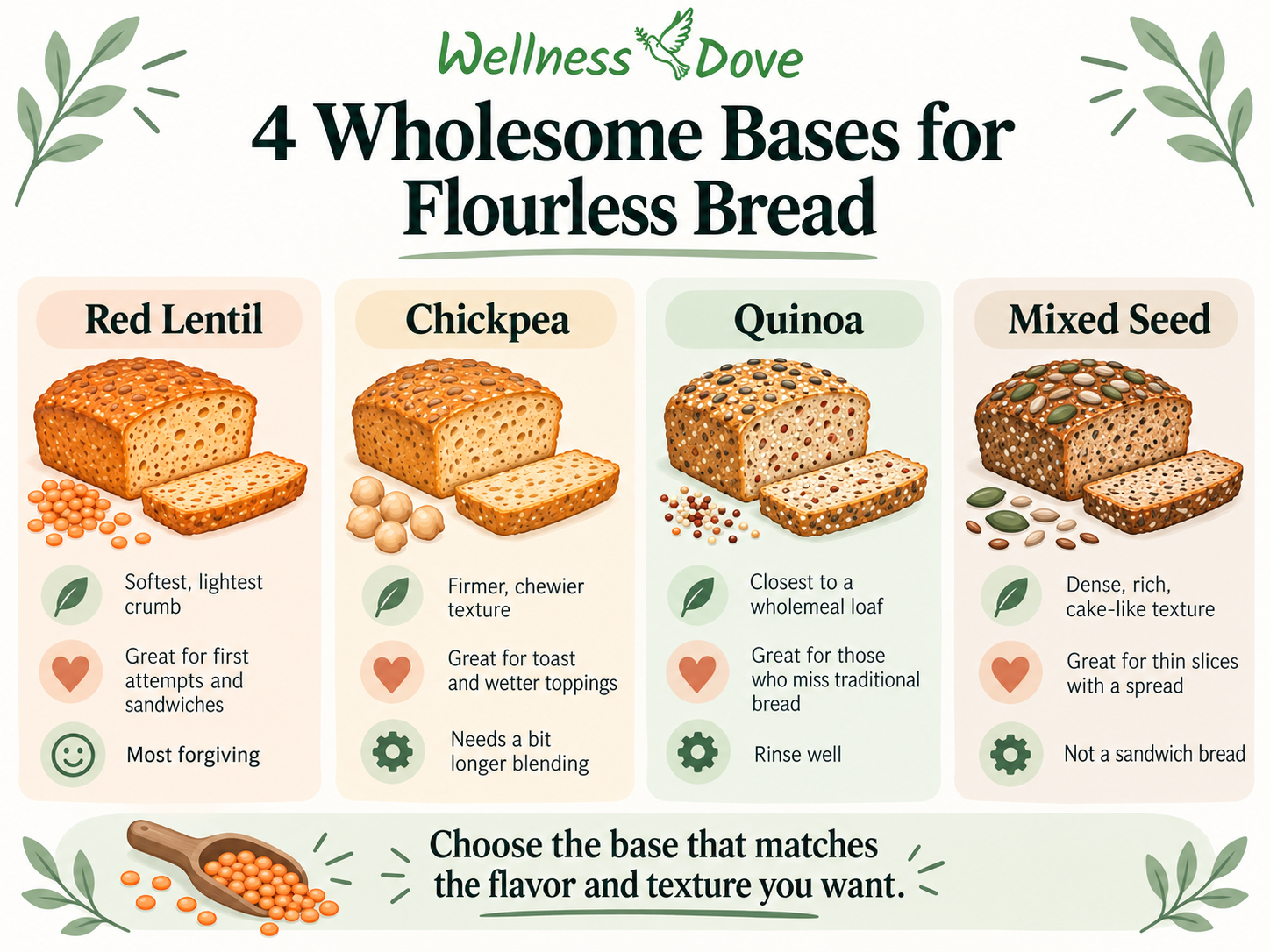
| Base | Texture | Best for | Note |
|---|---|---|---|
| Red lentil | Softest, lightest crumb | First attempt, sandwiches | Shortest soak. The forgiving one. |
| Chickpea | Firmer, denser, chewier | Toasting, holding a wet topping | Needs the longest blending |
| Quinoa | Closest to a seeded whole wheat | People who miss “proper” bread | Rinse well or it tastes bitter |
| Mixed seed | Dense, wet, cake-like | Thin slices with a spread | Not a sandwich bread |
Start with red lentils. They soak fastest, blend smoothest, and the loaf is the most tolerant of small mistakes. If your first flourless loaf is going to work, that is the one.
- Vegan Lentil Bread: four ingredients, the one we make most often.
- Wholesome Chickpea Bread: firmer and chewier. Good toasted.
- No-Yeast Quinoa Bread: the closest thing here to a conventional loaf.
- Vegan Seed Bread: dense and rich, cut it thin.
- Quick Lentil Bread Rolls: a red lentil dough shaped into rolls, baked in about 30 minutes.
- Chickpea Flatbread with Onions: made from chickpea flour rather than whole chickpeas, so not strictly flourless, but no rise and ready fastest of all.
If you would rather not go flourless, we also keep an oil-free no-knead einkorn loaf, a spinach and onion whole grain bread and a quick no-yeast bread in the rotation.
The Rule That Decides Whether It Works
If you take one thing from this page, take this.
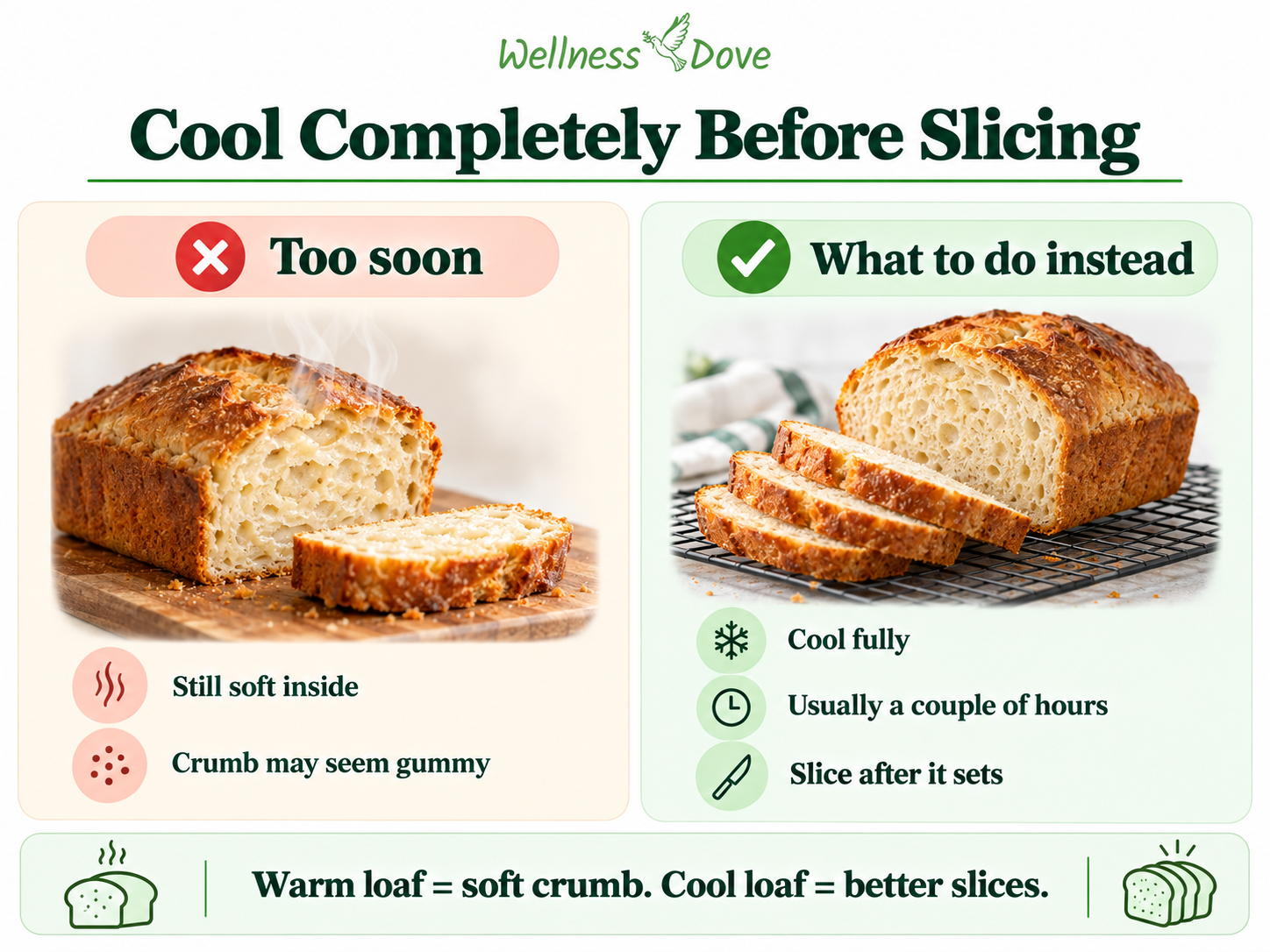
Let the loaf cool completely before you cut it. Completely. Not warm. Cool to the touch, which for a full loaf means a couple of hours on a rack.
While the loaf is warm, the psyllium gel and the cooked starch are both still soft, and they firm up as it cools. Cut into it early and the inside will look and feel underbaked no matter how long it was in the oven, and you will conclude the recipe is wrong. It is not. It is not finished.
Almost every message we get that begins “it came out gummy in the middle” ends with the person admitting they cut it warm.
And there is a second reason to wait, which nobody mentions
Cooking a starch and then cooling it changes its physical structure. Some of it converts into resistant starch, which behaves less like a starch and more like a fiber: it passes through the small intestine undigested and becomes food for the bacteria in your large intestine.
In studies, white bread that was frozen and toasted, and rice chilled overnight, gave a gentler blood sugar response, so freezing slices and toasting them likely helps this loaf a little too.
So the step that makes the loaf sliceable is also the first step toward that. That is a rare thing in cooking, and it is the reason we are so insistent about it.
The same trick works on potatoes and rice. Cook them, cool them, then eat them cold or reheated.
Flourless Bread Troubleshooting
Every one of these has happened in our kitchen.
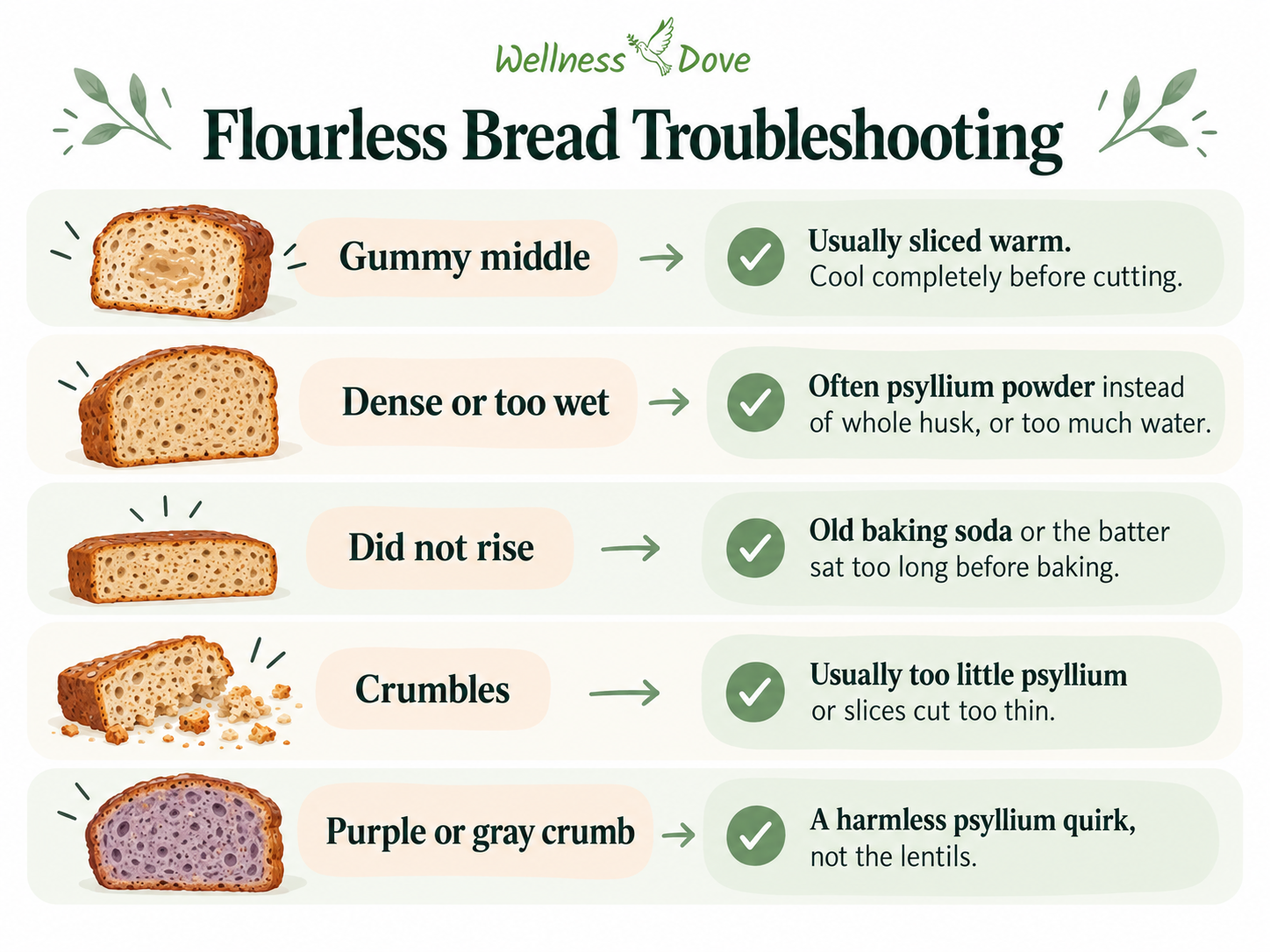
The middle is gummy or wet
The most common problem by a wide margin, and usually not a baking problem at all.
- You cut it warm. Cool it fully and cut the same loaf again. Nine times out of ten it is fine.
- You used psyllium powder instead of whole husk. Far more psyllium by weight went in than the recipe intended.
- Too much water. The lentil and chickpea loaves use little or none and should be a dough you can shape; only the quinoa loaf is a pourable batter.
- It genuinely needed longer. These loaves take 45 minutes to an hour, and ovens lie. If the top is firm, the loaf sounds hollow underneath and the center reads about 205°F, it is done.
It did not rise
- Old baking soda. Drop half a teaspoon into vinegar. If it does not fizz hard, replace it.
- The batter sat around. The reaction begins immediately. Blend, pan, oven, without a tea break in between.
- The acid never met the soda. Pour the vinegar directly onto the baking soda rather than around the edge of the blender jar.
It rose, then sank
It came out before the structure had set. Give it another ten minutes next time, and resist opening the oven in the first forty.
It crumbles when I slice it
Usually not enough psyllium, or slices cut too thin. These loaves want a confident thick slice and a serrated knife. Thin sandwich slices are what wheat is for.
It tastes beany
Rinse harder. After soaking, drain and rinse the lentils or chickpeas under running water until the water runs clear rather than cloudy. The cloudiness is the taste you are objecting to.
With quinoa this matters even more, because the natural coating on the grain is genuinely bitter.
The crumb has gone greenish or purple
Harmless, and it is the psyllium rather than the lentils. Some psyllium turns the crumb purple or grey. It is a known psyllium quirk, and the pigment behind it has not been pinned down. In our kitchen, psyllium powder does it more than whole husk. If it bothers you, a little extra vinegar or lemon juice in the batter is worth trying. It does not affect the taste and it does not mean anything has gone wrong.
It is denser than shop bread
Yes. It always will be, and this is worth saying plainly rather than pretending otherwise.
A supermarket loaf is mostly air held in a gluten net. A flourless loaf is whole legumes and fiber with no air pockets to speak of. One slice does the work of two or three, and it holds you for hours instead of ninety minutes.
If you want the airy thing, you want wheat. If you want bread that behaves like food, this is it.
How to Store Flourless Bread
- Counter: two days, covered, once fully cool. Any longer and the moisture works against you.
- Fridge: three to four days in a sealed container. The texture firms up, which most people prefer.
- Freezer: slice it first, then freeze. Up to three months, and you can toast straight from frozen.
Slicing before freezing is the small thing that decides whether you actually eat the loaf or find it in the freezer in March.
Is Flourless Bread Actually Better for You?
Compared with a standard supermarket loaf, yes, and for reasons that are easy to state.
Refining whole wheat flour into white flour strips out about three quarters of the fiber, from about 10.7 grams per 100 down to about 2.7. These loaves have not been refined at all, because there was never a flour stage.
Flourless is not the same as gluten-free
There is also a distinction worth knowing that most food writing misses. Whole grain flour and an intact grain are not the same food. Milling breaks open most of the cells and exposes the starch to digestion, and the finer the flour, the bigger the effect. An intact grain or legume still has its cell walls, so part of it is physically walled off from digestion.
A flourless loaf has nothing sifted out of it, but blending is still a kind of grinding, so it digests more like a coarse flour than a whole lentil. The gain is in what stayed in, not in what stayed intact.
And the base is a legume. In five groups of people aged 70 and over, in Japan, Sweden, Greece and Australia, legumes were the strongest dietary predictor of survival: a 7 to 8 percent lower death rate for every 20 grams eaten daily. Two tablespoons. A slice of lentil bread clears that on its own.
Venny is a medical doctor and a specialist in Nutrition and Dietetics; Andy holds a master’s degree in psychology. This is general information rather than medical advice. Psyllium is a concentrated fiber and should be eaten with plenty of water; if you have a diagnosed bowel condition or a history of obstruction, check with your own doctor before adding it.
Where to Start
Soak red lentils tonight. Make the lentil loaf tomorrow. Let it cool all the way before you cut it.
If that one works, the others will.
And, always, seek health consciously.
Read Next
- Every Bread Recipe We Have, in One Place
- The Four Numbers That Make Plant Food Filling
- Lunch Is Where Plant-Based Eating Falls Apart
Sources (20)
- Wieser H. Chemistry of gluten proteins. Food Microbiology. 2007;24(2):115-119. View
- Marlett JA, Fischer MH. A poorly fermented gel from psyllium seed husk increases excreta moisture and bile acid excretion in rats. Journal of Nutrition. 2002;132(9):2638-2643. View
- Zandonadi RP, Botelho RB, Araújo WM. Psyllium as a substitute for gluten in bread. Journal of the American Dietetic Association. 2009;109(10):1781-1784. View
- Cappa C, Lucisano M, Mariotti M. Influence of Psyllium, sugar beet fibre and water on gluten-free dough properties and bread quality. Carbohydrate Polymers. 2013;98(2):1657-1666. View
- Vidal-Valverde C, Frías J, Valverde S. Changes in the carbohydrate composition of legumes after soaking and cooking. Journal of the American Dietetic Association. 1993;93(5):547-550. View
- Avezum L, Ollier L, Siguemoto E, Rajjou L, Mestres C. Hydrolysis and diffusion of raffinose oligosaccharides family products in chickpeas, lentils, and beans under different pH and temperature steeping conditions. Food Research International. 2024;191:114732. View
- Guo H, Wang S, Liu C, et al. Key phytochemicals contributing to the bitterness of quinoa. Food Chemistry. 2024;449:139262. View
- Strkalj L, Yakubov GE, Burton RA, Cowley JM. Structural and functional properties of fiber from psyllium (Plantago ovata) husk: current knowledge and strategies to expand its application in food and beyond. Comprehensive Reviews in Food Science and Food Safety. 2025;24(5):e70297. View
- Englyst HN, Kingman SM, Cummings JH. Classification and measurement of nutritionally important starch fractions. European Journal of Clinical Nutrition. 1992;46 Suppl 2:S33-S50. View
- Burton P, Lightowler HJ. The impact of freezing and toasting on the glycaemic response of white bread. European Journal of Clinical Nutrition. 2008;62(5):594-599. View
- Sonia S, Witjaksono F, Ridwan R. Effect of cooling of cooked white rice on resistant starch content and glycemic response. Asia Pacific Journal of Clinical Nutrition. 2015;24(4):620-625. View
- Fernandes G, Velangi A, Wolever TM. Glycemic index of potatoes commonly consumed in North America. Journal of the American Dietetic Association. 2005;105(4):557-562. View
- U.S. Department of Agriculture. FoodData Central, SR Legacy: wheat flour, whole-grain (FDC 168893); wheat flour, white, all-purpose (168894); lentils, pink or red, raw (174284); lentils, boiled (172421). View
- Heaton KW, Marcus SN, Emmett PM, Bolton CH. Particle size of wheat, maize, and oat test meals: effects on plasma glucose and insulin responses and on the rate of starch digestion in vitro. American Journal of Clinical Nutrition. 1988;47(4):675-682. View
- Edwards CH, Ryden P, Mandalari G, Butterworth PJ, Ellis PR. Structure-function studies of chickpea and durum wheat uncover mechanisms by which cell wall properties influence starch bioaccessibility. Nature Food. 2021;2(2):118-126. View
- Bajka BH, Pinto AM, Ahn-Jarvis J, et al. The impact of replacing wheat flour with cellular legume powder on starch bioaccessibility, glycaemic response and bread roll quality: a double-blind randomised controlled trial in healthy participants. Food Hydrocolloids. 2021;114:106565. View
- Darmadi-Blackberry I, Wahlqvist ML, Kouris-Blazos A, et al. Legumes: the most important dietary predictor of survival in older people of different ethnicities. Asia Pacific Journal of Clinical Nutrition. 2004;13(2):217-220. View
- Code of Federal Regulations. 21 CFR 201.319: water-soluble gums, hydrophilic gums and hydrophilic mucilloids, required warnings and directions. View
- Hefny AF, Ayad AZ, Matev N, Bashir MO. Intestinal obstruction caused by a laxative drug (Psyllium): a case report and review of the literature. International Journal of Surgery Case Reports. 2018;52:59-62. View
- Code of Federal Regulations. 21 CFR 101.81: health claims, soluble fiber from certain foods and risk of coronary heart disease. View