

It is the first question anybody asks, and it is almost always asked the wrong way around.
The question is not which plants have protein in them. All of them do.
The question worth answering is how much you actually need, and what happens if you go looking for a great deal more than that.
The short answer: The official requirement is 0.8 grams per kilogram of body weight a day, which works out at roughly 56 grams for an average man and 46 for an average woman. Every whole plant food contains all twenty amino acids. Beans and lentils run 20 to 30 percent of their calories as protein, and leafy greens are higher still. If you eat enough food and most of it is unprocessed, the protein arrives without being chased.
How Much Protein Do You Actually Need?
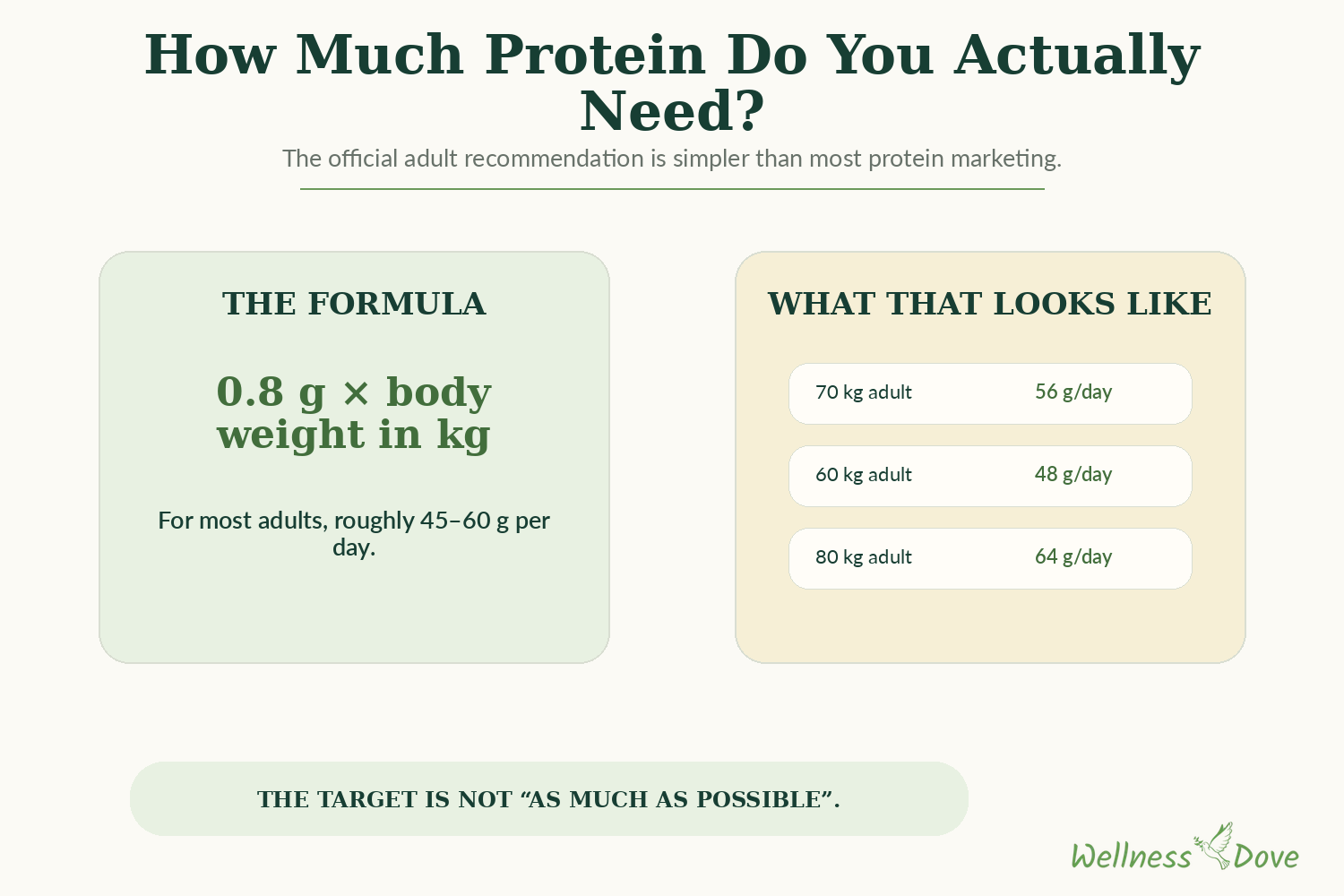
The recommended intake is 0.8 grams per kilogram of body weight per day for adults.
For most people that lands somewhere between 45 and 60 grams a day.
Two things about that number are worth knowing, and neither gets mentioned often.
First, it is deliberately generous. A recommended intake is not an average requirement. It is set high enough to cover almost everybody in the population, including the people at the far end of the range. Most people need less than the number they are told to aim for.
Second, a single six-ounce steak carries about 50 grams. That is close to a whole day’s requirement in one item, and more than the figure for an average woman, which tells you something about how the typical Western diet is arranged.
The comparison that settles it
Human beings grow faster in the first months of life than at any other point.
The food designed for exactly that stage, by nothing more clever than evolution, is breast milk.
Breast milk is about 1 percent protein by weight, and 5 to 6 percent of its calories.
If 5 percent is enough to double a human being’s size, the idea that an adult sitting at a desk needs a third of their plate to be protein deserves rather more scrutiny than it usually gets.
The Best Vegan Protein Sources, by Percentage of Calories
Grams per serving is a misleading way to compare foods, because servings are different sizes and nobody eats a hundred grams of anything on purpose.
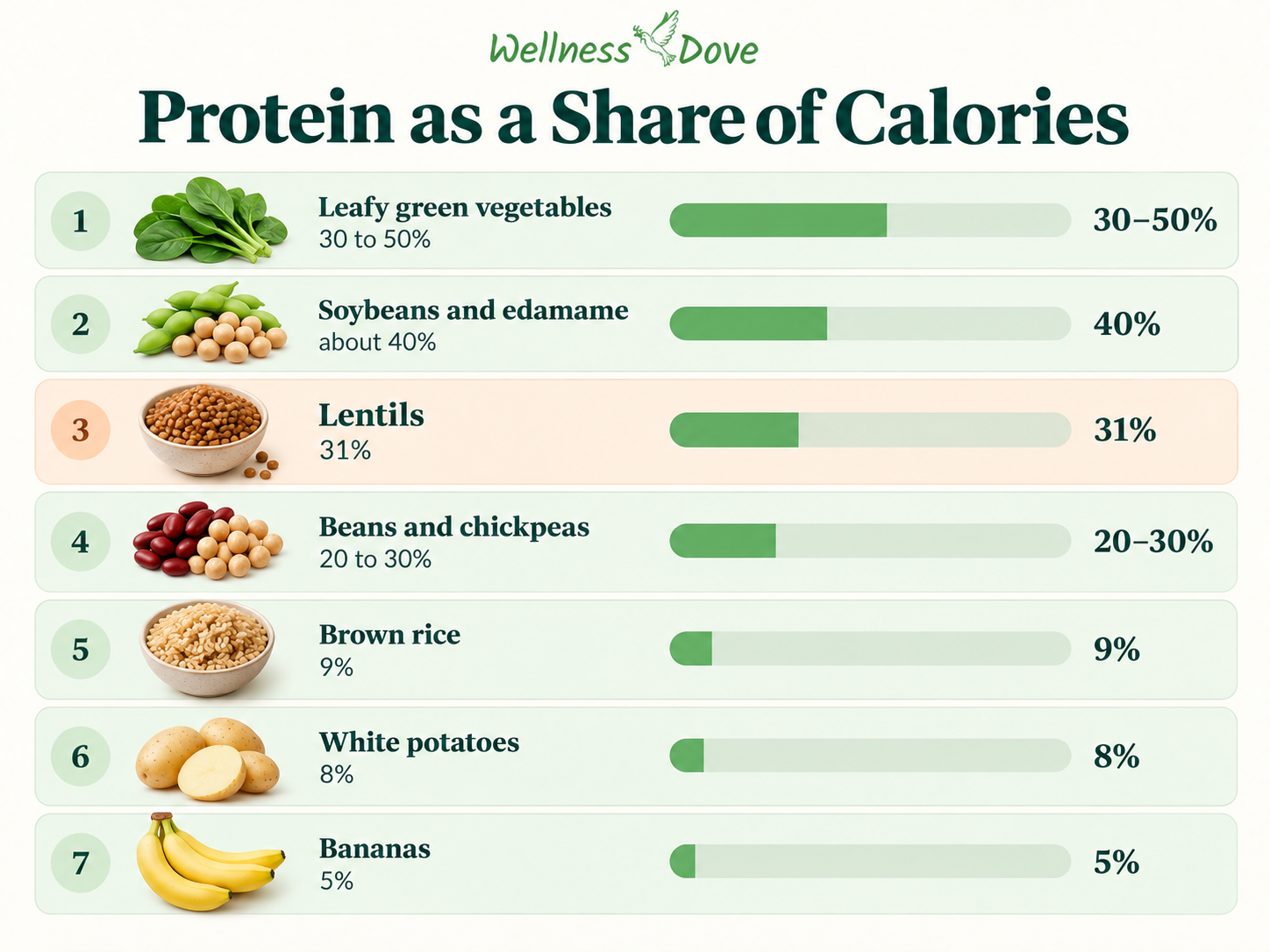
The honest comparison is what share of a food’s calories arrive as protein, because that is what you actually get when you eat enough of it to be full.
| Food | Protein, as a share of calories |
|---|---|
| Leafy green vegetables | 30 to 50% (spinach at the top) |
| Soybeans and edamame | about 40% |
| Lentils | 31% |
| Beans and chickpeas | 20 to 30% |
| Brown rice | 9% |
| White potatoes | 8% |
| Bananas | 5% |
Look at the bottom of that table rather than the top.
A potato is 8 to 11 percent protein by calories. Breast milk is 5 to 6.
A diet built on potatoes alone would clear the requirement, which is not a recommendation, only an illustration of how much room there is.
Why every plant has all the amino acids
There is a reason for this, and it is rather elegant.
Animals can eat, so an animal can obtain amino acids it cannot make. Plants cannot eat.
A plant has to synthesize all twenty amino acids itself, because there is nowhere else for them to come from.
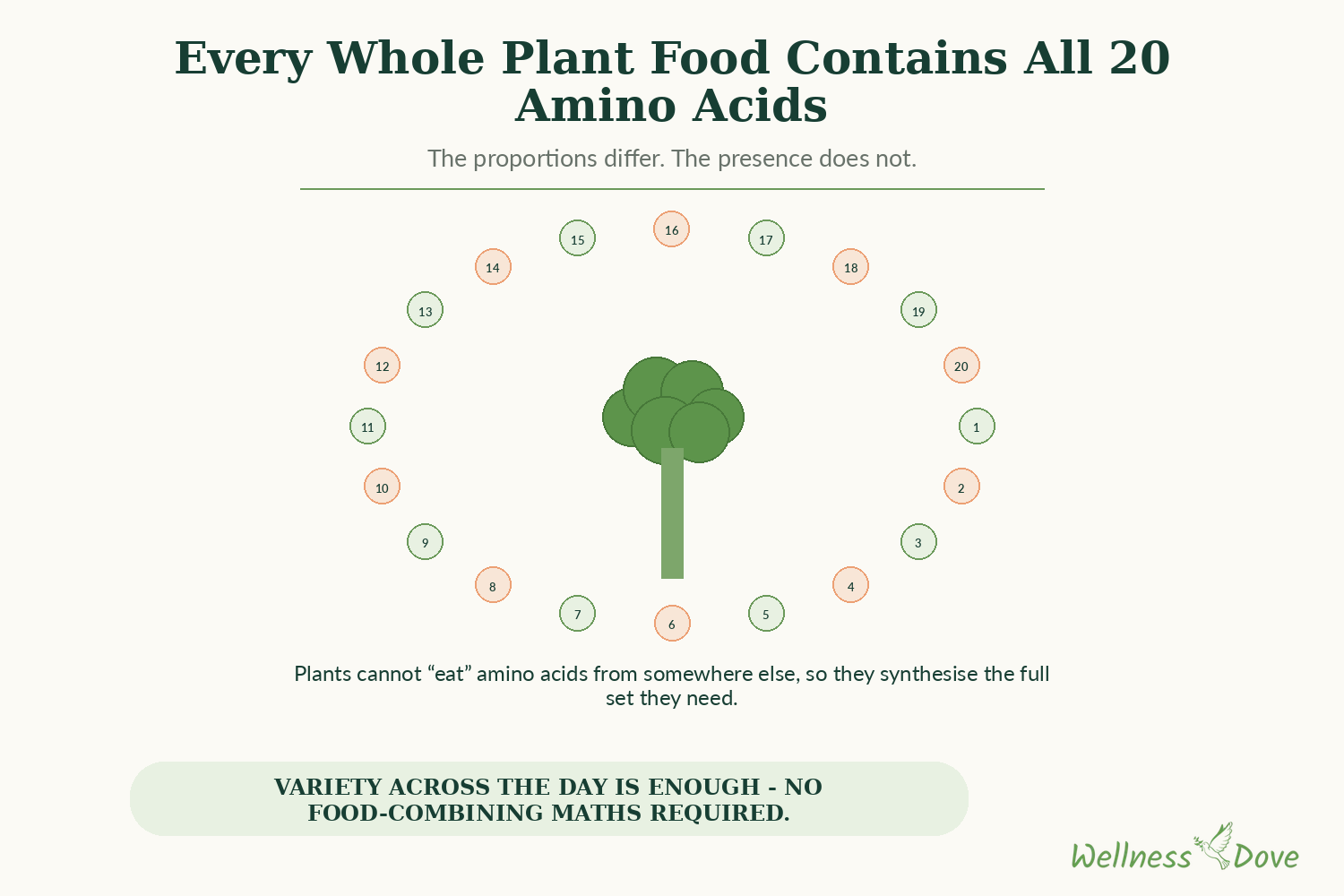
Which means every whole plant food you eat contains every one of them. The proportions differ. The presence does not.
The foods we actually keep in the house
We do not shop for protein and never have. We shop for beans, grains and greens, and it takes care of itself.
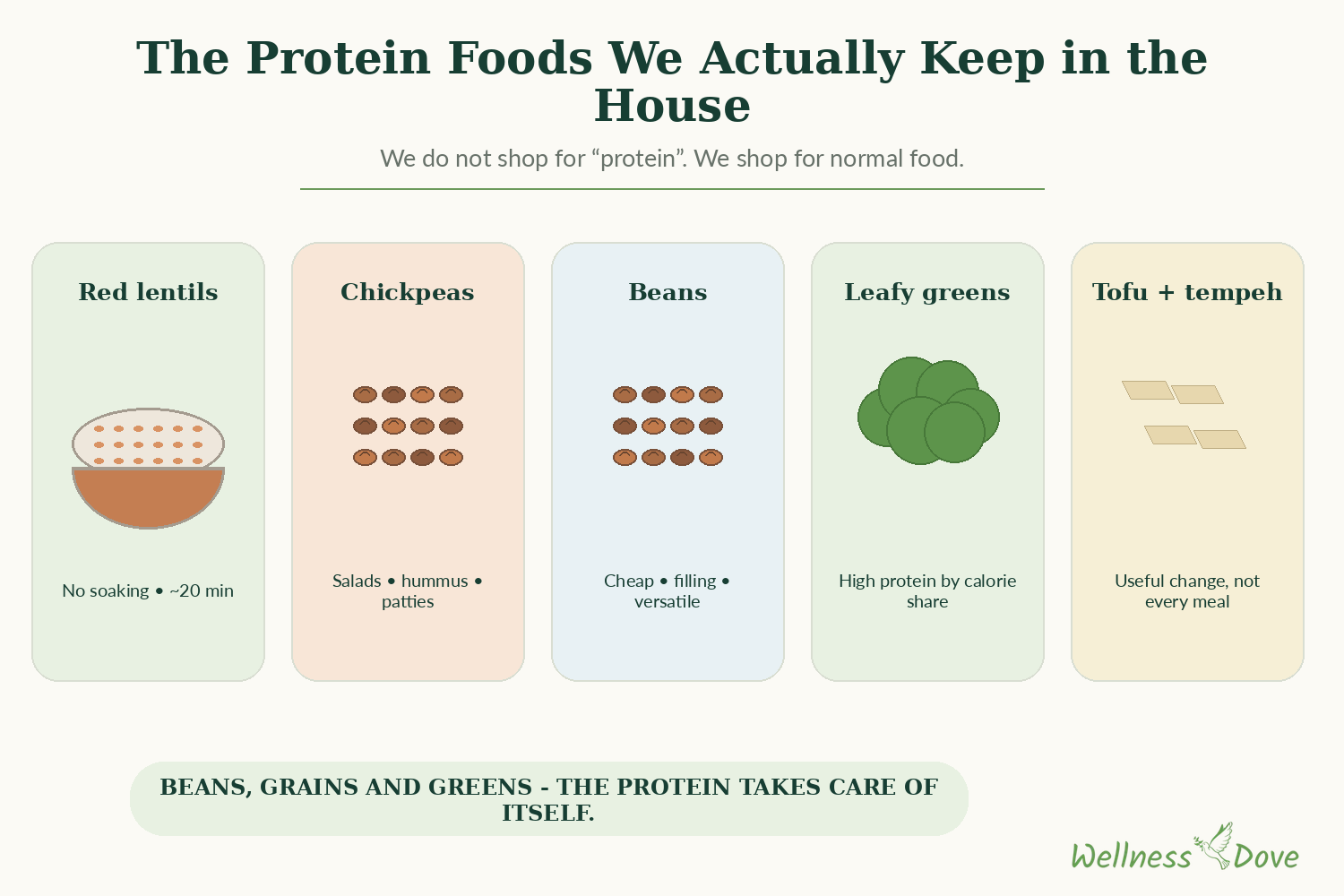
- Red lentils: no soaking, twenty minutes, and many people new to beans find them easier on the stomach than bigger beans.
- Chickpeas: the most useful can in the pantry. Salad, spread, or baked into balls.
- Beans of any kind: in a study of people over 70 in Japan, Sweden, Greece and Australia, every extra 20 grams of beans a day (about two tablespoons) went with a 7 to 8 percent lower risk of dying during follow-up.
- Leafy greens, which nobody thinks of as protein and which get a third or more of their calories from it.
- Tofu and tempeh, in ordinary amounts rather than as a meat substitute at every meal.
Do You Need to Combine Vegan Protein Sources?
No. And the story of where that idea came from is worth two minutes.
Protein combining, the rule that beans must be eaten with rice at the same meal, went mainstream in 1971 with Frances Moore Lappé’s Diet for a Small Planet.
Lappé herself retracted it in a later edition of the same book. It was an idea about how nutrition might work, not a finding about how it does.
Your body keeps a circulating pool of amino acids and draws on it across the day. Nothing has to arrive in the same bowl.
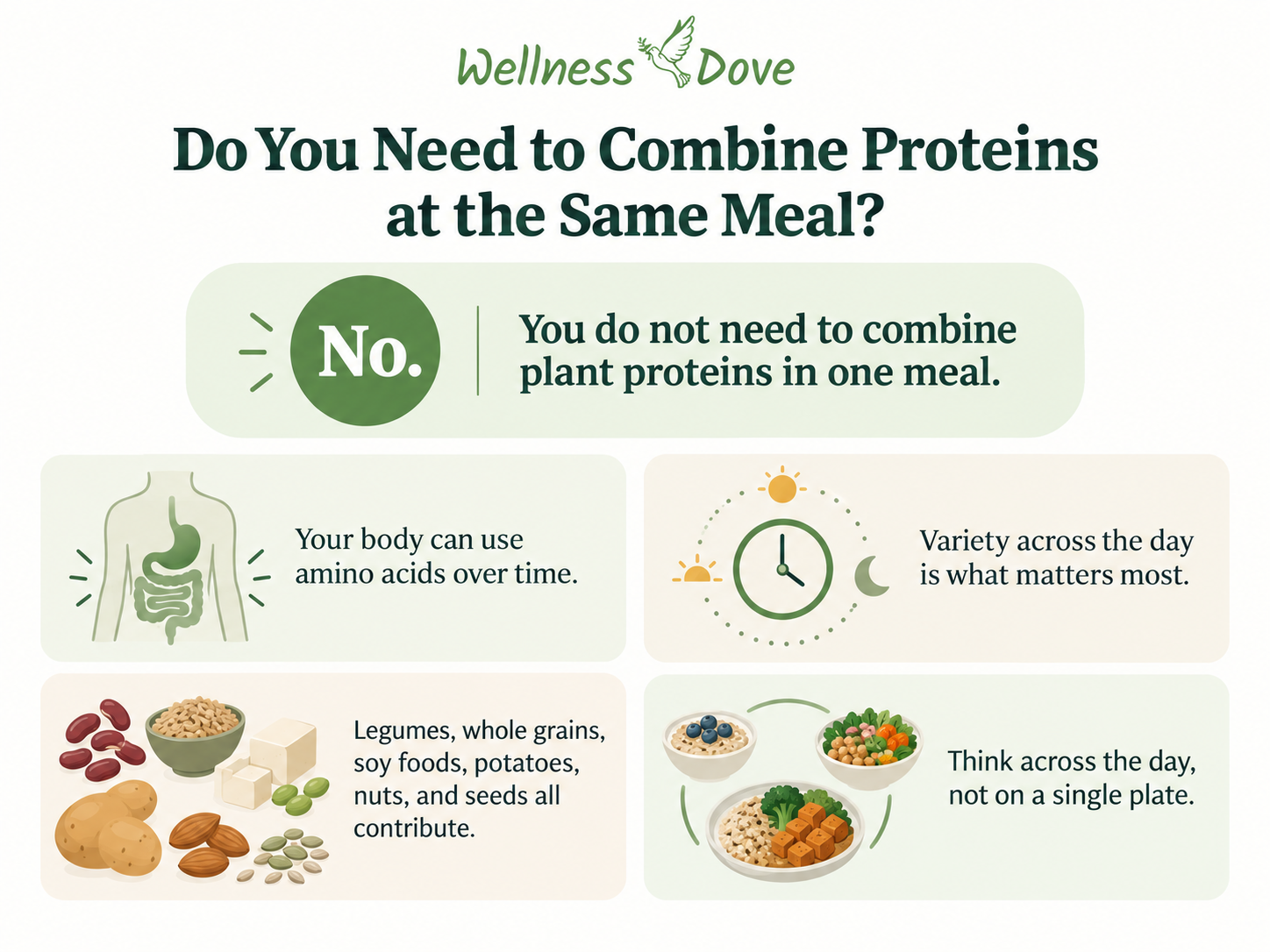
Eat a variety of plants across a week and the arithmetic looks after itself.
The only two ways to end up short of protein are to eat too few calories overall, or to eat mostly refined and processed food. Both of those are worth fixing for other reasons anyway. Neither is caused by leaving meat off the plate.
What Happens When You Eat Too Much Protein
This is the half of the subject that almost never gets written about, and it is the half that matters more.
Bones
Most arguments about bone health are about how much calcium a person takes in.
They are on the wrong side of the equation. For most people the useful question is not how much calcium arrives but how much leaves, and a high animal protein intake increases the calcium you lose in urine.
Be aware that this one is genuinely argued over: higher protein also raises how much calcium you absorb, and the largest review of the bone evidence found no net harm above the recommended intake. What is harder to explain away is that hip fracture rates tend to be highest in the countries that eat the most dairy and animal protein, and that within countries, drinking more milk has not been found to lower hip fracture risk. Strength training helps bone too, and costs nothing.
Kidneys
After a protein-rich meal, the kidneys widen their blood vessels and filter harder for a few hours, which raises the pressure inside their tiny filters.
Over a few days that is nothing. The type seems to matter too: in a small study of 11 volunteers, a large tuna meal raised kidney filtration by about a third within three hours, and the same amount of protein from tofu did not.
Where this becomes a real concern is in people who have already lost some kidney function, and Harvard’s work in the Nurses’ Health Study found that among those women, the more non-dairy animal protein they ate the more function they lost. In healthy kidneys the evidence is much weaker than it is usually made to sound.
The growth signal
This is the part that is worth reading slowly.
IGF-1 (insulin-like growth factor 1) is a growth-promoting hormone. In infancy and childhood it does exactly what you want it to. In an adult, more of it is not better, because what it promotes is growth in tissue that has finished growing.
Protein is the part of the diet most consistently linked to IGF-1. In over a thousand women, fat and carbohydrate did not track with it, but protein did, mostly through milk, and vegan women in another study had 13 percent lower IGF-1.
What that is associated with, across several large studies:
- In the European Prospective Investigation into Cancer and Nutrition, higher IGF-1 was associated with a 40 percent higher breast cancer risk in women diagnosed after 50.
- Pooling 17 prospective studies from 12 countries, women with the highest IGF-1 levels had a 28 percent higher breast cancer risk than those with the lowest, mainly for estrogen-receptor-positive tumors, whether or not they had gone through menopause.
- In the Physicians’ Health Study, which followed 21,660 men for 28 years, the men who went on to develop prostate cancer were about twice as likely to die of it if they drank whole milk daily. That is a finding about how the disease progresses in men already diagnosed, not about the odds of getting it. Skim milk did not show this, so the fat or hormones in milk may matter more than its protein.
Venny here. These are observational studies, which means they show association rather than proof of cause, and I would not want anybody to read them as a diagnosis or a promise. But there are several of them, they run in the same direction, they have a plausible mechanism behind them, and four separate meta-analyses have found the same link between IGF-1 and breast cancer. That is a stronger position than most nutrition claims occupy, and it is the reason I do not treat animal protein as a neutral ingredient.
And the number that puts it together
One study followed more than six thousand people for eighteen years and sorted them by protein intake.
In the 50 to 65 age group, people getting 20 percent or more of their calories from protein had four times the cancer death risk and 75 percent higher overall mortality than those under 10 percent.
When the researchers accounted for animal protein, the link with overall deaths disappeared and the cancer link shrank. Plant protein did not change it.
The high group was eating 20 percent of calories as protein, against a US average of about 16. Above average, then, but nowhere near bodybuilder territory. This was not a study of extremists.
The One Group Who Should Eat More Protein, Not Less
We are including this because leaving it out would be dishonest, and because it is the part of the research that most plant-based writing quietly skips.
In the same study, the pattern reversed in the oldest group.
Among people aged 66 and over, the lowest-protein group had a higher cancer death rate over the following years, not a lower one.
The researchers suggested older bodies may use protein less efficiently. From around 65 onward, involuntary weight loss and frailty become the larger risk, and the calculation changes.
Expert groups on aging suggest at least 1.0 to 1.2 grams of protein per kilogram of body weight a day after 65, and more during illness or recovery.
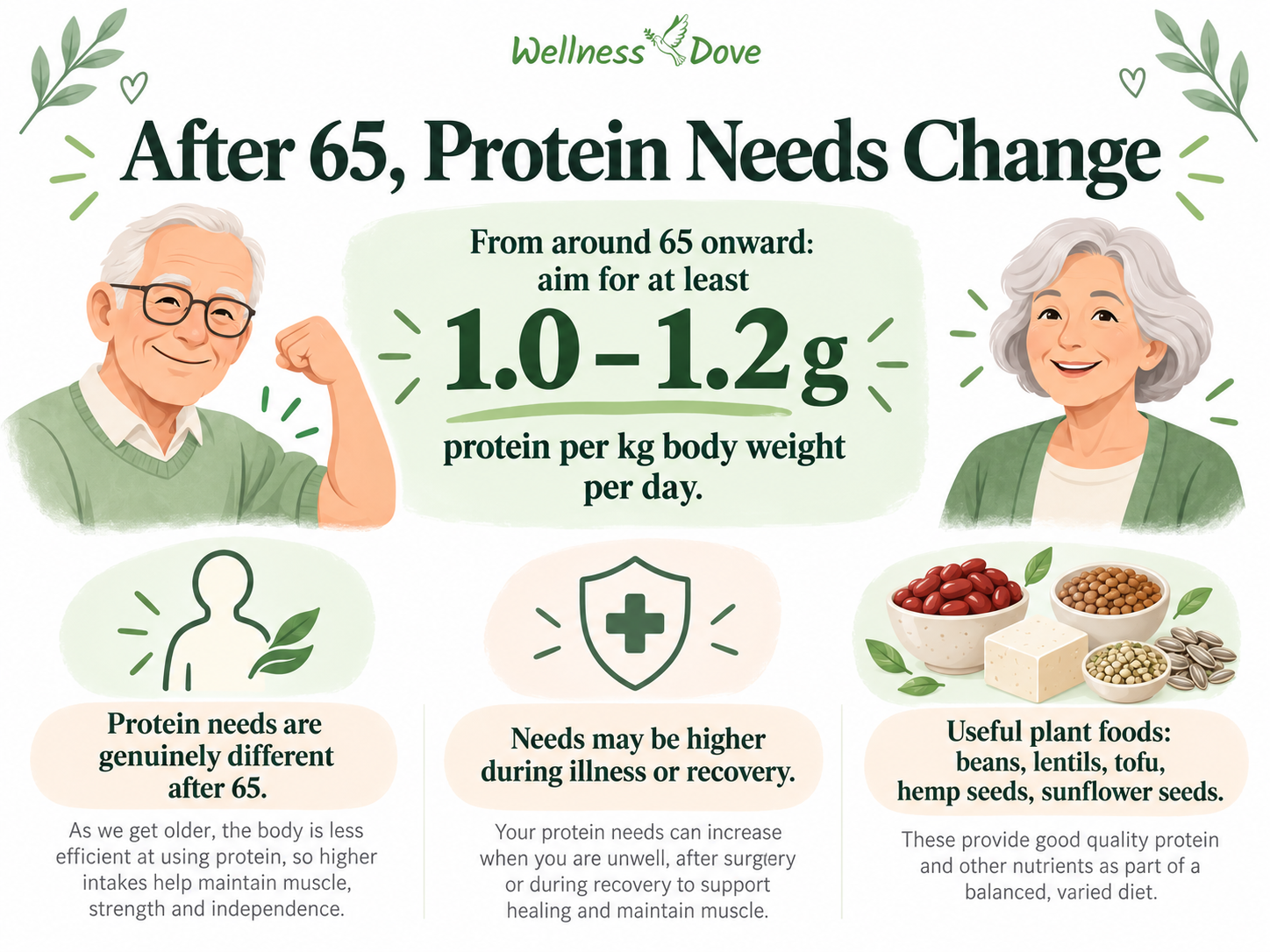
Higher-protein plant foods are the first place to go for that: beans, lentils, hemp seeds, sunflower seeds, tofu.
Which is a useful reminder that almost nothing in nutrition is one rule for all adults, and that anyone who tells you otherwise is simplifying.
Vegan Protein Sources for Athletes
Training changes the answer less than people expect.
Sports nutrition bodies put the figure at 1.4 to 2.0 grams per kilogram of body weight a day, which for a 70-kilogram (154-pound) athlete eating 3,000 calories works out at roughly 13 to 19 percent of calories. That is higher than we would suggest for a sedentary person and we are not going to pretend otherwise.
The point is that it still arrives on its own: beans and lentils are 20 to 30 percent protein, soybeans are about 40, and an athlete eating enough to fuel the training is eating enough protein by arithmetic.
An athlete eats more food than a non-athlete, so an athlete eats more protein without doing anything deliberate about it.
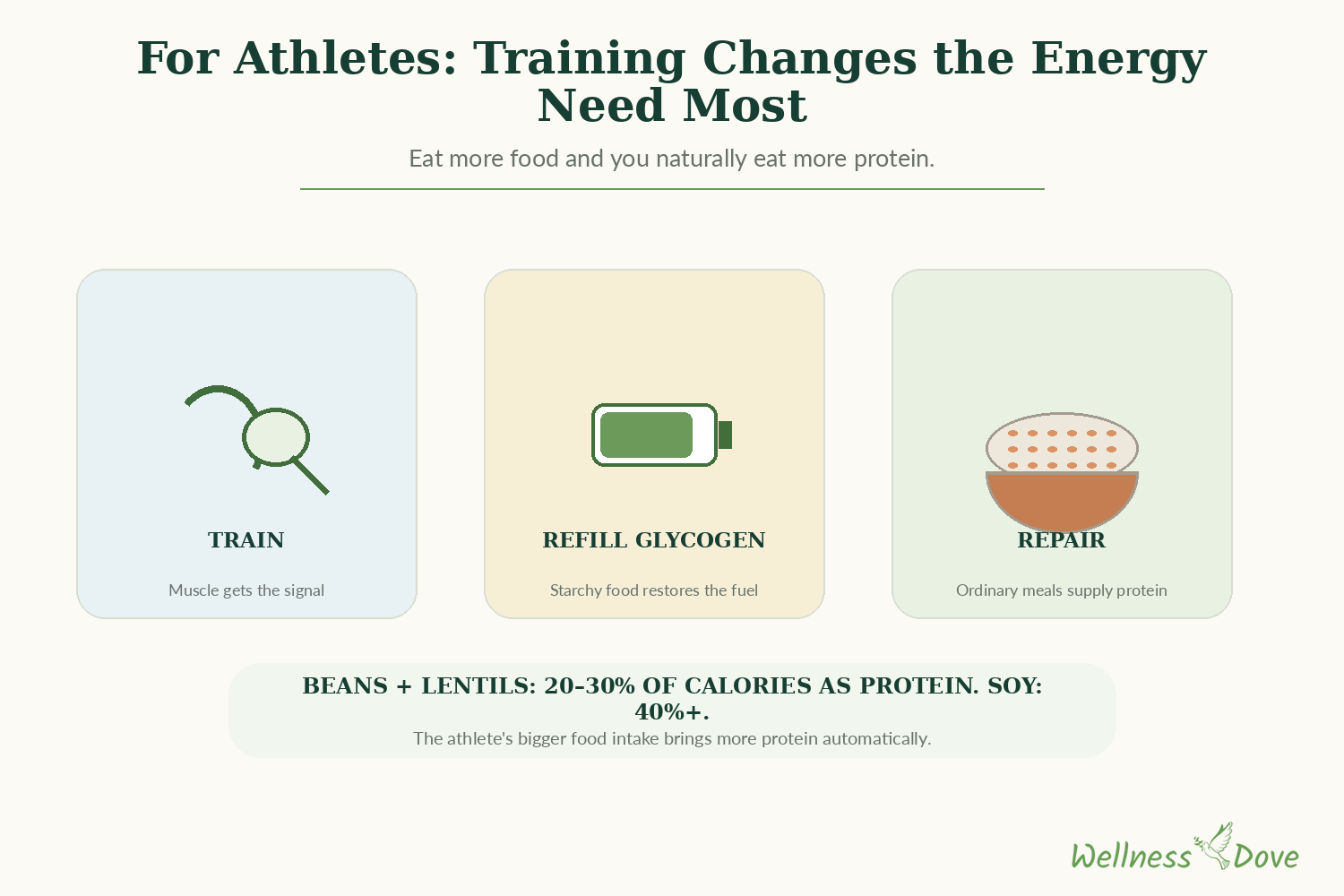
What genuinely changes with training is glycogen, not protein.
Your liver holds about 80 grams of glycogen, roughly 300 calories’ worth, and spends it keeping your blood sugar steady. Your muscles hold about 500 grams, roughly 2,000 calories’ worth, and spend it on movement. The two stores are separate and both need replenishing daily, which is a job for starchy food, not for protein.
Muscle is built in training and repaired by ordinary food. It is not assembled out of powder.
On protein powder
One fact is worth knowing before spending money on any of it.
In the US, supplements do not need FDA approval before they go on sale. Nobody checks the claims on the tub before it is printed, and nobody has to demonstrate long-term safety.
If a product were as effective as its packaging suggests, that would be a strange thing to leave untested.
What a Day of Vegan Protein Looks Like
This is roughly our own week, and none of it is arranged around the question.
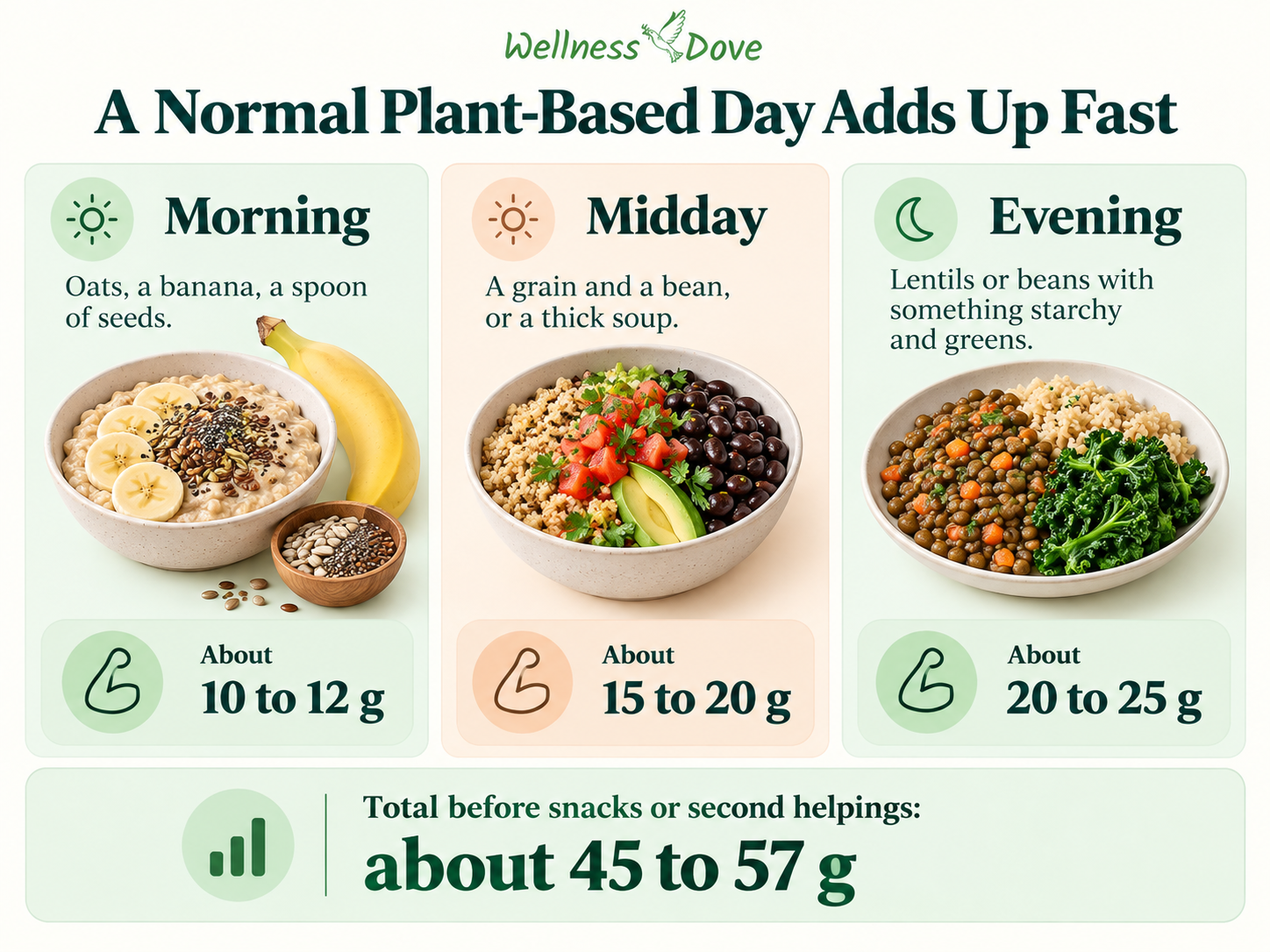
- Morning: oats, a banana, a spoon of seeds. Around 10 to 12 grams before anybody has thought about it.
- Midday: a grain and a bean in a box, or a thick soup. Another 15 to 20.
- Evening: lentils or beans with something starchy and a large pile of greens. A cup of cooked lentils alone is 18 grams, so another 20 to 25.
That comes to roughly 45 to 57 grams before snacks or second helpings, and a bigger person eats more food, so the protein rises with them. We have never weighed anything.
If you are hungry between meals or fading in the afternoon, the problem is far more likely to be not enough food overall than not enough protein. That is the mistake we made ourselves for months.
What to Say When Somebody Asks
The honest version is short.
Beans, lentils, grains and greens. It adds up faster than people think, and I have never had a blood test suggest otherwise.
That is usually the end of it. We spent our first year with a great deal more to say and persuaded nobody, which is a lesson we wrote about separately.
Venny is a medical doctor and a specialist in Nutrition and Dietetics; Andy holds a master’s degree in psychology. This is general information rather than medical advice. If you have kidney disease, are pregnant, are recovering from surgery or illness, or are over 65, your protein needs are genuinely different from the general case and are worth discussing with your own doctor.
And, always, seek health consciously.
Read Next
- Most People Quit Plant-Based Eating Because They Are Hungry
- The Four Numbers That Make Plant Food Filling
- What Actually Happens When You Switch to a Plant-Based Diet
- Lunch Is Where Plant-Based Eating Falls Apart
Sources (16)
- Levine ME, Suarez JA, Brandhorst S, et al. Low protein intake is associated with a major reduction in IGF-1, cancer, and overall mortality in the 65 and younger but not older population. Cell Metab. 2014;19:407-17. View
- Bauer J, Biolo G, Cederholm T, et al. Evidence-based recommendations for optimal dietary protein intake in older people: a position paper from the PROT-AGE Study Group. J Am Med Dir Assoc. 2013;14:542-59. View
- Deutz NE, Bauer JM, Barazzoni R, et al. Protein intake and exercise for optimal muscle function with aging: recommendations from the ESPEN Expert Group. Clin Nutr. 2014;33:929-36. View
- Endogenous Hormones and Breast Cancer Collaborative Group. Insulin-like growth factor 1 (IGF1), IGF binding protein 3 (IGFBP3), and breast cancer risk: pooled individual data analysis of 17 prospective studies. Lancet Oncol. 2010;11:530-42. View
- Rinaldi S, Peeters PHM, Berrino F, et al. IGF-I, IGFBP-3 and breast cancer risk in women: the European Prospective Investigation into Cancer and Nutrition (EPIC). Endocr Relat Cancer. 2006;13:593-605. View
- Renehan AG, Zwahlen M, Minder C, et al. Insulin-like growth factor (IGF)-I, IGF binding protein-3, and cancer risk: systematic review and meta-regression analysis. Lancet. 2004;363:1346-53. View
- Song Y, Chavarro JE, Cao Y, et al. Whole milk intake is associated with prostate cancer-specific mortality among U.S. male physicians. J Nutr. 2013;143:189-96. View
- Darmadi-Blackberry I, Wahlqvist ML, Kouris-Blazos A, et al. Legumes: the most important dietary predictor of survival in older people of different ethnicities. Asia Pac J Clin Nutr. 2004;13:217-20. View
- Nakamura H, Takasawa M, Kashara S, et al. Effects of acute protein loads of different sources on renal function of patients with diabetic nephropathy. Tohoku J Exp Med. 1989;159:153-62. View
- Knight EL, Stampfer MJ, Hankinson SE, et al. The impact of protein intake on renal function decline in women with normal renal function or mild renal insufficiency. Ann Intern Med. 2003;138:460-7. View
- Darling AL, Manders RJF, Sahni S, et al. Dietary protein and bone health across the life-course: an updated systematic review and meta-analysis over 40 years. Osteoporos Int. 2019;30:741-61. View
- Young VR, Pellett PL. Plant proteins in relation to human protein and amino acid nutrition. Am J Clin Nutr. 1994;59:1203S-12S. View
- Ballard O, Morrow AL. Human milk composition. Pediatr Clin North Am. 2013;60:49-74. View
- Jäger R, Kerksick CM, Campbell BI, et al. International Society of Sports Nutrition position stand: protein and exercise. J Int Soc Sports Nutr. 2017;14:20. View
- Lappé FM. Diet for a Small Planet. New York: Ballantine Books; 1971.
- U.S. Department of Agriculture. FoodData Central, SR Legacy. View

11KSmkJDO