

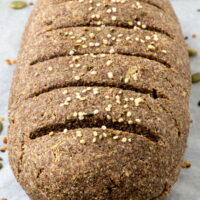
Flax, chia and psyllium all turn to gel in water, which is why readers ask whether one can stand in for another. On our seed bread, a reader asked about using chia instead of the flax. “Yes you can use chia instead of the flax seed,” Venny answered. Another asked about using chia instead of the psyllium in the same loaf, and her answer was much more cautious: chia “might not have the same strong gelling and thickening properties as psyllium husk.”
They look alike in the jar. They don’t do the same jobs, in the kitchen or in your body.
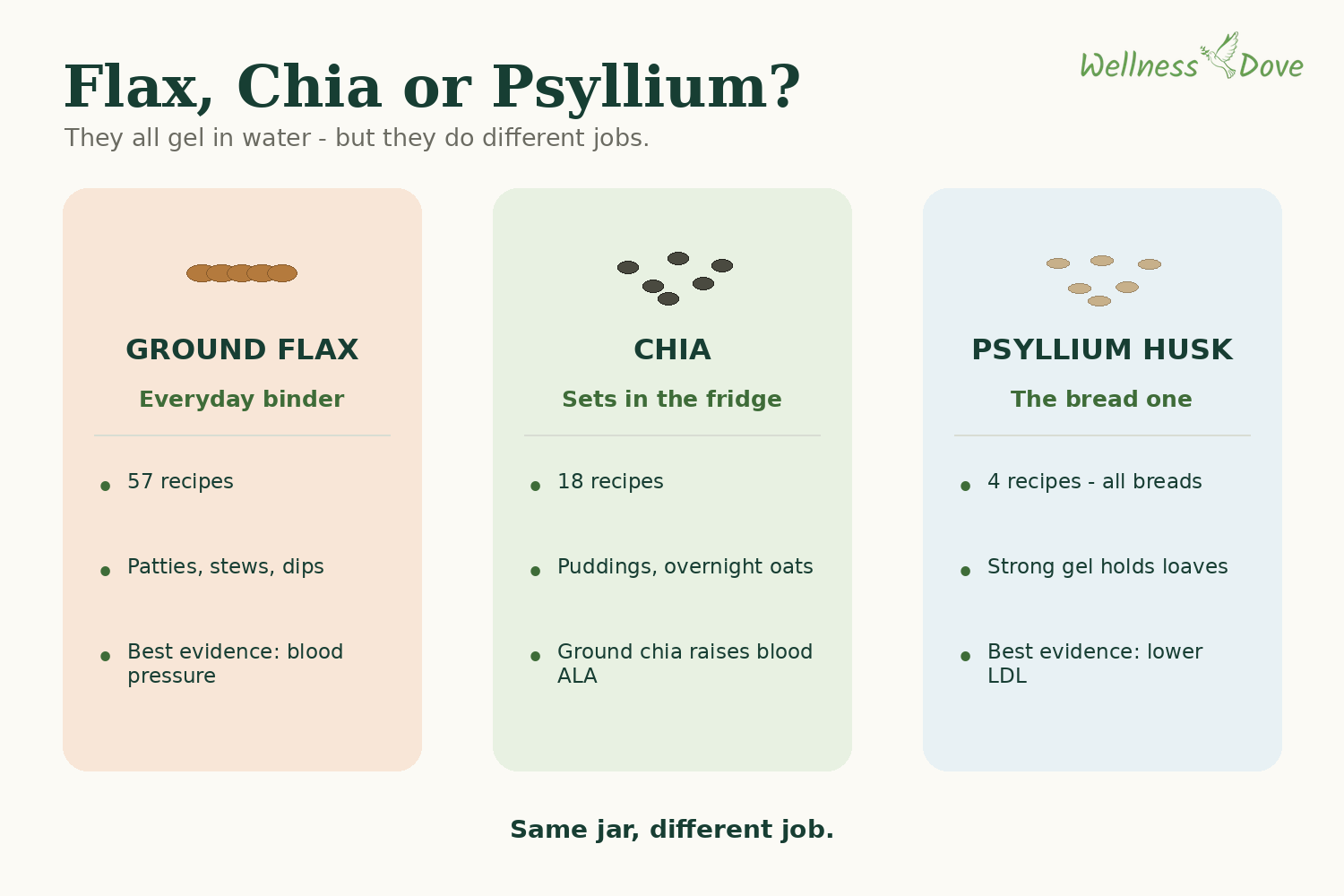
The short answer: ground flax is the everyday one: it binds patties, disappears into stews and soups, and has blood pressure trials behind it. Psyllium husk is the bread one: all four of our psyllium recipes are breads, its gel is what lets them slice, and it’s the only one of the three with an FDA heart-health claim. Chia sets puddings, desserts and frostings in the fridge.
Eat flax ground, and chia too if you want its omega-3. In two trials, whole flaxseed and whole chia didn’t significantly raise blood levels of ALA, the plant omega-3 (not the DHA in fish oil). The ground seeds did.
Flax is in 57 of our recipes and chia in 18. Psyllium husk is in 4, all of them breads.
Chia vs Flax vs Psyllium at a Glance
| Ground flax | Chia | Psyllium husk | |
|---|---|---|---|
| In our recipes | 57 | 18 | 4 |
| What we use it for | Binding patties and nuggets, stirring into cooked dishes, salads and dips | Puddings, desserts and frostings that set in the fridge, overnight oats | Flourless bread, every time |
| Whole or ground | Always eaten ground | Listed whole in 10, ground in 8 | Whole husk |
| Best evidence in the body | Lower blood pressure: a large drop in one trial, a small one pooled across 11 studies | Raises omega-3 ALA when ground; small effects at best on heart-risk markers | Lower LDL cholesterol, across 28 trials |
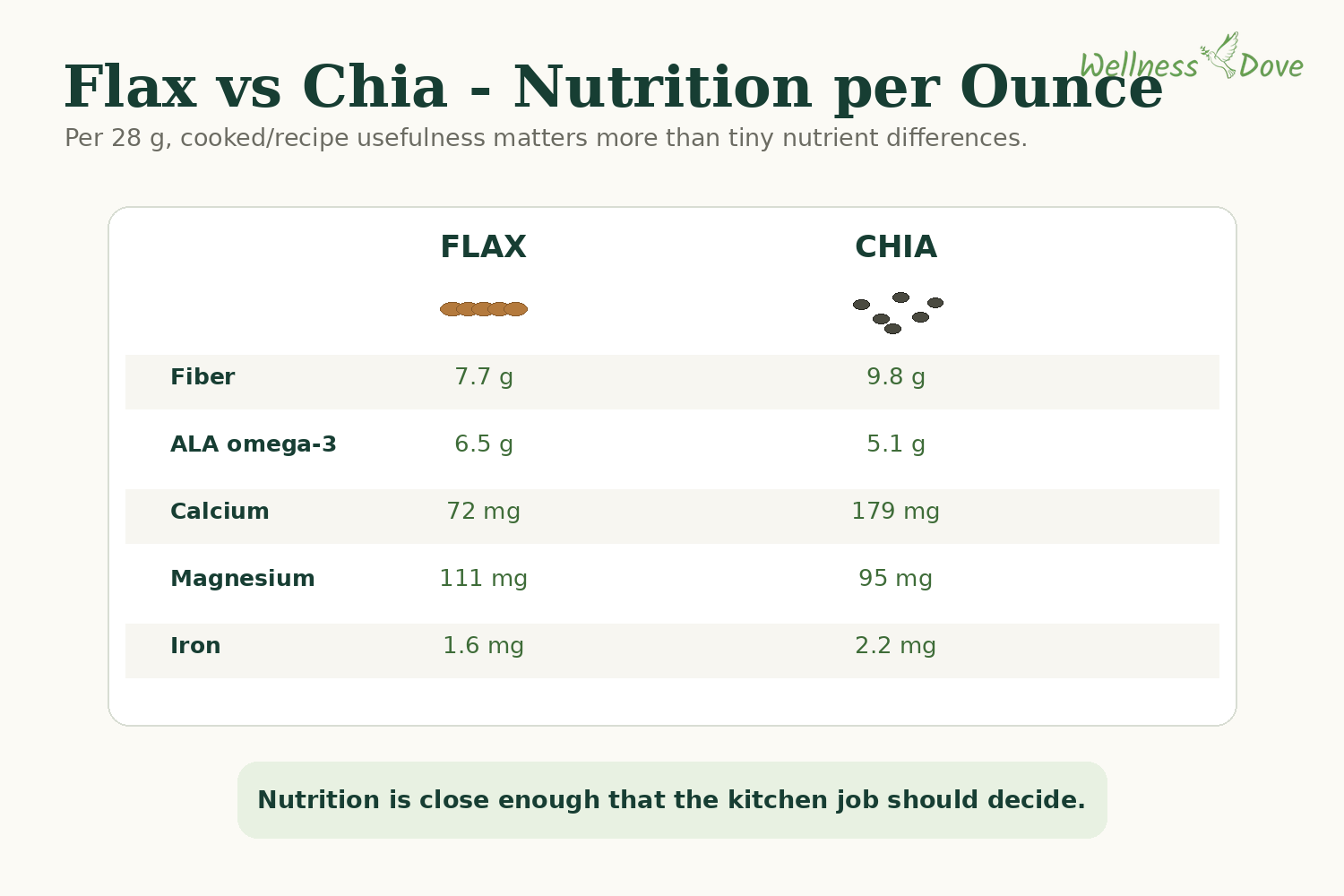
Chia vs Flax Seeds: Nutrition per Ounce
| Per ounce (28 g) | Flaxseed | Chia seeds |
|---|---|---|
| Fiber | 7.7 g | 9.8 g |
| ALA (plant omega-3) | 6.5 g | 5.1 g |
| Calcium | 72 mg | 179 mg |
| Magnesium | 111 mg | 95 mg |
| Iron | 1.6 mg | 2.2 mg |
They’re close enough that nutrition shouldn’t decide it. Chia carries more fiber and about two and a half times the calcium; flax carries a little more omega-3. A tablespoon of ground flax, about 7 grams, has roughly 1.6 grams of ALA.
Psyllium isn’t in USDA’s SR Legacy reference data. It’s the husk of a seed rather than a whole seed, and it’s almost all fiber, most of it the soluble, gel-forming kind. Our bread without flour guide goes into what that fiber does in a loaf.
Ground vs Whole Flaxseed: Why Grinding Matters
Whole flaxseeds have a hard coat, and plenty of them pass through you unopened.
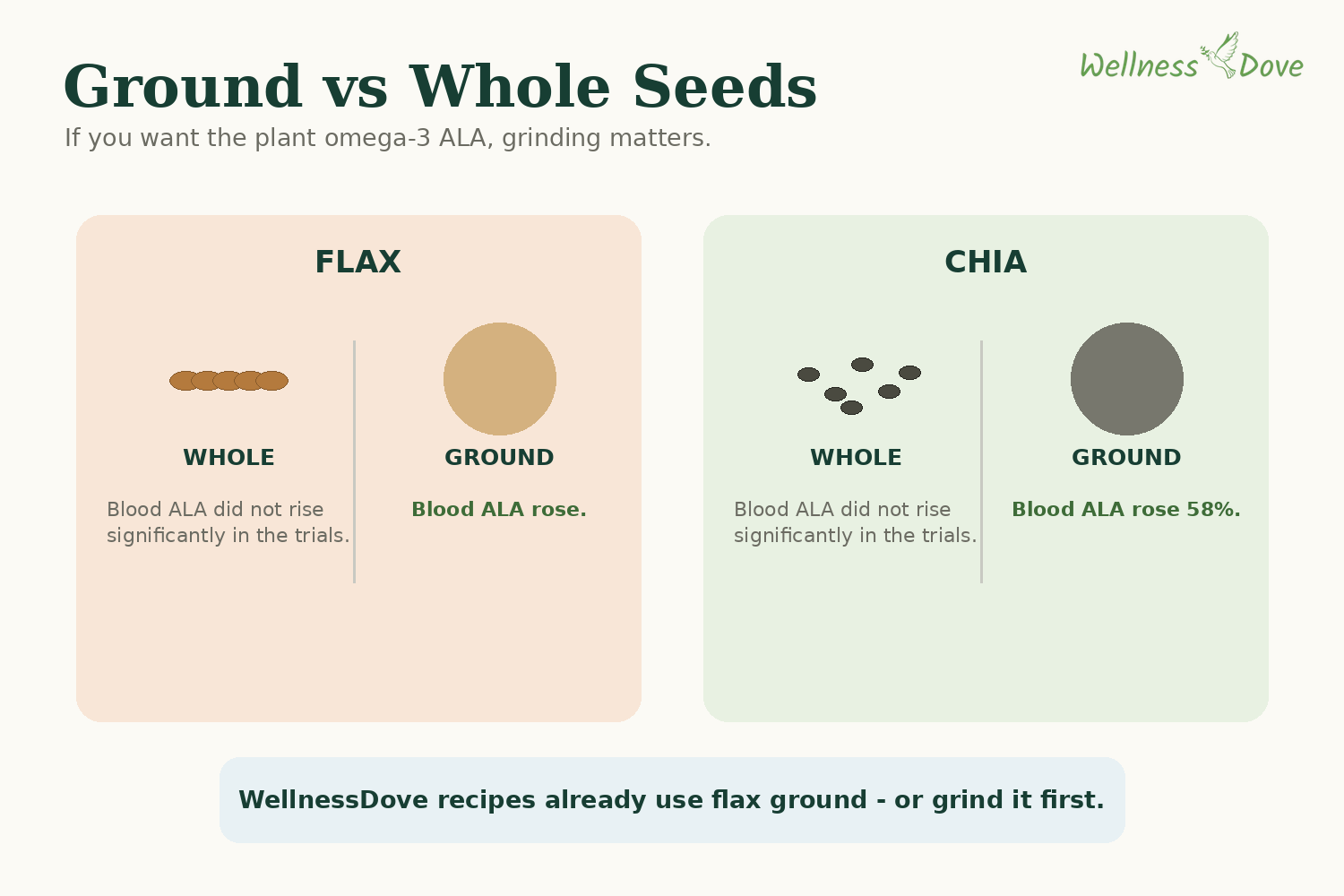
In a 2008 Canadian trial, healthy adults ate 30 grams of flaxseed a day baked into muffins, as whole seeds or milled seeds, or a matching dose of flaxseed oil. Within a month, blood levels of ALA rose in the milled and oil groups. In the whole-seed group they didn’t rise significantly, though that group also had trouble sticking with it. People in all three groups had some stomach discomfort at first, but it settled in the milled-seed group, and no one in that group dropped out.
Chia looks the same. In a 2012 trial, 62 postmenopausal women aged 49 to 75 ate 25 grams of chia a day for 10 weeks, whole or milled, against a poppy seed placebo. Milled chia raised blood ALA by 58%. Whole chia made no significant difference.
Every flax recipe on this site already calls for it ground, or grinds it. Even our seed bread, which starts with 7 ounces of whole flaxseed, blends it into flour first.
What Flax Does in Our Kitchen
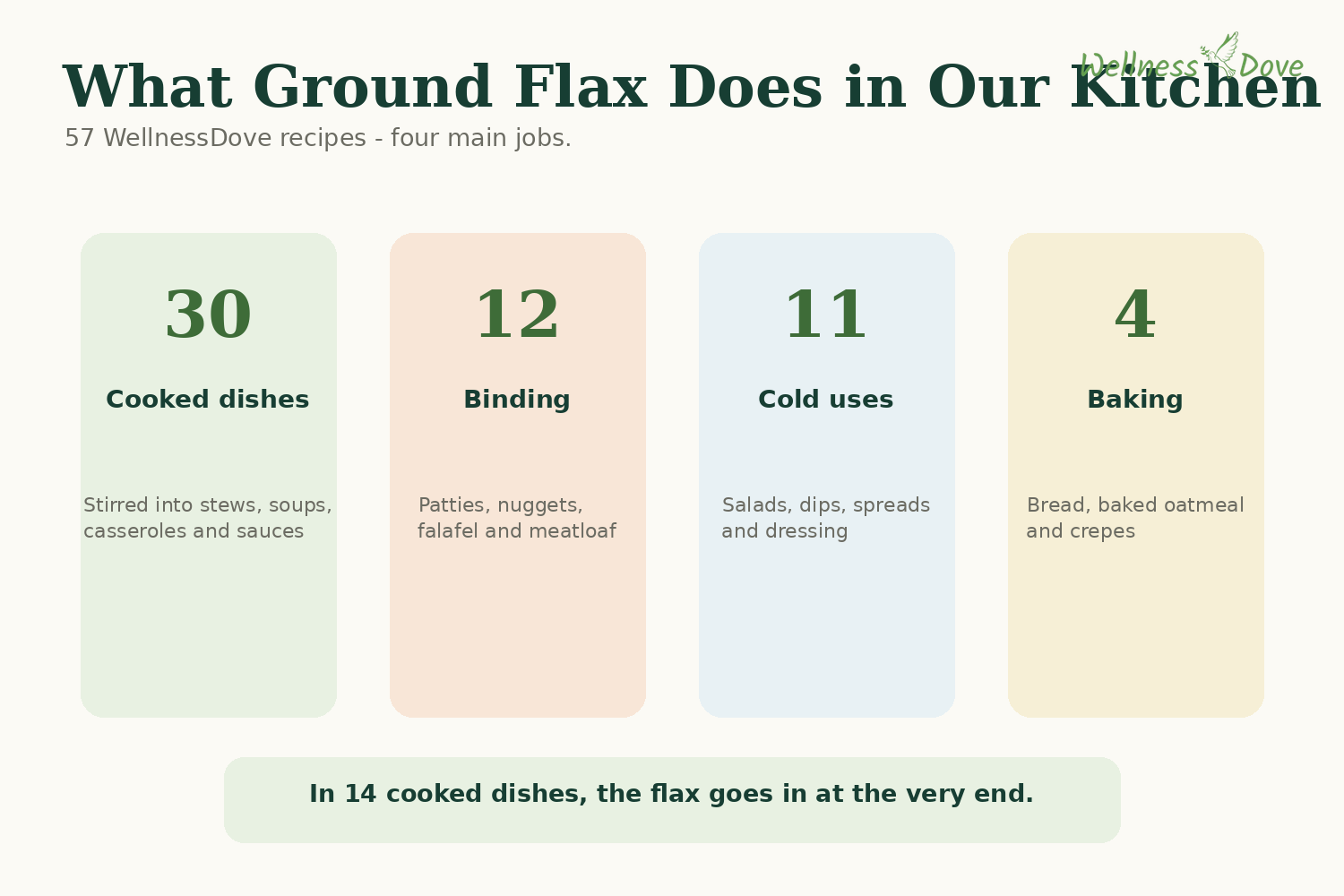
Flax is the most-used of the three here by far, and it does more than bind. Of our 57 flax recipes:
| How the flax is used | Recipes |
|---|---|
| Stirred into stews, soups, casseroles and sauces | 30 |
| Binding patties, nuggets, falafel and a meatloaf | 12 |
| Mixed into salads, dips, spreads and a dressing | 11 |
| Baked into bread and baked oatmeal, or cooked into crepes | 4 |
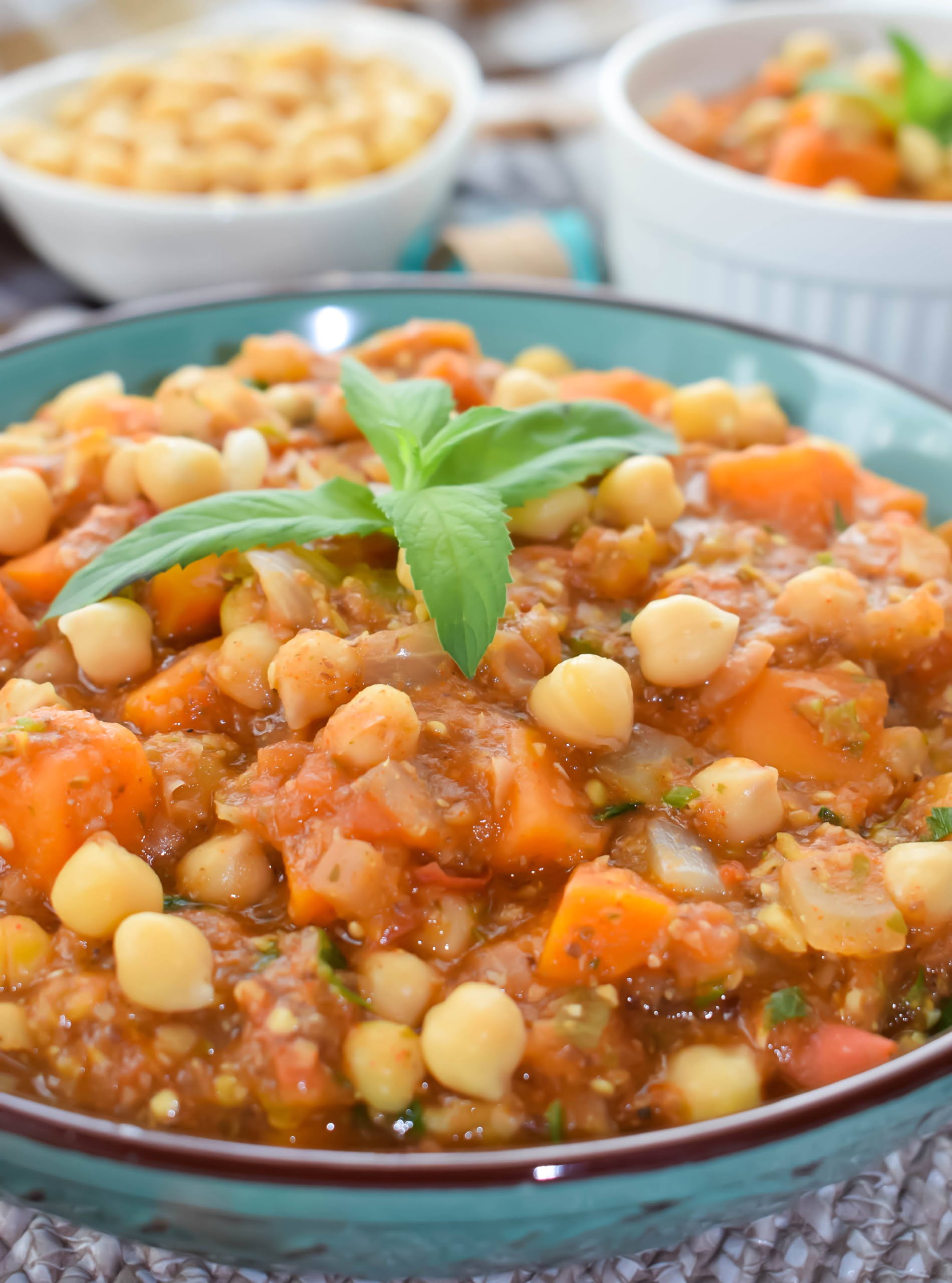
More than half go into cooked dishes, and in 14 of them the ground flax goes in at the very end, once the dish is done: our red lentil stew, chickpea eggplant stew and sweet potato red lentil soup all finish that way. Part of the reason is thickening: Venny has told readers she uses ground flax to thicken a mixture. It isn’t there to protect the omega-3, which survives baking (see below).
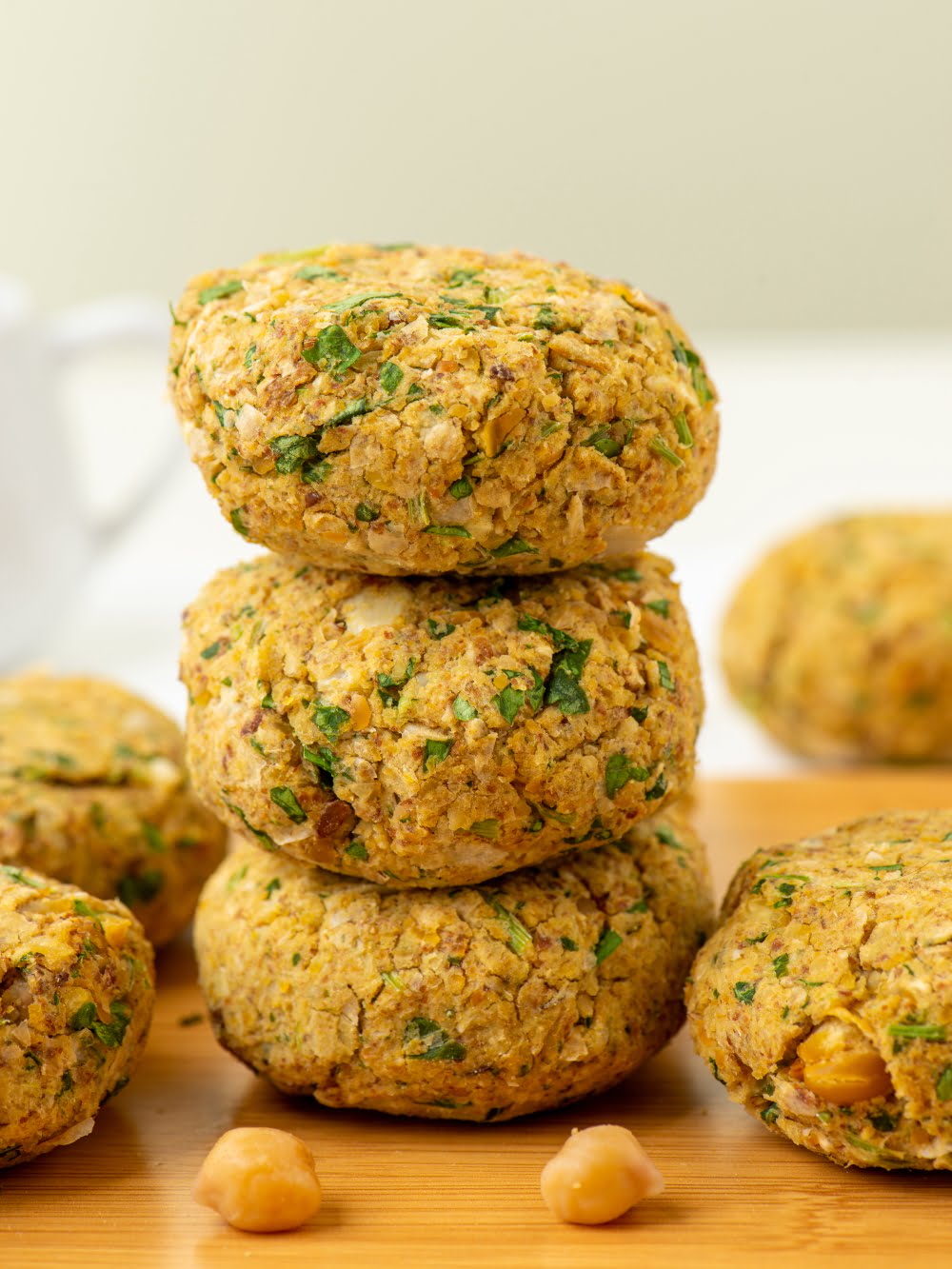
The binding recipes use more. Our homemade falafel takes half a cup of ground flax, and our guide to what holds vegan patties together compares flax with oats and the other binders.
Flax Egg for Baking: What It Can and Can’t Do
A flax egg is ground flax stirred into water and left to thicken. It binds, and that’s all it does: it won’t make a cake rise and it won’t hold a loaf together. The ratio, the timing and the cases where it fails are all in our egg substitutes guide, which compares flax, chia, psyllium, dates and banana as binders.
Flaxseed and Blood Pressure
In a 2013 Canadian trial, 110 people with peripheral artery disease (narrowed leg arteries) ate foods containing 30 grams of milled flaxseed a day, about 4 tablespoons, or matching foods without it, in a trial that ran a year. Neither the patients nor the researchers knew who was eating which.
After six months, systolic blood pressure (the top number) was about 10 points lower in the flax group than in the placebo group, and diastolic (the bottom number) about 7 points lower. In patients who started at 140 or above, systolic pressure fell by 15 points.
Three things keep that in proportion. The trial was set up to study heart and artery problems in these patients; blood pressure was measured along the way. Three-quarters of the patients had high blood pressure, many of them already on medicine for it. And pooled across 11 studies of flaxseed and its extracts, blood pressure fell by about 2 points on average.
Both flax trials in this guide were also partly funded by the flax industry, alongside Canada’s national health research agency, and the blood pressure trial by the Canola Council too.
Andy: A trial dose is what researchers needed to see an effect, not a target for your kitchen. Even with the flax hidden in foods made for them, about one in five people in each group didn’t finish that year-long trial. Over a year, a tablespoon you keep stirring into your stew is more flax than four tablespoons you give up after a week.
Does Ground Flaxseed Go Rancid?
Slowly. In a 2000 Canadian study, milled flaxseed stored at room temperature (about 73°F) for 128 days in lined paper bags showed no meaningful rise in the main measures of oxidation. A trained panel couldn’t smell a difference between fresh and stored flax, and bread made with the 4-month-old flax tasted the same as bread made with fresh.
Baking doesn’t destroy its omega-3 either. In a 1994 study, muffin mix made with flaxseed flour was held at about 350°F for 2 hours and kept all its ALA. Ground flax heated on its own lost a little.
So buy ground flax if grinding is a chore, keep it sealed, and once it’s open keep it in the fridge, as our egg substitutes guide suggests.
What Chia Does: Puddings, Desserts and Overnight Oats
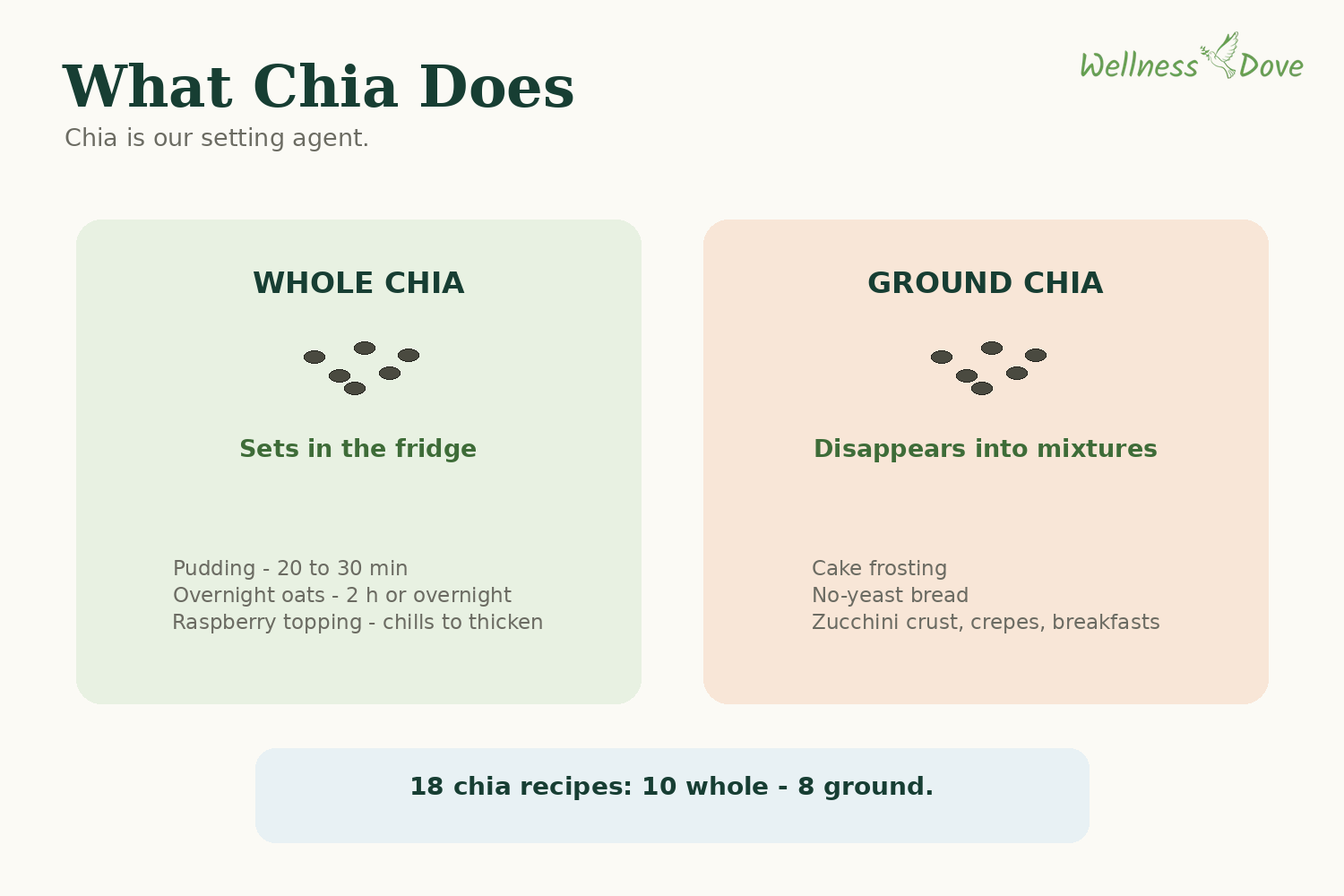
Chia is our setting agent. Of our 18 chia recipes, 10 list whole seeds and 8 ground.
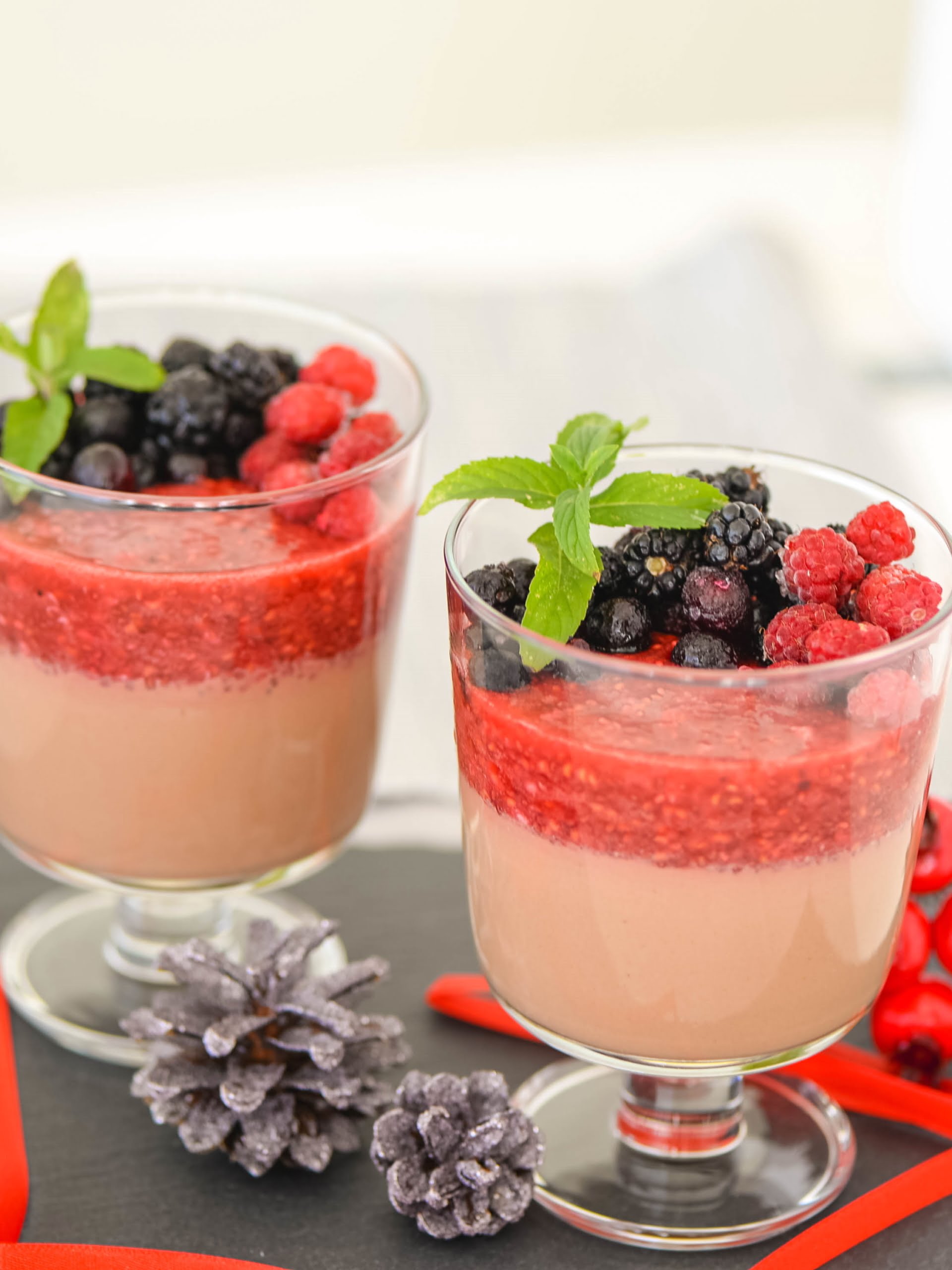
- Whole chia sets things in the fridge in 6 of its 10 recipes. Our chocolate chia pudding uses 1¼ tablespoons of chia and sets in 20 to 30 minutes. Our strawberry overnight oats add half a tablespoon and sit overnight, or at least 2 hours. Our chocolate raspberry mousse uses chia to thicken its raspberry topping.
- Ground chia mostly disappears into things. Both of our layer cakes use 3 tablespoons of it to thicken a frosting that sets in the fridge, including our chocolate walnut cake. It also goes into a no-yeast bread, a zucchini pizza crust, crepes and three breakfasts.
For the body, chia’s case is modest. In the 10-week trial above, chia raised blood ALA when it was milled, but neither whole nor milled chia changed blood pressure, cholesterol or inflammation markers compared with the placebo.
Pooled across 14 small trials, chia lowered triglycerides a little, and at higher doses lowered LDL by about 5 mg/dL and systolic pressure by about 3 points. Venny has suggested chia in place of flax in savory recipes too, though she hasn’t tested it in our patties.
What Psyllium Husk Does: The One That Makes Bread
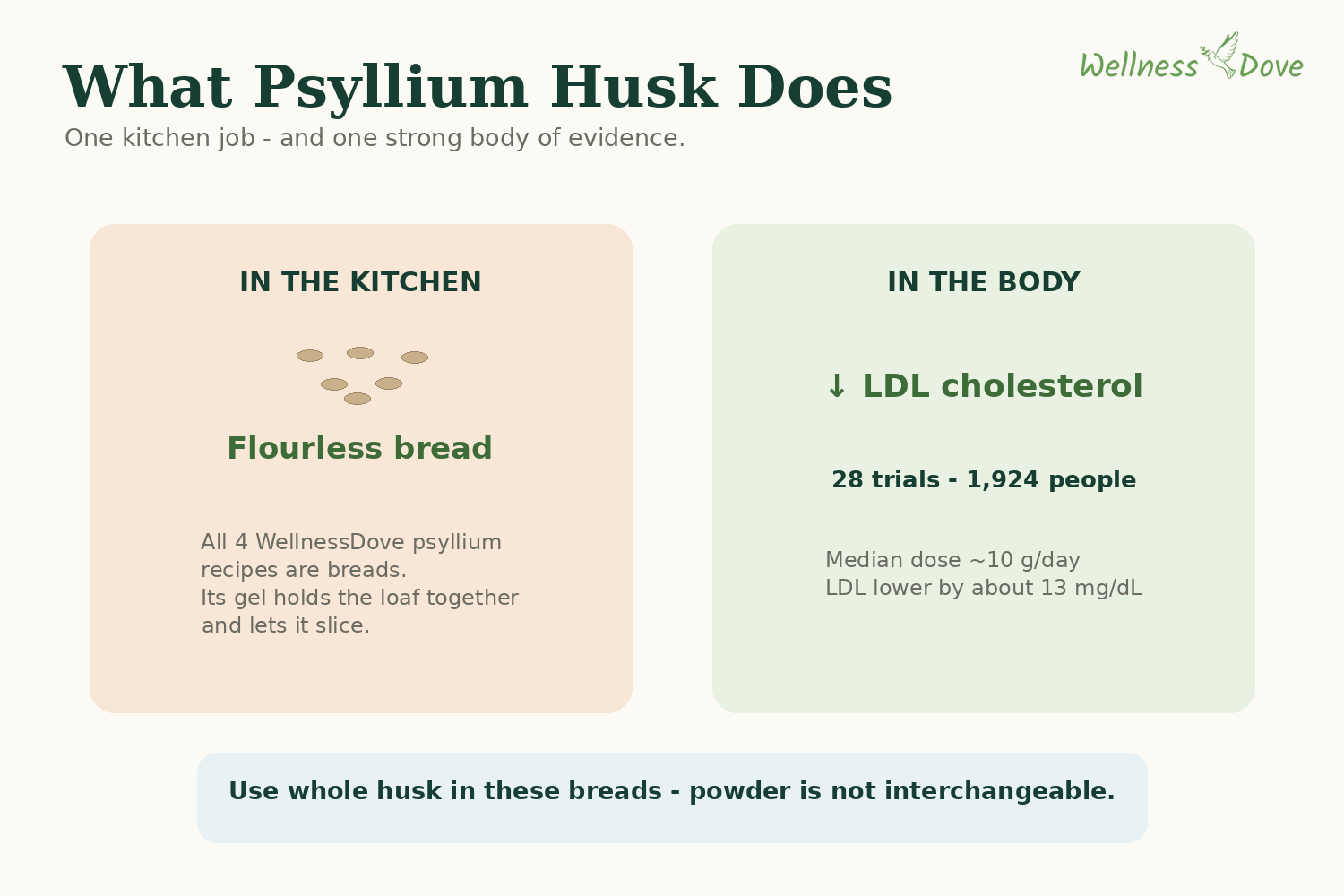
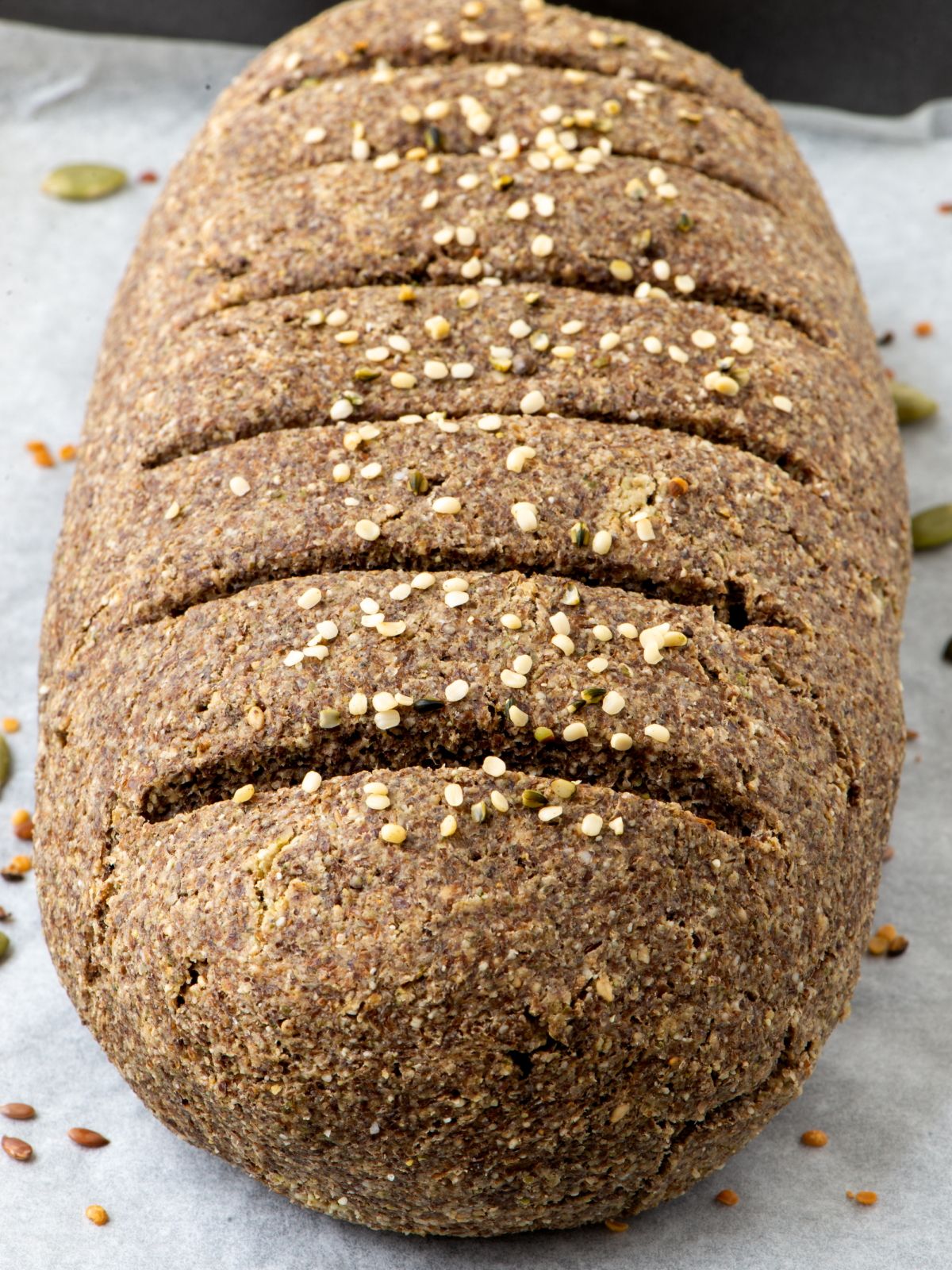
Psyllium is the only one of the three we use for a single job. All 4 of our psyllium recipes are flourless breads: lentil bread, lentil bread rolls, chickpea bread and seed bread. Its gel is what holds those loaves together and lets you slice them. Our bread without flour guide explains how, and why whole husk and psyllium powder aren’t interchangeable.

Our lentil bread uses 1.2 ounces (34 grams) of whole husk for 12 slices, so each slice carries about 3 grams of psyllium husk.
Psyllium’s other strength is cholesterol:
- The FDA allows a heart-health claim for psyllium at 7 grams a day of its soluble fiber.
- In a 2018 meta-analysis of 28 trials with 1,924 people, a median of about 10 grams of psyllium a day lowered LDL cholesterol by about 13 mg/dL (0.33 mmol/L).
Like the gel in oats, psyllium’s gel is thought to work largely by carrying bile acids out of the body; our oats guide explains how that lowers cholesterol.
Psyllium, Chia and Flax Safety
Some people are allergic to psyllium, from breathing in the dust or eating it, and the supplement labels carry an allergy alert for that reason.
From Venny, a medical doctor and a specialist in Nutrition and Dietetics: all three of these swell, and that’s the whole point of them. It’s also the main way they can hurt you.
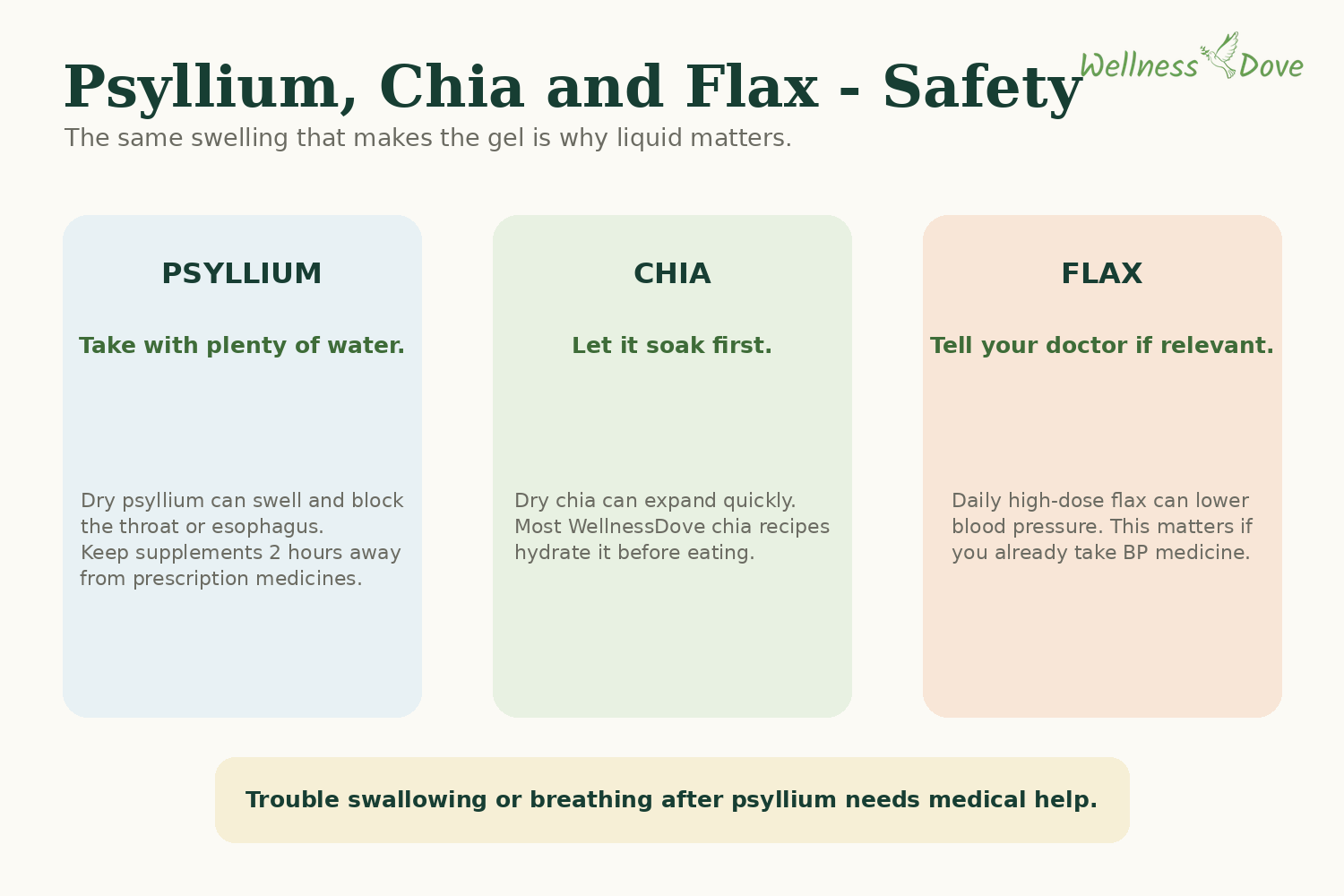
Psyllium sold in the US as an over-the-counter fiber laxative has to carry a choking warning: taken without enough fluid, it can swell and block the throat or esophagus. So take psyllium husk or powder in at least a full glass of water, stir and drink it right away, add more liquid if it thickens, and don’t take it at all if you have trouble swallowing. Chest pain, vomiting or trouble swallowing or breathing after taking it needs medical help right away.
Doctors have also reported chia seeds swelling into a gel that blocked a patient’s esophagus; that patient likely had eosinophilic esophagitis, an inflammatory condition of the esophagus. Let chia soak before you eat it, the way most of our chia recipes do.
In our breads the psyllium is mixed into a wet dough and baked, so it isn’t the dry powder that warning is about. It’s still concentrated fiber: have a drink with it, and if you have a bowel condition or have ever had a bowel obstruction, check with your own doctor first.
Then there are medicines. If you take psyllium as a supplement, the labels say to take it at least 2 hours before or after any prescription medicine you take by mouth. And if you take blood pressure medicine and start eating flax every day, tell your doctor: in the trial above, 30 grams a day left systolic pressure about 10 points lower than placebo, in patients many of whom were already on blood pressure medicine.
Venny is a medical doctor and a specialist in Nutrition and Dietetics; Andy holds a master’s degree in psychology. This is general information rather than medical advice.
Which One to Buy for What
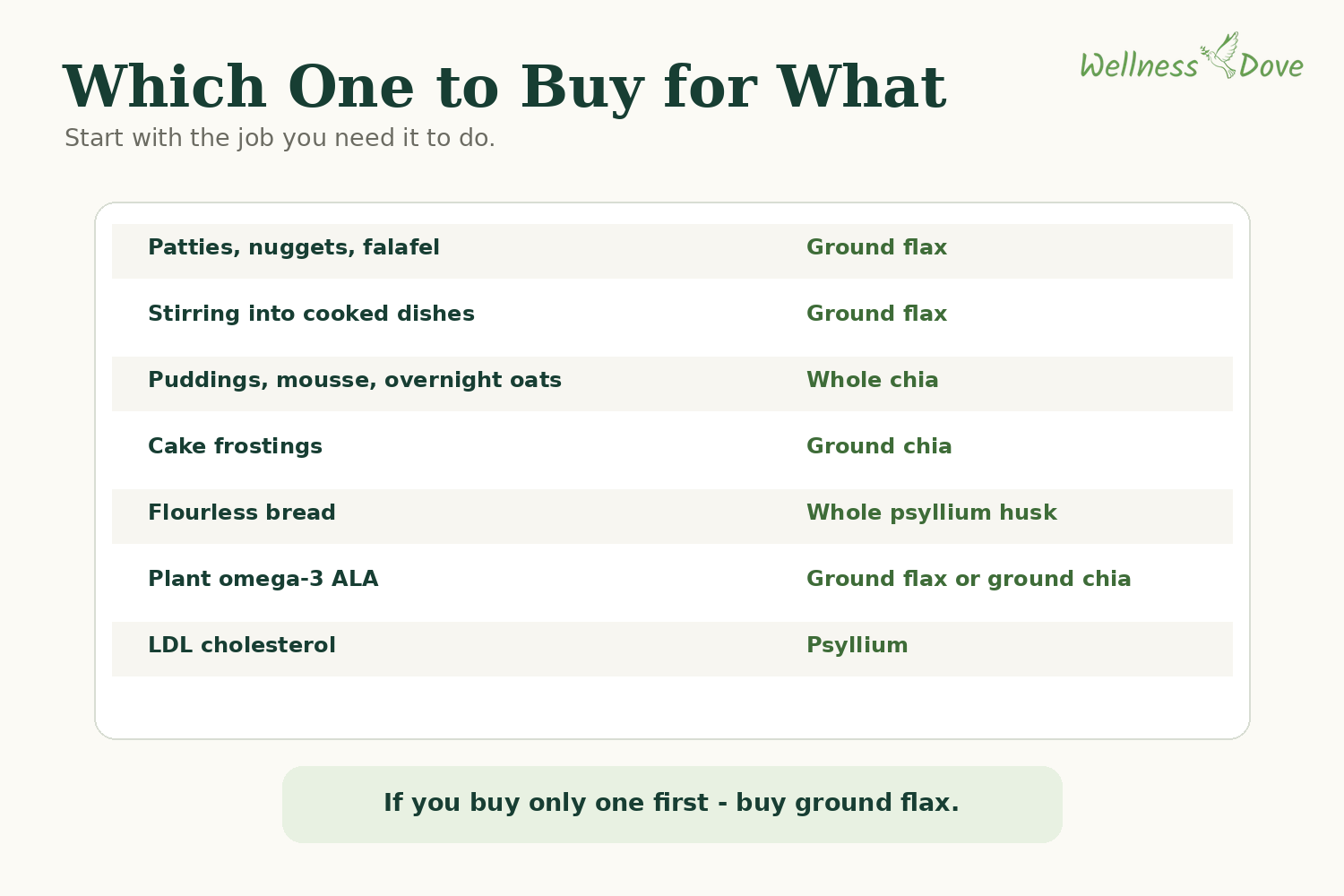
| What you’re making | Use | Why |
|---|---|---|
| Patties, nuggets, falafel | Ground flax | 12 of our recipes use it to bind |
| Stirring into cooked dishes | Ground flax | 30 of our cooked dishes use it |
| Puddings, mousse, overnight oats | Whole chia | Sets in the fridge |
| Cake frostings | Ground chia | Both our layer cakes set their frosting with 3 tablespoons |
| Flourless bread | Whole psyllium husk | All four of our psyllium recipes are breads |
| Plant omega-3 | Ground flax or ground chia | Whole seeds didn’t raise blood ALA in the trials |
| LDL cholesterol | Psyllium | 28 trials; as a supplement, take it with water, away from medicines, and ask your doctor first |
Where to Start With Flax, Chia and Psyllium
Buy a bag of ground flax first, because it does the most. Stir 2 tablespoons into the next stew or soup you make once it’s done, the way our red lentil stew does. Then, on a weekend, buy whole psyllium husk and bake our lentil bread.
And, always, seek health consciously.
Read Next
- Bread Without Flour: How It Works, and Which Loaf to Make
- Egg Substitutes for Baking: Which Binder Works for What
- Vegan Meatballs, Patties and Burgers: What Holds Them Together
- Rolled, Quick or Steel Cut: Which Oats to Buy for What
- Lentils: Which Kind to Buy, and How to Cook Each One
Sources (14)
- U.S. Department of Agriculture. Seeds, flaxseed (FDC 169414); Seeds, chia seeds, dried (FDC 170554). FoodData Central, SR Legacy. View
- Austria JA, Richard MN, Chahine MN, et al. Bioavailability of alpha-linolenic acid in subjects after ingestion of three different forms of flaxseed. Journal of the American College of Nutrition. 2008;27(2):214-221. View
- Nieman DC, Gillitt N, Jin F, et al. Chia seed supplementation and disease risk factors in overweight women: a metabolomics investigation. Journal of Alternative and Complementary Medicine. 2012;18(7):700-708. View
- Rodriguez-Leyva D, Weighell W, Edel AL, et al. Potent antihypertensive action of dietary flaxseed in hypertensive patients. Hypertension. 2013;62(6):1081-1089. View
- Khalesi S, Irwin C, Schubert M. Flaxseed consumption may reduce blood pressure: a systematic review and meta-analysis of controlled trials. Journal of Nutrition. 2015;145(4):758-765. View
- Malcolmson LJ, Przybylski R, Daun JK. Storage stability of milled flaxseed. Journal of the American Oil Chemists’ Society. 2000;77(3):235-238. View
- Chen ZY, Ratnayake WMN, Cunnane SC. Oxidative stability of flaxseed lipids during baking. Journal of the American Oil Chemists’ Society. 1994;71(6):629-632. View
- Fateh HL, Ahmed DH, Najafabadi MS, Moludi J. The impact of chia seeds on diabetes, blood pressure, lipid profile, and obesity indicators: systematic review and meta-regression analysis of 14 randomized controlled trials. Prostaglandins and Other Lipid Mediators. 2024;175:106907. View
- U.S. Code of Federal Regulations. 21 CFR 101.81, Health claims: soluble fiber from certain foods and risk of coronary heart disease. View
- Jovanovski E, Yashpal S, Komishon A, et al. Effect of psyllium (Plantago ovata) fiber on LDL cholesterol and alternative lipid targets, non-HDL cholesterol and apolipoprotein B: a systematic review and meta-analysis of randomized controlled trials. American Journal of Clinical Nutrition. 2018;108(5):922-932. View
- U.S. Code of Federal Regulations. 21 CFR 201.319, Water-soluble gums, hydrophilic gums, and hydrophilic mucilloids: required warnings and directions. View
- U.S. National Library of Medicine. DailyMed: Organic natural fiber (psyllium husk) powder, drug facts label. View
- Simmelink A, Rawl RE, Browne L, Scobey M. Watch it grow: esophageal impaction with chia seeds. Case Reports in Internal Medicine. 2017;4(2):49. View
- ClinicalTrials.gov. Effects of dietary flaxseed on symptoms of cardiovascular disease in patients with peripheral arterial disease (FLAXPAD). NCT00781950. View