

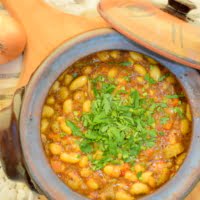
Beans that are still hard after two hours on the stove usually aren’t the cook’s fault. The bag was old, the water was hard, or the tomatoes went in too early. With kidney beans there’s a bigger mistake to avoid: a pot that never got hot enough.
The short answer: soak dried beans, drain them, cover with fresh water and simmer. Great northern beans take 45 to 60 minutes. Kidney, navy and pinto beans take 90 minutes to 2 hours, and an old bag can take longer than that.
Salt the soaking water: in a 2023 study on pinto beans it made them cook faster. Add tomatoes, vinegar and lemon only after the beans are tender.
And bring dried beans to a full, rolling boil before anything else, and keep kidney beans at a hard boil for at least 30 minutes, the FDA’s advice. Raw beans carry a natural toxin that gentle heat doesn’t destroy, which is why dried beans should never go straight into a slow cooker. Canned beans are already safe.
We cook with beans other than chickpeas and lentils in 28 recipes, and this guide is about those. Chickpeas and lentils have guides of their own, and lentils need no soaking at all.
How Long Dried Beans Take to Cook
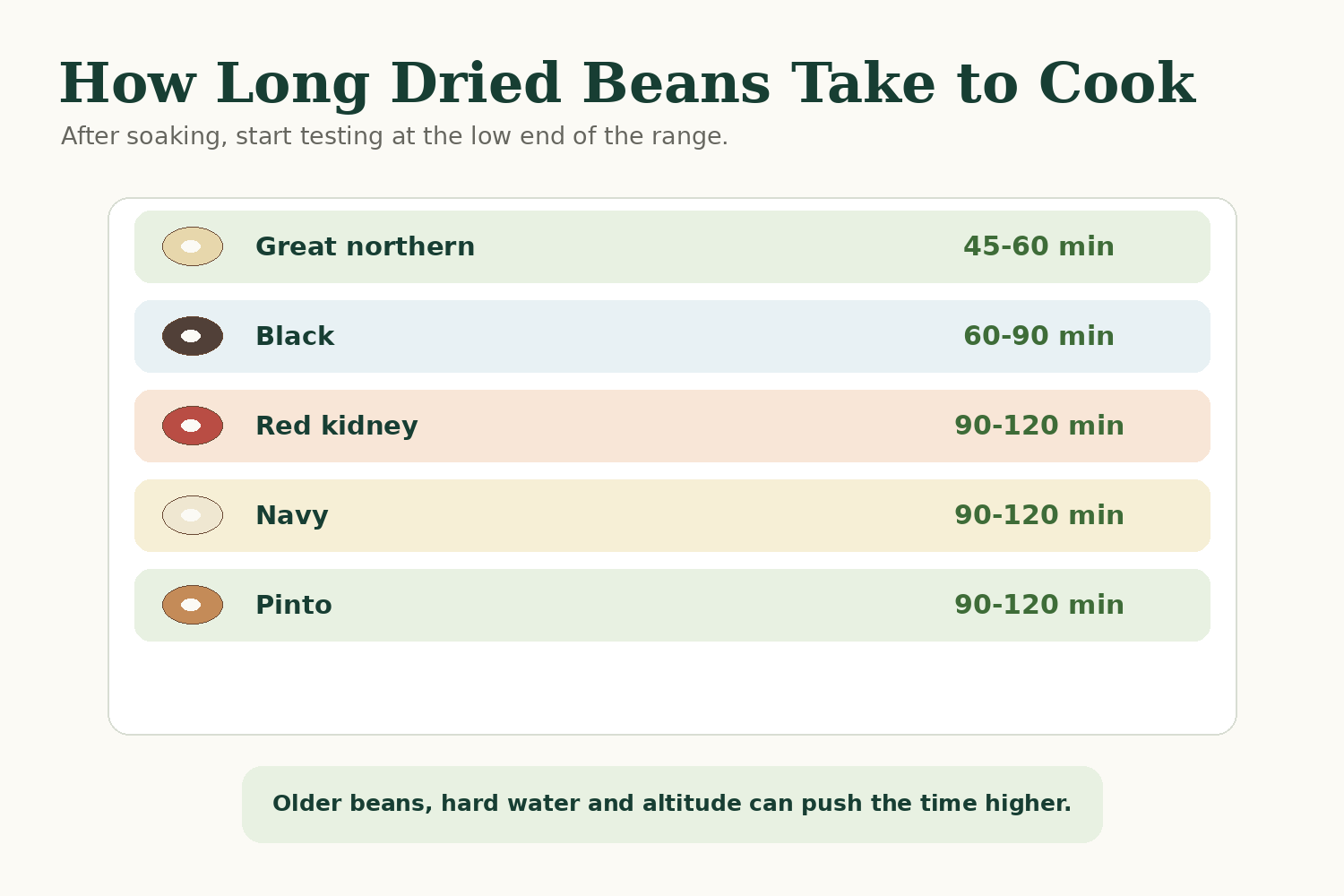
Soaked great northern beans are done in under an hour. Kidney, navy and pinto beans need 90 minutes to 2 hours. These are the University of Nebraska-Lincoln Extension’s times for beans that have already been soaked:
| Bean | Soaked, then simmered |
|---|---|
| Great northern | 45 to 60 minutes |
| Black | 60 to 90 minutes |
| Red kidney | 90 to 120 minutes |
| Navy | 90 to 120 minutes |
| Pinto | 90 to 120 minutes |
Treat those as a range to start testing from: the University of Maine’s chart gives black beans 1½ to 2 hours, not 1 to 1½. Older beans take longer, and so does altitude: in a 2023 study on pinto beans, unsoaked beans took longest at the highest elevation tested.
To check, taste a few, or mash one against the side of the pot with a fork. They’re done when there’s no firm core left in the middle.
Do You Have to Soak Dried Beans?
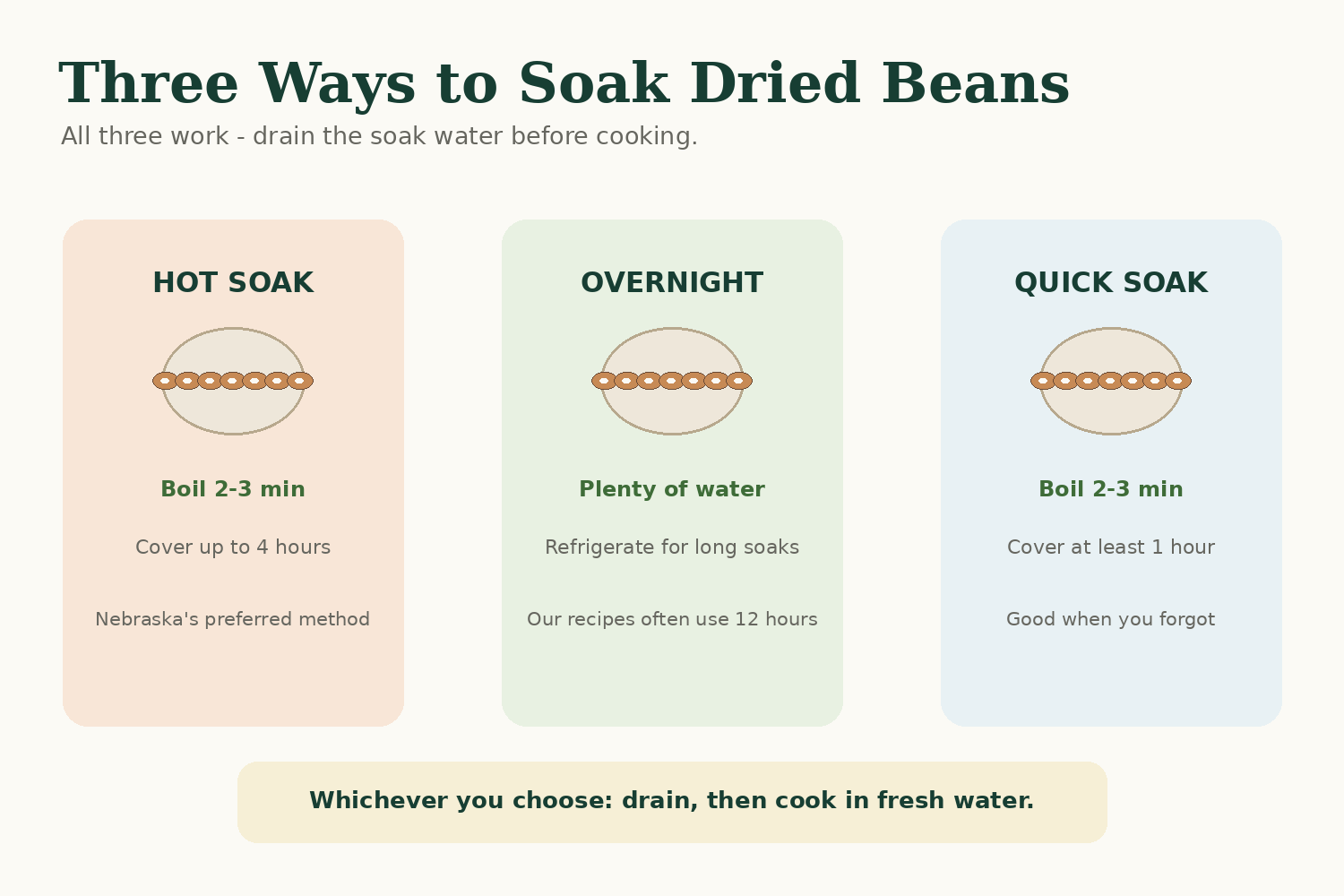
No, but you’ll stand at the stove a lot longer. In a 2023 study on pinto beans, an overnight soak and a quick soak cut the cooking time by a similar amount compared with beans cooked straight from dry. There are three ways to do it, and the Nebraska extension prefers the first:
- Hot soak, Nebraska’s preferred method. About 10 cups of water for each pound (2 cups) of beans. Bring to a boil, boil 2 to 3 minutes, then cover and leave for up to 4 hours. Nebraska prefers it because it shortens cooking, draws out more of the gas-causing sugars and gives the most consistently tender beans.
- Overnight soak. About 10 cups of water per pound. Our recipes soak overnight, some for 12 hours. The Nebraska and Maine extension services both recommend soaking in the refrigerator, and Colorado State recommends it for any soak longer than 12 hours.
- Quick soak, if you forgot. About 6 cups of water per pound, bring to a boil, boil 2 to 3 minutes, take off the heat, cover and leave for at least an hour.
Whichever you choose, drain the soaking water and cook in fresh water. Beans carry a family of sugars (raffinose and its relatives) that we can’t digest and our gut bacteria ferment, which is behind much of the gas. Soaking draws some of them out into the water you pour away.
Andy: The hard part of dried beans is remembering to soak them the night before, and that’s a memory problem, not a willpower one. Memory problems respond to a specific plan. In a 2025 analysis of 642 experiments, people who made an “if this happens, then I’ll do that” plan followed through more often than people who only intended to, especially when the task was remembering. The effect is modest, so make the plan concrete: when the dinner dishes are done, the beans go in the bowl.
Why Red Kidney Beans Need a Hard Boil
Get this wrong and beans can make you violently sick within hours.
Raw kidney beans contain phytohemagglutinin, a natural protein in the bean (a lectin) that causes sudden vomiting and diarrhea. As few as four or five soaked raw kidney beans have been reported to cause it. In confirmed cases reviewed in the UK, symptoms began 1 to 7 hours after eating.
Red kidney beans carry the most, but not all of it. In a 2025 analysis of raw retail beans, white kidney beans (cannellini) had about two-thirds as much as red kidney beans, and pinto and black beans about 40 percent. Hong Kong’s food safety authority advises cooking every kind of bean properly for that reason.
Heat destroys it, but only real heat:
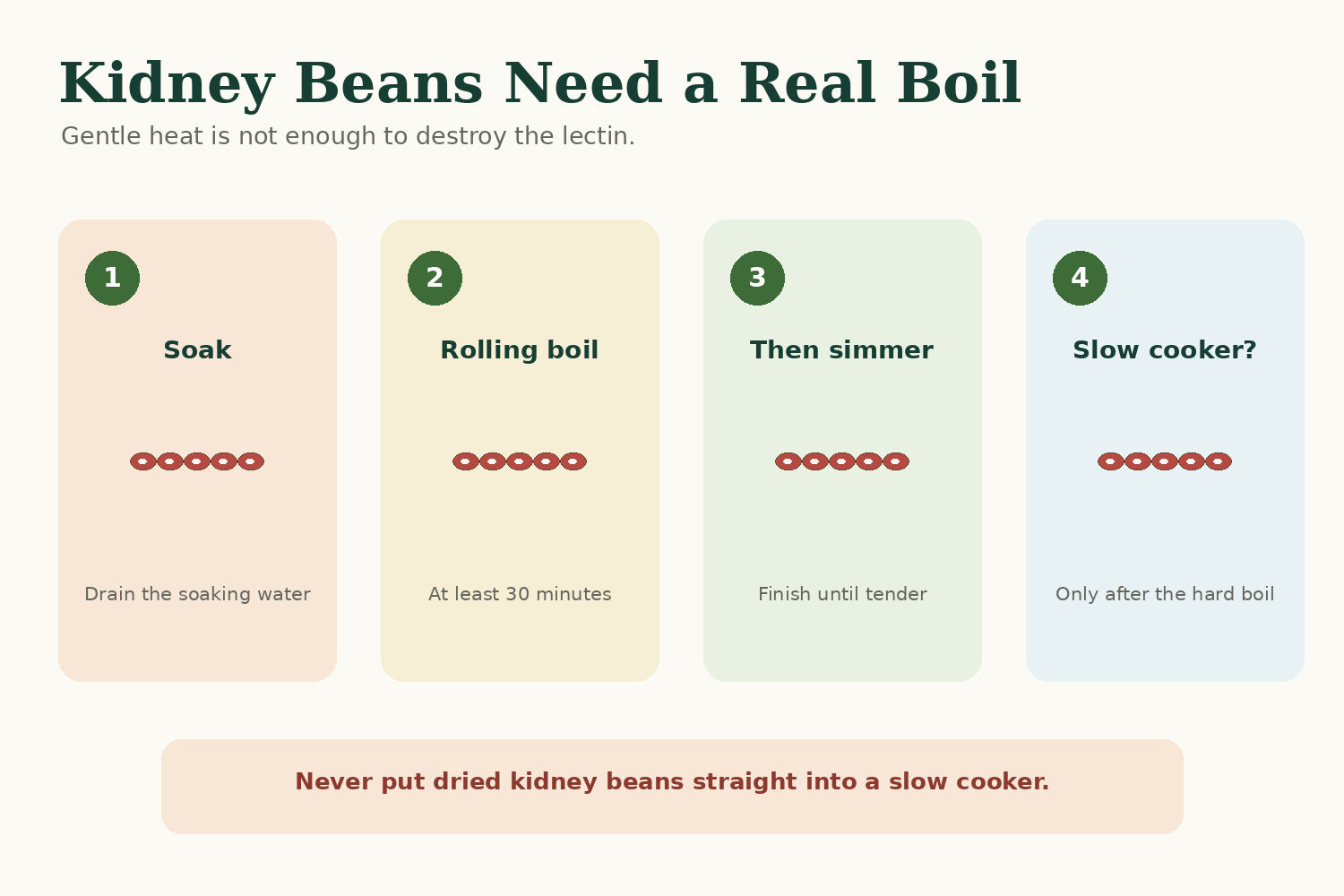
- Get the beans to a full, rolling boil early, and keep it there for 30 minutes. Ten minutes at a full boil destroyed the toxin in the tests the FDA cites, and it’s the line Hong Kong’s food safety authority draws, but the FDA and the University of Illinois Extension both advise at least 30 minutes as the safe margin. Kidney beans need 90 minutes anyway, so what matters is a real boil early, not a pot that creeps up to a simmer.
- Never put dried beans straight into a slow cooker. Beans in a slow cooker often reach only about 167°F, which is below boiling. The University of Illinois Extension says to soak kidney beans, pour the water away and boil them briskly for 30 minutes before they go in. The FDA goes further and says not to use slow cookers for kidney beans at all.
- At high altitude, be more careful. Water boils at a lower temperature up there, and Hong Kong’s food safety authority flags high altitude as a particular risk.
- Hours of gentle heat don’t replace a boil. In 2018, about 200 people at a military base in France fell ill within hours of the same lunch. The chili’s kidney beans had soaked for only an hour and a half, then cooked overnight in an oven at about 176°F. Hours of cooking, and the beans never boiled.
Canned beans are safe. Canning removes more than 99% of the lectin: a whole can holds roughly 1,000 times less than the amount estimated to cause poisoning. Our clay-pot baked beans, made with white beans, take the careful route anyway: a 10-minute boil first, with that water poured away.
Lectins in raw beans are a real hazard. They aren’t a reason to avoid cooked beans: in a study of older adults in four countries, legumes were the one food group that consistently went with living longer (more on that below).
From Venny, a medical doctor and a specialist in Nutrition and Dietetics: kidney bean poisoning is usually over within hours. The vomiting and diarrhea are violent, but they pass, and most adults recover without any treatment.
The case I’d want every parent to know about is a child. In 2026, doctors described an 8-year-old girl who collapsed after a home-cooked kidney bean stew and needed resuscitation and fluids. Her family thought the beans were thoroughly cooked. They had soaked for only a few hours and boiled in the stew for about 15 to 20 minutes. Her father ate the same meal and was only mildly sick. She went home on her second day in the hospital, fully recovered, and cases like hers are rare.
So if a child, or anyone frail, keeps vomiting after a bean meal, don’t wait it out at home. Get medical help early.
Venny is a medical doctor and a specialist in Nutrition and Dietetics; Andy holds a master’s degree in psychology. This is general information rather than medical advice.
Which Beans Hold Their Shape and Which Go Creamy
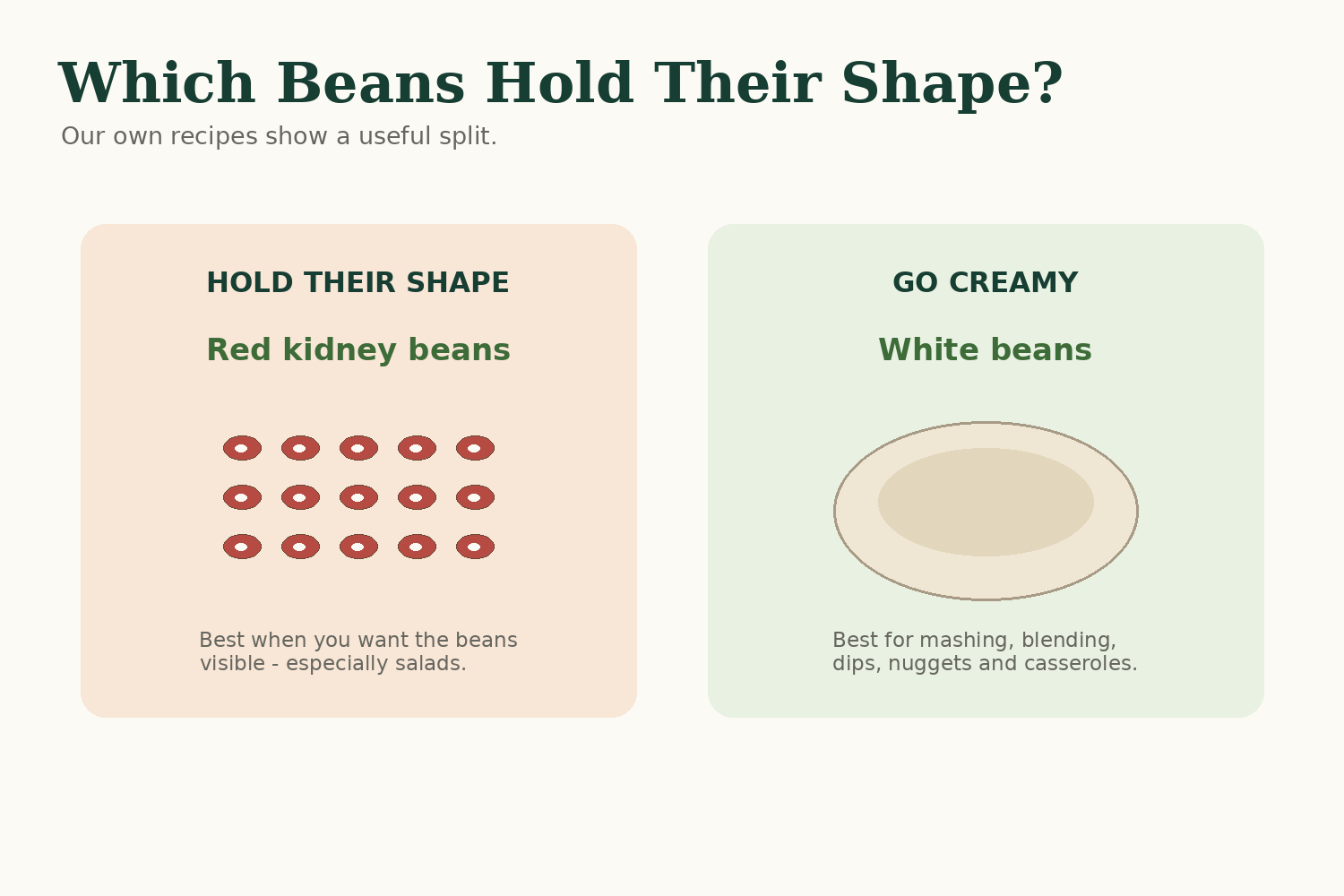
Our own recipes show the split. Red kidney beans appear in 12 of them, and 7 of those are salads. White beans appear in 9, and those are the ones we bake, mash and blend: four casseroles, a dip, a mash, a batch of nuggets and a soup. Only one is a salad.

That’s how our recipes use them, so at the store: kidney beans for anything you want to see whole, white beans for anything you want to mash or blend.
| Bean | Our recipes | Where we use it |
|---|---|---|
| Red kidney | 12 | 7 salads, plus a soup, a risotto, a scramble and baked sweet potato dishes |
| White (cannellini, navy, unspecified white) | 9 | 4 casseroles, a dip, a mash, nuggets, a soup, 1 salad |
| Mung | 2 | A stew and a patty mix |
| Black | 1 | Sweet potato black bean burgers |
| Butter | 1 | 10-minute bean dip |
| Giant (gigantes) | 1 | Baked beans with mushrooms |
| Unspecified (“cooked beans”) | 4 | A soup, a mash and two stuffed or sauced pepper dishes |
Two recipes use two kinds of bean, so the rows add up to more than 28.

Our white bean mash and white bean nuggets are both blended until smooth. Our bean and avocado salad keeps its beans whole.
Cannellini vs Great Northern Beans
Both are white varieties of the same species, Phaseolus vulgaris, and they’re often sold side by side.
- Cannellini are white kidney beans. They’re larger and kidney-shaped.
- Great northern beans are medium-sized white beans, and among the faster beans to cook: the Nebraska chart gives them 45 to 60 minutes, against 90 to 120 for kidney beans.
One difference matters for safety. Cannellini are kidney beans, and they carry the same lectin. The University of Illinois Extension puts it at about a third of the level in red kidney beans; the 2025 analysis measured about two-thirds. Either way, give dried cannellini the same full boil.
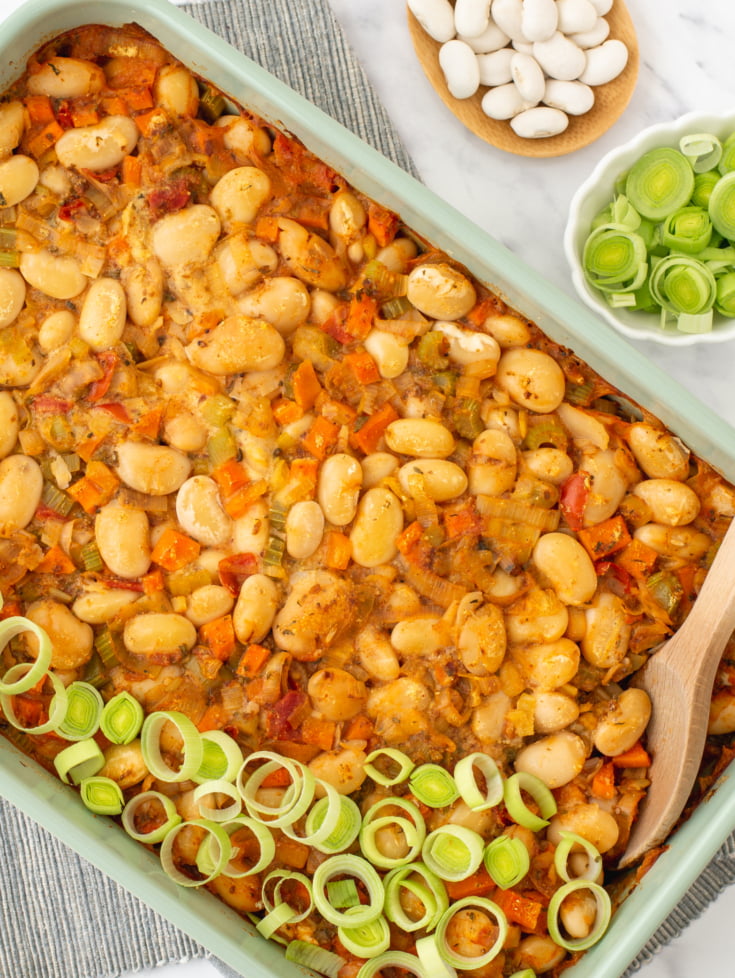
We cook with cannellini and white kidney beans in four recipes, including our bean and leek casserole and quick bean dip. We have no great northern recipes, but if you can’t find cannellini, great northern beans are the closest stand-in: in America’s Test Kitchen’s comparison they had more tender skins and slightly less creamy insides, and tasted nearly as good.
Canned or Dried Beans: What Differs
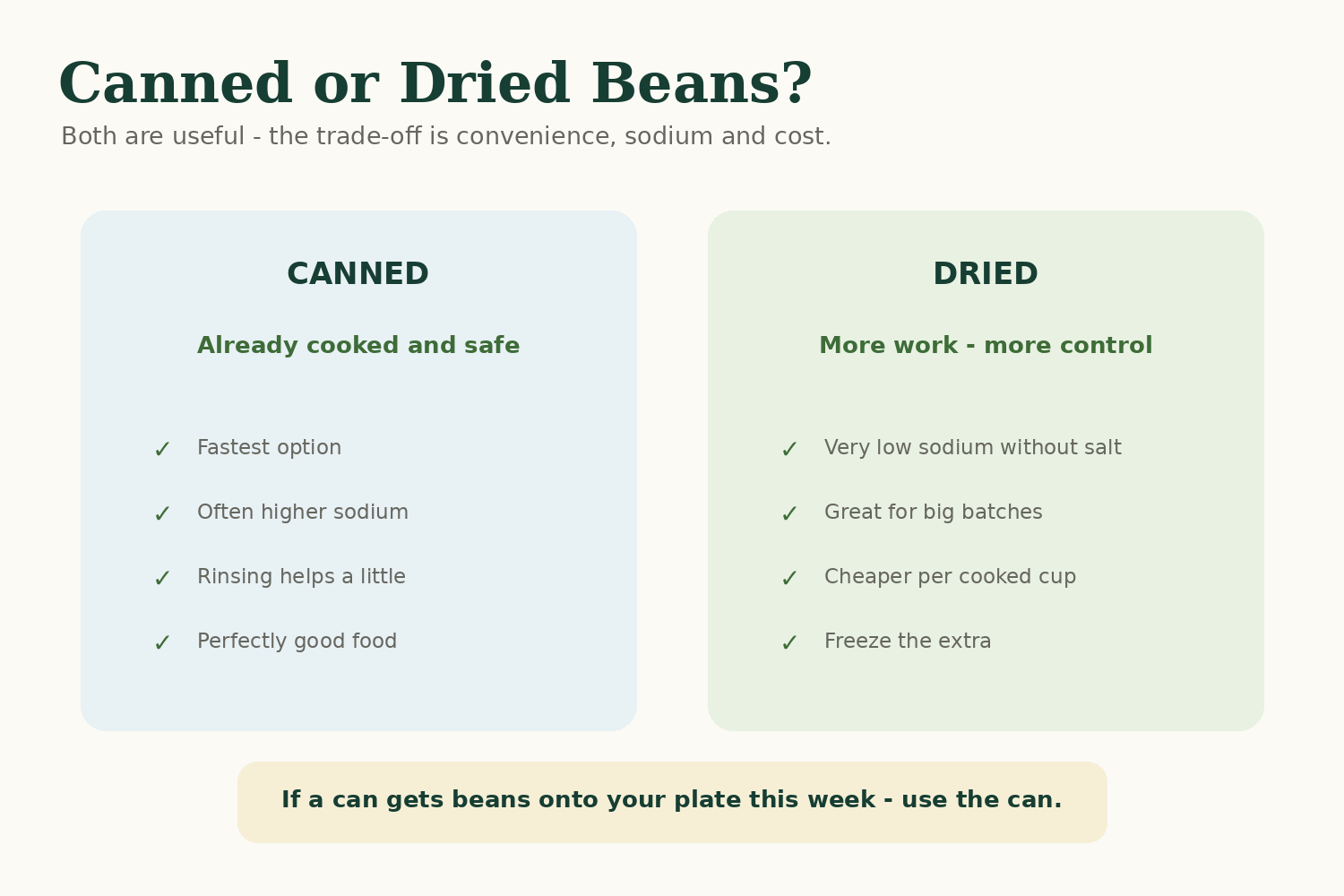
Canned beans are already safe. They’re fully cooked, and the lectin is more than 99% gone, so nothing in the hard-boil section applies to them.
Most of the salt in a can is inside the beans, so rinsing helps less than you’d think. Draining pours away the salty liquid, and rinsing the drained beans takes off only a little more. USDA measured canned beans drained, then drained and rinsed:
| Per 100 g | Drained | Drained and rinsed | Cooked from dried, no salt |
|---|---|---|---|
| Red kidney beans | 231 mg | 208 mg | 2 mg |
| Pinto beans | 239 mg | 212 mg | 1 mg |
| Chickpeas | 246 mg | 212 mg | 7 mg |
Rinsing removed only another 10 to 14 percent. A cup of drained, rinsed canned kidney beans still carries about 330 mg of sodium. The same cup cooked from dried without salt carries about 4 mg. If sodium matters to you, buy cans labeled no salt added, or cook from dried.
Canned beans are a perfectly good food. If a can is what gets beans onto your plate this week, use the can.
We use both. Our salads use canned red kidney beans, drained and rinsed: 7 of our 12 kidney bean recipes call for a can. Our big-batch dishes, like the bean and leek casserole and the clay-pot baked beans, start from dry. Our chickpeas guide works through the cost difference.
Salt the Soaking Water for Softer Beans
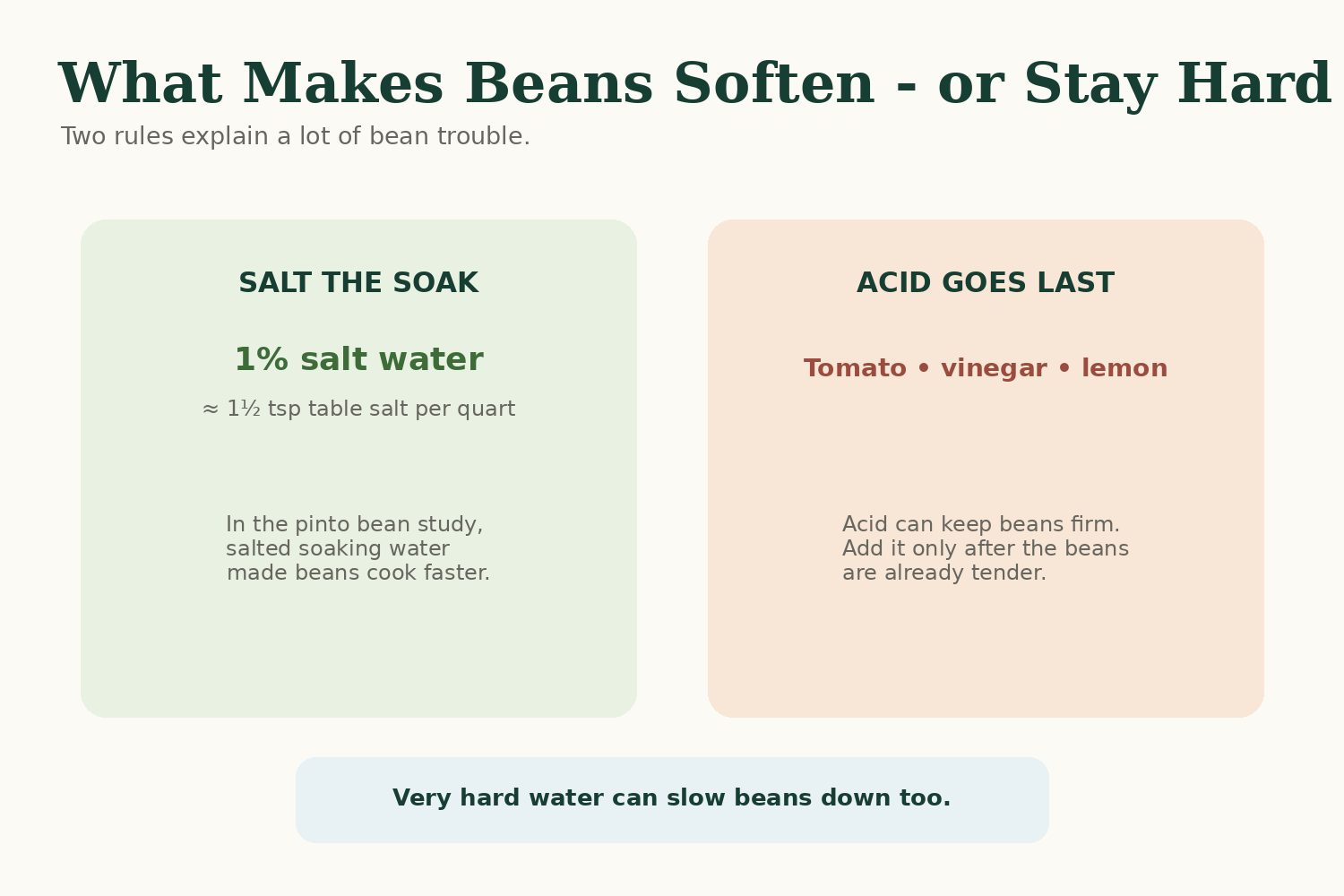
The old rule says salt toughens beans. In a 2023 study on pinto beans, it worked the other way, at least in the soak.
Beans soaked in 1% salt water cooked faster than beans soaked in plain water. That’s about 1½ teaspoons of table salt per quart. Beans soaked in baking soda water cooked fastest of all, but none of our recipes use it: the Nebraska extension warns that baking soda destroys thiamin, a B vitamin, and can give beans an off flavor.
Calcium works the other way. In a 2023 KU Leuven study, beans soaked in a calcium solution took longer to cook, because calcium stiffens the pectin that glues the bean’s cells together. That’s the likely reason hard water slows beans down.
Some extension services, Maine’s among them, still advise keeping salt out during cooking. The measured benefit is in the soak, so that’s where we’d put it.
Add Tomatoes to Beans Only After They’re Tender
Acid firms a bean up from the inside, in the cell walls that hold it together, so beans cooked with tomatoes can stay hard for hours. The University of Nebraska-Lincoln Extension puts it plainly: lemon juice, vinegar, tomatoes and wine “can prevent beans from becoming tender,” so add them after the beans are cooked.
That’s why our bean and leek casserole boils the beans until soft before the tomatoes join them.
Why Old Dried Beans Won’t Soften
If you’ve simmered beans for hours and they stayed gritty, with no acid in the pot, the bag was probably old. Very hard water and high altitude can slow them too.
Dried beans keep changing in storage. Food scientists call it the hard-to-cook defect: over time, and faster in warm, humid storage, the cell walls stiffen in ways that cooking no longer undoes. In the KU Leuven study, three months at 95°F (35°C) and high humidity was enough to lengthen the cooking time of the beans tested.
- Store dry beans somewhere cool and dry, in a sealed container. The University of Maine suggests using them within a year.
- Buy from a store that sells a lot of them, so the stock turns over.
What Beans Do in the Body
Beans are a starch food, like potatoes and rice, with an unusual amount of fiber on top: about 13 grams in a cup of cooked kidney beans. That fiber, and some of the starch, isn’t digested in the small intestine. Gut bacteria ferment it in the large intestine, and that fermentation seems to be behind some of what beans do for you, and much of the gas.
Beans eaten at dinner were still changing blood sugar at breakfast. In a 2013 Lund University trial, 16 healthy young adults ate either a dinner of Swedish brown beans or a dinner of white bread, then the same white bread breakfast the next morning.
After the bean dinner, their blood sugar response to breakfast was 23% lower and their insulin response 16% lower, 11 to 14 hours after they’d eaten the beans. The hydrogen on their breath, a marker of fermentation, was 141% higher. Researchers call this the second-meal effect: the beans were still working overnight.
Over years, legumes were the one food group that consistently went with living longer. That was in a study of 785 adults aged 70 and over in Japan, Sweden, Greece and Australia, followed for up to seven years. Every extra 20 grams a day of legume foods, about two tablespoons of cooked beans, went with a 7 to 8 percent lower risk of dying during the study.
The legumes were local: soy foods such as tofu and miso in Japan, brown beans and peas in Sweden, lentils, chickpeas and white beans around the Mediterranean. It’s an observational study, so it shows a link rather than proof.
Beans and Gas
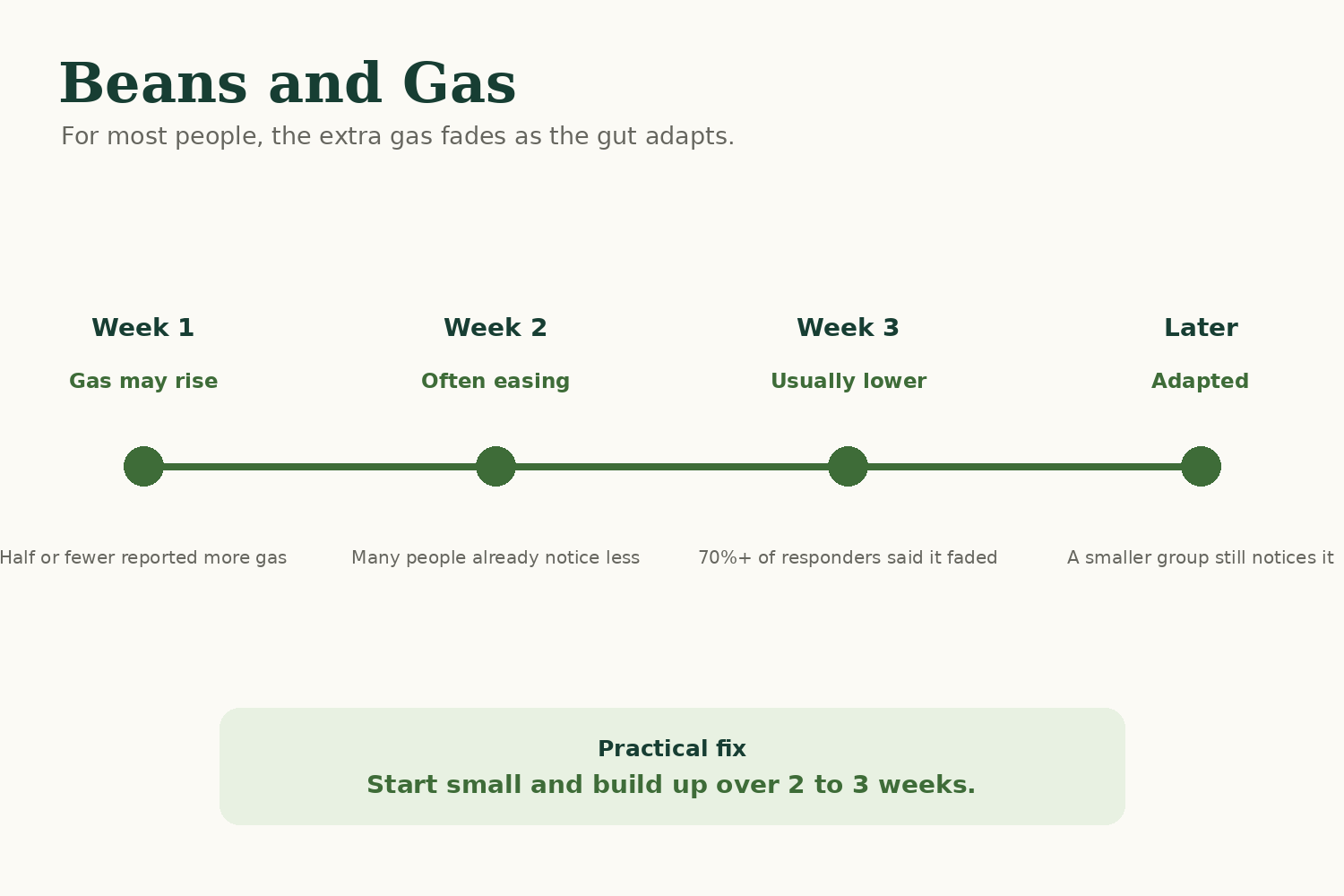
Bean gas comes from the same fermentation as the second-meal effect above, the one that sent breath hydrogen up the morning after the Lund bean dinner. For most people, the gas doesn’t last.
In three feeding studies where adults ate half a cup of beans a day for 8 to 12 weeks, half or fewer reported more gas in the first week of pinto or baked beans, and only 19% with black-eyed peas. Between 3 and 11 percent reported more gas on the control diets, with no beans in them at all.
And of the people who did notice more gas, 70 percent or more felt it had faded by the second or third week. A smaller group still noticed it weeks later.
That fading is your gut bacteria adjusting. In a 2017 Barcelona study, 10 healthy adults took a fermentable fiber supplement related to, though not the same as, the sugars in beans. Their gas production rose 37% at the start and was back to where it began after two weeks, because the bacteria had shifted toward ways of fermenting that make less gas. Two of the authors worked for the company that makes the supplement, so read it as a mechanism rather than a verdict.
So the fix for bean gas is a small daily amount, built up over two or three weeks. Our lentils guide has the 2-tablespoon ramp we use.
Cook Dried Beans Once, Freeze the Rest
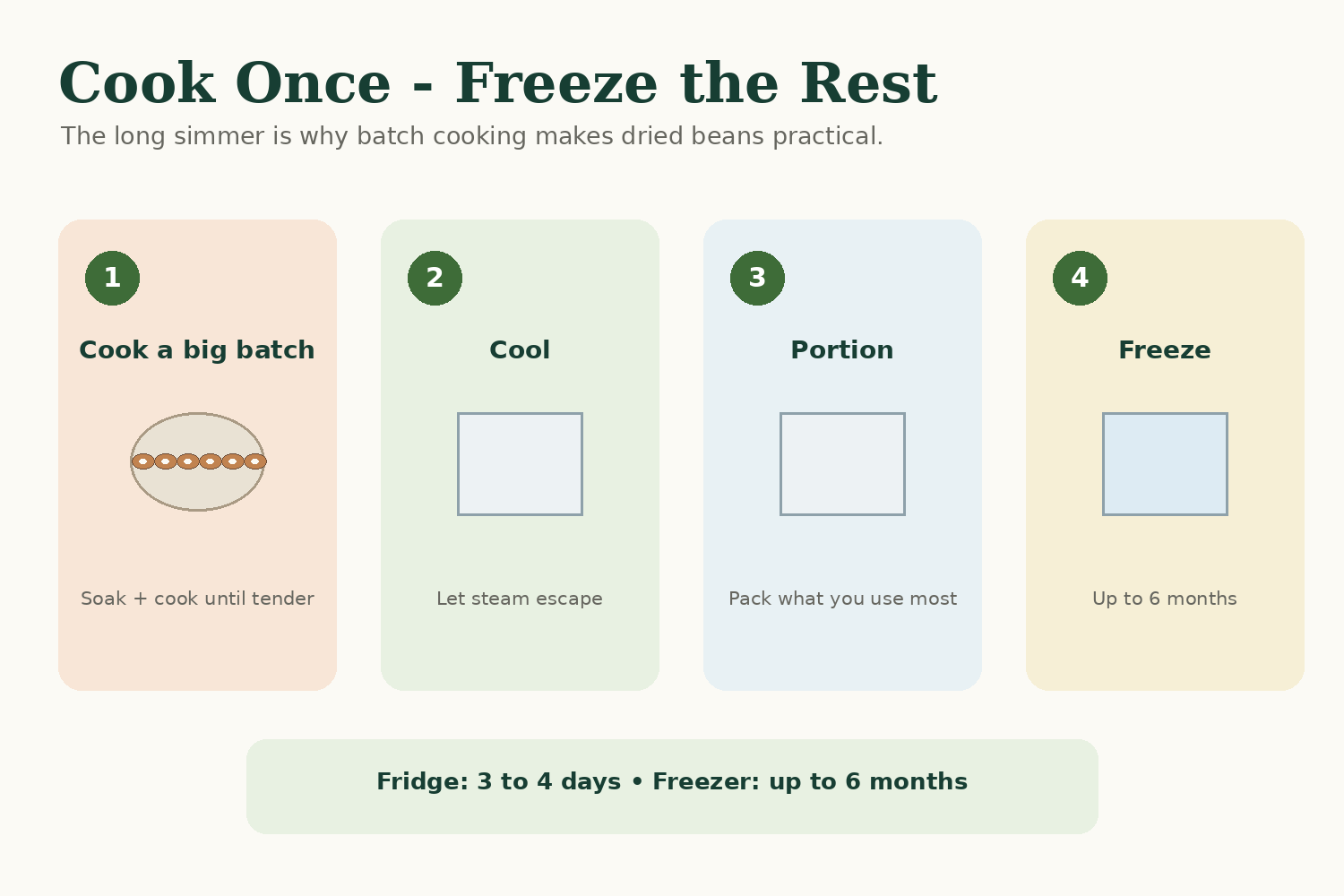
An hour and a half of simmering takes the same time for one cup of dried beans or four. Doing it every couple of weeks is what makes cooking from dried realistic.
The University of Maine gives cooked beans 3 to 4 days in the refrigerator and up to 6 months in the freezer. Freeze them in the portion you use most.
Dried Bean Troubleshooting
| What went wrong | Most likely why | What to do |
|---|---|---|
| They won’t soften after hours | Acid went in too early, the beans are old, or the water is very hard | If there’s no acid in the pot, suspect the beans first. Next time, buy from a store with more turnover |
| They’re taking far longer than the chart | Hard water, altitude or age | Salt the soak next time, and allow extra time at altitude |
| Firm in the middle, soft outside | Not cooked long enough | Keep going and test every 10 minutes |
| They taste flat | No salt at any stage | Salt the soak, and season the finished dish |
| More gas than you’d like | A sudden jump in quantity | Drain the soaking water, and build up over 2 or 3 weeks |
| Someone got sick within hours of eating beans | Undercooked beans, usually kidney beans | A full, rolling boil before any gentle cooking, and never dried beans straight into a slow cooker. In a child who keeps vomiting, get medical help |
Where to Start With Dried Beans
Start with a bag of white beans. Put them to soak when the dinner dishes are done, and the next day make our bean and leek casserole, which boils the beans soft before the tomatoes go in.
And, always, seek health consciously.
Read Next
- Chickpeas: Canned or Dried, and How to Cook Them
- Lentils: Which Kind to Buy, and How to Cook Each One
- Vegan Meatballs, Patties and Burgers: What Holds Them Together
- Sprouting at Home: Which Sprouts Are Worth It, and How to Grow Them
- Bread Without Flour: How It Works, and Which Loaf to Make
- 13 Oil-Free Vegan Dinners, Fastest First
Sources (22)
- University of Nebraska-Lincoln Extension. How to cook dry beans from scratch. Colgrove K, Henneman A. View
- Yerxa K. How to store and cook dried beans. University of Maine Cooperative Extension; 2021, updated 2025. View
- Didinger C, Cichy K, Urrea CA, Scanlan M, Thompson H. The effects of elevation and soaking conditions on dry bean cooking time. Legume Science. 2023;5(4):e207. View
- Thompson HJ, Neil ES, McGinley JN, Lutsiv T. Toward standardized measurement of active phytohemagglutinin in common bean, Phaseolus vulgaris, L. Foods. 2025;14(24):4247. View
- Rodhouse JC, Haugh CA, Roberts D, Gilbert RJ. Red kidney bean poisoning in the UK: an analysis of 50 suspected incidents between 1976 and 1989. Epidemiology and Infection. 1990;105(3):485-491. View
- U.S. Food and Drug Administration. Bad Bug Book: Handbook of Foodborne Pathogenic Microorganisms and Natural Toxins, 2nd ed. Phytohaemagglutinin (kidney bean lectin). View
- Peterson L. Kidney beans and slow cookers. University of Illinois Extension; 2024. View
- Centre for Food Safety, Hong Kong. Phytohaemagglutinin poisoning. View
- Watier-Grillot S, Larréché S, Mazuet C, et al. From foodborne disease outbreak (FBDO) to investigation: the plant toxin trap, Brittany, France, 2018. Toxins. 2023;15(7):457. View
- Haile AM, Mengistie BT, Teshager AA, Belisa TK, Zewde EB, Deress AS. Severe red kidney beans toxicity in an 8-year-old girl: a rare case of hypovolemic shock and prerenal acute kidney injury. International Journal of Emergency Medicine. 2026;19(1):49. View
- U.S. Department of Agriculture. Beans, kidney, red, canned, drained solids (FDC 174285); drained solids, rinsed in tap water (FDC 175243); cooked, boiled, without salt (FDC 175194). FoodData Central, SR Legacy. View
- U.S. Department of Agriculture. Beans, pinto, canned, drained solids (FDC 174286); drained solids, rinsed in tap water (FDC 173797); cooked, boiled, without salt (FDC 175200). FoodData Central, SR Legacy. View
- U.S. Department of Agriculture. Chickpeas, canned, drained solids (FDC 173800); drained, rinsed in tap water (FDC 173801); cooked, boiled, without salt (FDC 173757). FoodData Central, SR Legacy. View
- Zhu L, Che AJC, Kyomugasho C, Chen D, Hendrickx M. Effect of bio-chemical changes due to conventional ageing or chemical soaking on the texture changes of common beans during cooking. Food Research International. 2023;173(Pt 2):113377. View
- Liu K. Cellular, biological, and physicochemical basis for the hard-to-cook defect in legume seeds. Critical Reviews in Food Science and Nutrition. 1995;35(4):263-298. View
- Nilsson A, Johansson E, Ekström L, Björck I. Effects of a brown beans evening meal on metabolic risk markers and appetite regulating hormones at a subsequent standardized breakfast: a randomized cross-over study. PLoS One. 2013;8(4):e59985. View
- Darmadi-Blackberry I, Wahlqvist ML, Kouris-Blazos A, et al. Legumes: the most important dietary predictor of survival in older people of different ethnicities. Asia Pacific Journal of Clinical Nutrition. 2004;13(2):217-220. View
- Winham DM, Hutchins AM. Perceptions of flatulence from bean consumption among adults in 3 feeding studies. Nutrition Journal. 2011;10:128. View
- Mego M, Accarino A, Tzortzis G, et al. Colonic gas homeostasis: mechanisms of adaptation following HOST-G904 galactooligosaccharide use in humans. Neurogastroenterology and Motility. 2017;29(9):e13080. View
- Sheeran P, Listrom O, Gollwitzer PM. The when and how of planning: meta-analysis of the scope and components of implementation intentions in 642 tests. European Review of Social Psychology. 2025;36(1):162-194. View
- Colorado State University Extension. Cooking dry beans. View
- America’s Test Kitchen. Cannellini bean substitute. View