


A tablespoon of seed, a jar, and less than a week. That is the entire supply chain.
Nothing else you eat has a shorter one. No field, no truck, no packaging, no shop. You rinse a jar twice a day and food appears on your windowsill for pennies.
And one sprout is worth more attention than the rest of them put together: broccoli, which is not the one most people grow.
The short answer: Grow broccoli sprouts. They carry far more of the compound that makes broccoli worth eating than mature broccoli does, they cost pennies, and they are ready in three to five days. Soak the seed overnight, drain it into a jar with a mesh lid, rinse morning and evening, keep the jar tilted so it drains. Start with one small jar, not a big tray. And raw sprouts are not for everyone: if you are pregnant, elderly, very young or immunocompromised, cook them or skip them.
Why Broccoli Sprouts Are the One Worth Growing
Broccoli contains a compound called glucoraphanin. On its own it does little: without the plant’s enzyme, your gut bacteria convert only a small share of it.
Damage the plant, by chopping or chewing it, and an enzyme the plant keeps in separate cells meets that compound and converts it into sulforaphane. Work at Johns Hopkins in the 1990s, led by Paul Talalay, identified it as one of the most powerful natural switches for the body’s own defensive enzyme systems.
The sprout carries dramatically more of the precursor than the grown vegetable. Talalay’s group published the figure in the Proceedings of the National Academy of Sciences in 1997. Three-day-old sprouts of broccoli and cauliflower carried 10 to 100 times the glucoraphanin of the mature plants, gram for gram of fresh weight. Talalay’s own shorthand when Hopkins announced it was that three-day-old sprouts hold 20 to 50 times the protective compounds of a mature head.
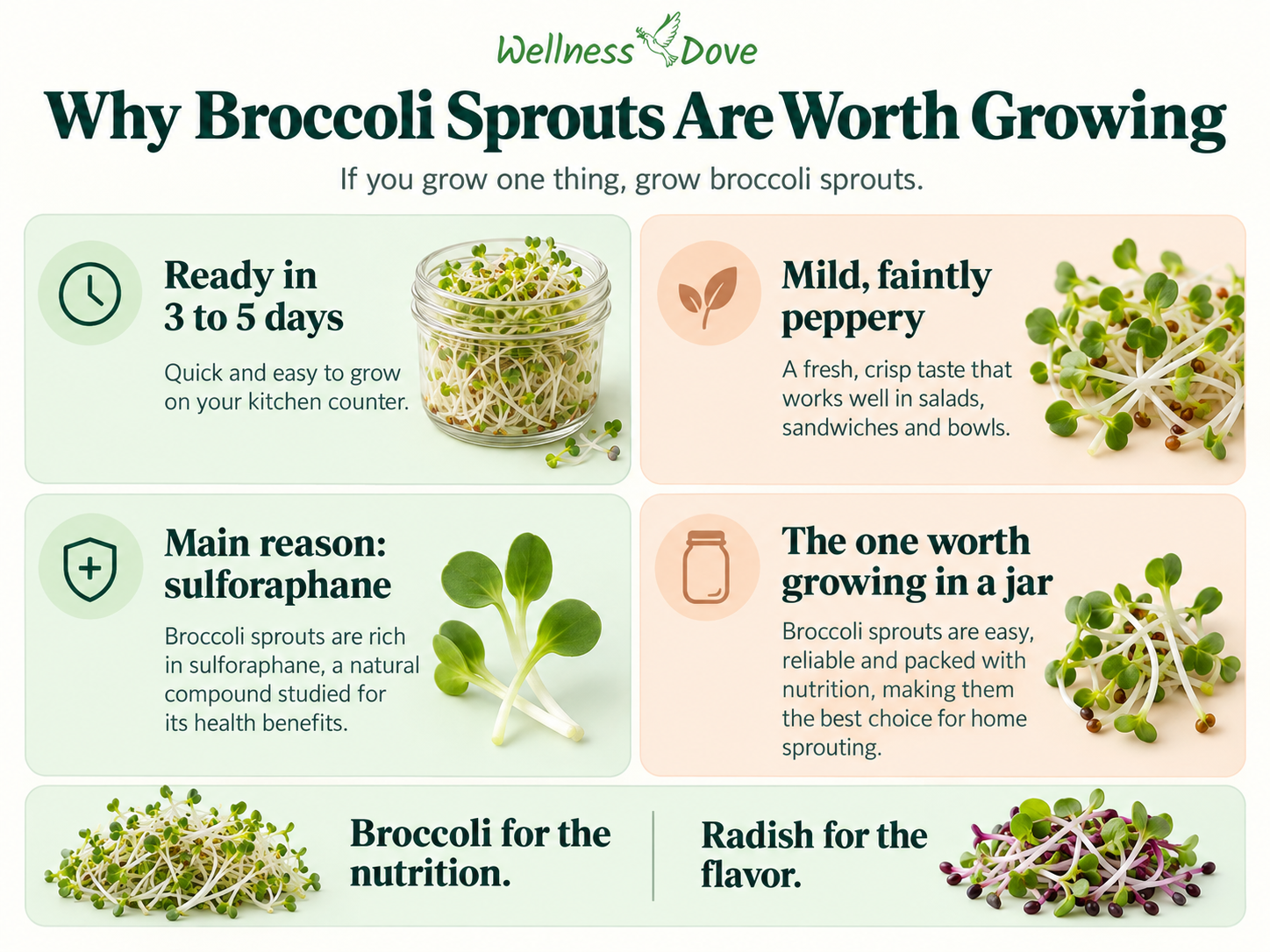
The case rests entirely on that, and it is unusual. Most of the time the mature vegetable is the better food. Here the seedling wins, and it wins by a distance.
Harvest between day three and day five. That is the window the measurements point at. One study tracking sprouts across their growth found sulforaphane highest at day 5, measured per gram of dried sprout, with days two to five all well ahead of the later ones.
So there is no need to rush them out of the jar, and nothing is gained by leaving them a week. Trials have used a median of about 100 micromoles of sulforaphane a day. In one of them, that took 111 grams of blended fresh sprouts, around three cups. A handful is a smaller dose than the trials used, and at seed prices even the full amount is pennies.
Which sprouts to grow, and what each is for
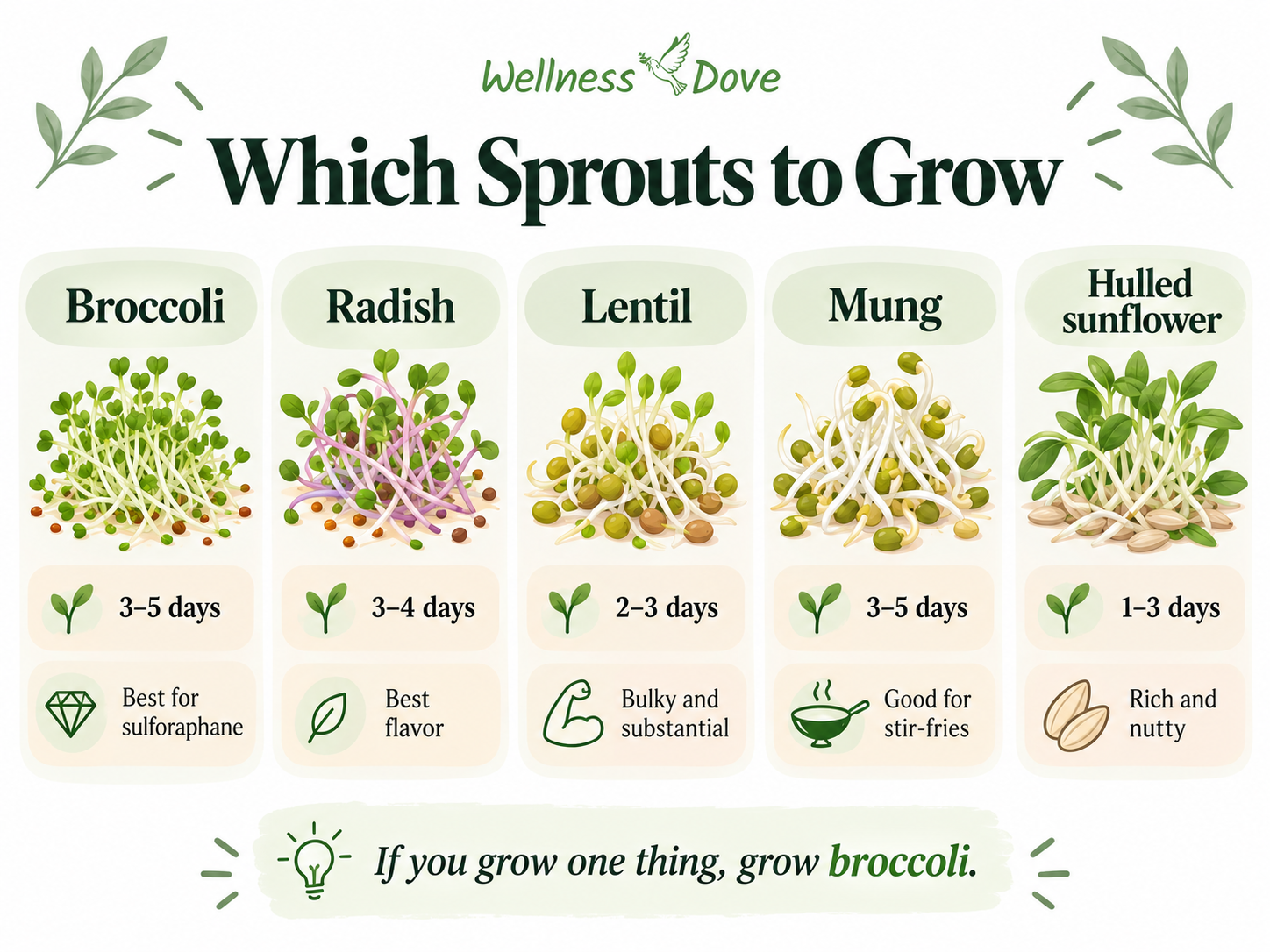
| Seed | Ready in | Tastes like | Why bother |
|---|---|---|---|
| Broccoli | 3 to 5 days | Mild, faintly peppery | The sulforaphane. The reason to own a jar |
| Radish | 3 to 4 days | Hot, properly peppery | Also a crucifer. Best flavor of the lot |
| Lentil | 2 to 3 days | Nutty, substantial | Bulk. Goes in salads by the handful |
| Mung | 3 to 5 days | Crunchy, watery | Stir-fries, and it cooks well |
| Sunflower (hulled) | 1 to 3 days | Rich, nutty | The one we put in salads whole. The tall shoots you see in restaurants are microgreens, grown in a tray for a week or more, not a jar crop |
If you grow one thing, grow broccoli. If you grow two, add radish, because it is a crucifer as well and it actually tastes of something.
How to Grow Sprouts at Home in a Jar
You need a jar, a mesh lid, seeds sold for sprouting, and a windowsill. That is all.
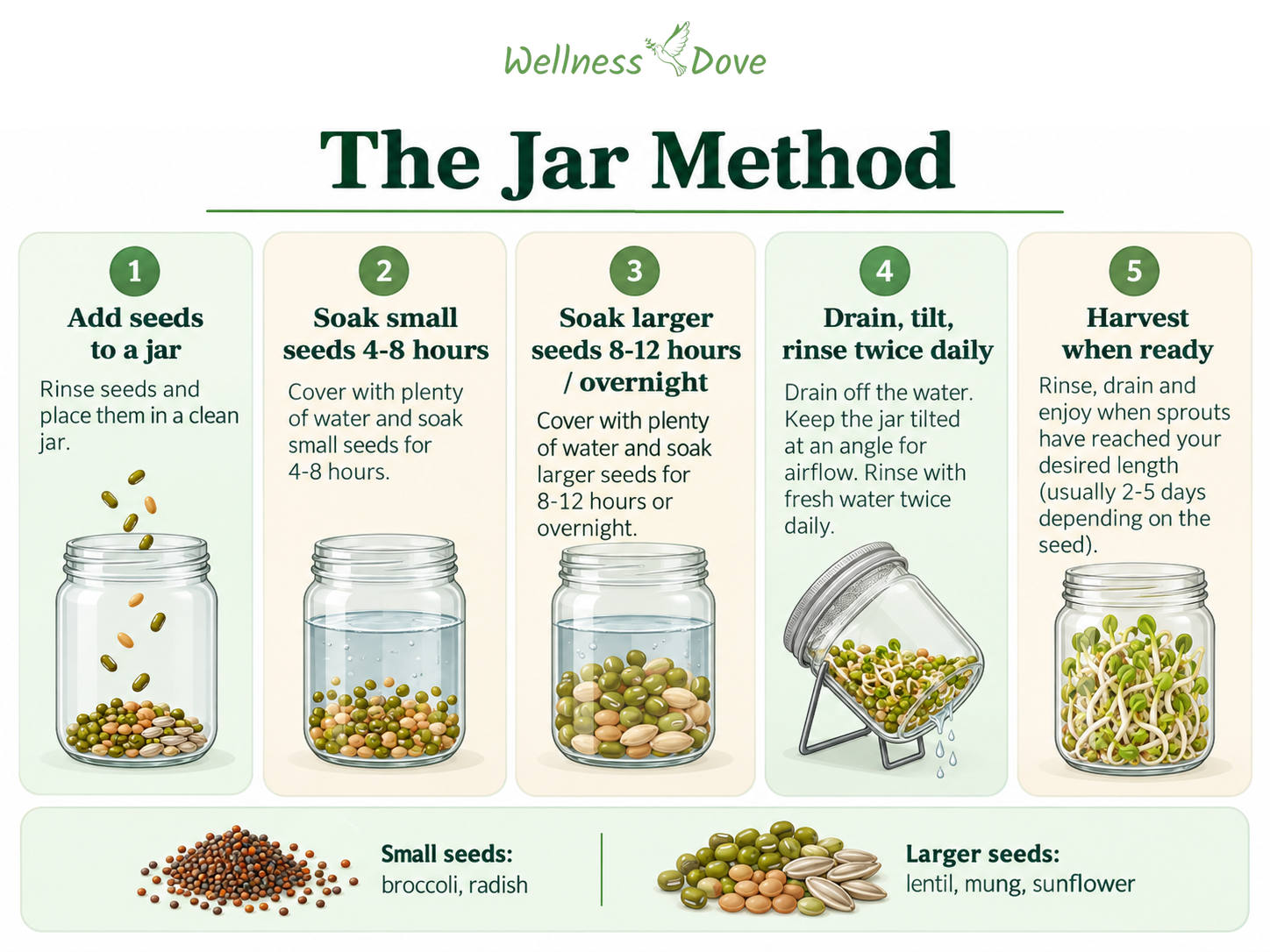
- Soak. One to two tablespoons of seed, covered with plenty of cool water. Small seed such as broccoli and radish needs four to eight hours. Larger seed such as lentil, mung and sunflower wants eight to twelve, or overnight.
- Drain and rinse. Tip the water away, rinse with fresh water, drain again thoroughly. This moment is day zero, and the harvest times below all count from here.
- Tilt the jar. Mesh side down at an angle, in a bowl or a rack, so water keeps draining and air keeps moving. Sitting water is what ruins a batch.
- Rinse twice a day. Morning and evening. Fresh water in, swirl, tip it all out, back on the tilt.
- Harvest. Broccoli at three to five days, lentil at two to three, radish at three to four, mung at three to five, hulled sunflower at one to three. Rinse, drain well, and store in the fridge in a sealed container.
A useful rule for grains and legumes, if you are sprouting those: the shoot should be no longer than the seed itself. Longer than that and the texture turns against you.
Andy: We own an automatic sprouter with three stackable trays. It sat on top of the fridge gathering dust for months, and one afternoon I picked it up to carry it down to the basement. I stopped on the way, because binning a machine that grows one of the healthiest foods there is felt absurd. Then I worked out why we had stopped using it: we had been running all three trays every cycle.
Three trays is an industrial quantity of sprouts.
It was a lot of work to produce and then an obligation to eat, and both ends became a chore. We run one tray now. The dose that makes something a chore is the dose that ends it, and in my experience ambition is one of the most common reasons people abandon a health habit. One jar on the windowsill, which our son checks every morning, beats three trays nobody wants to empty.
Sprout Safety, and Who Should Not Eat Them Raw
This section exists because sprouts are genuinely different from other vegetables, and most writing about them skips it.
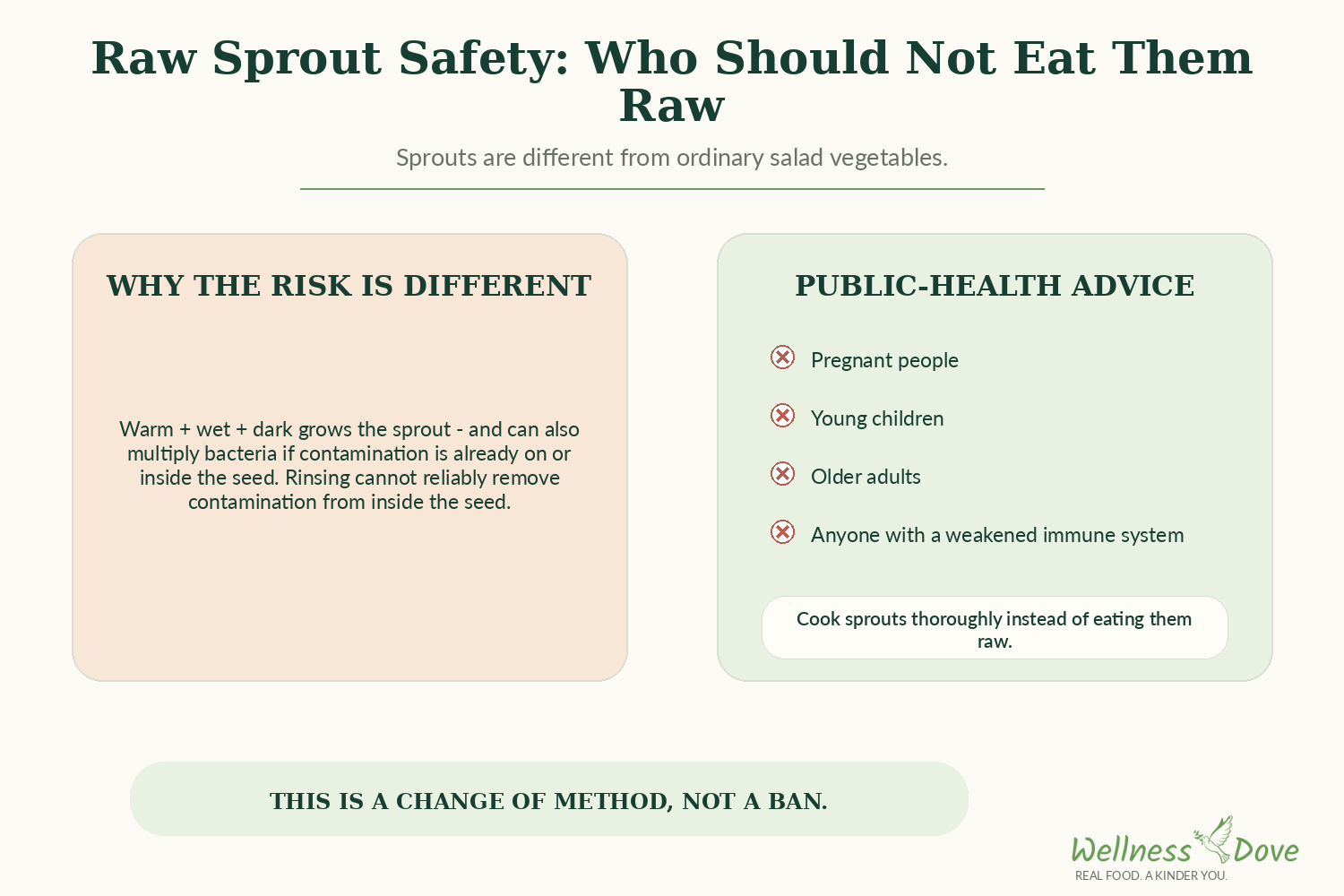
The conditions that turn a seed into a sprout are warm, wet and dark for several days. Those are also close to ideal conditions for bacteria. If anything harmful is present on the seed, sprouting multiplies it instead of washing it away. Rinsing does not undo that, because the contamination can sit inside the seed and not just on the surface.
This is not theoretical. As of the CDC’s update on 1 September 2026 the FDA and CDC were still investigating an outbreak of E. coli and Salmonella traced to alfalfa sprouts, with 55 illnesses and 4 hospitalizations across 15 states. On 28 August the recall was extended to a radish sprout mix from the same grower, so this is not only an alfalfa problem.
Venny: The public health advice is specific and I am not going to soften it. Children, older adults, pregnant women and anyone with a weakened immune system should not eat raw or lightly cooked sprouts of any kind, home-grown included. That covers people on chemotherapy, people with diabetes, and anyone on immunosuppressant medication.
Lightly is the word that catches people out: a quick toss through a stir-fry at the end is not cooking them.
Cooking sprouts thoroughly kills the bacteria, and they are excellent cooked, so this is a change of method rather than a ban. For everybody else, growing your own is reasonable, and the practical steps below genuinely reduce the risk rather than pretending it away.
How to reduce the risk
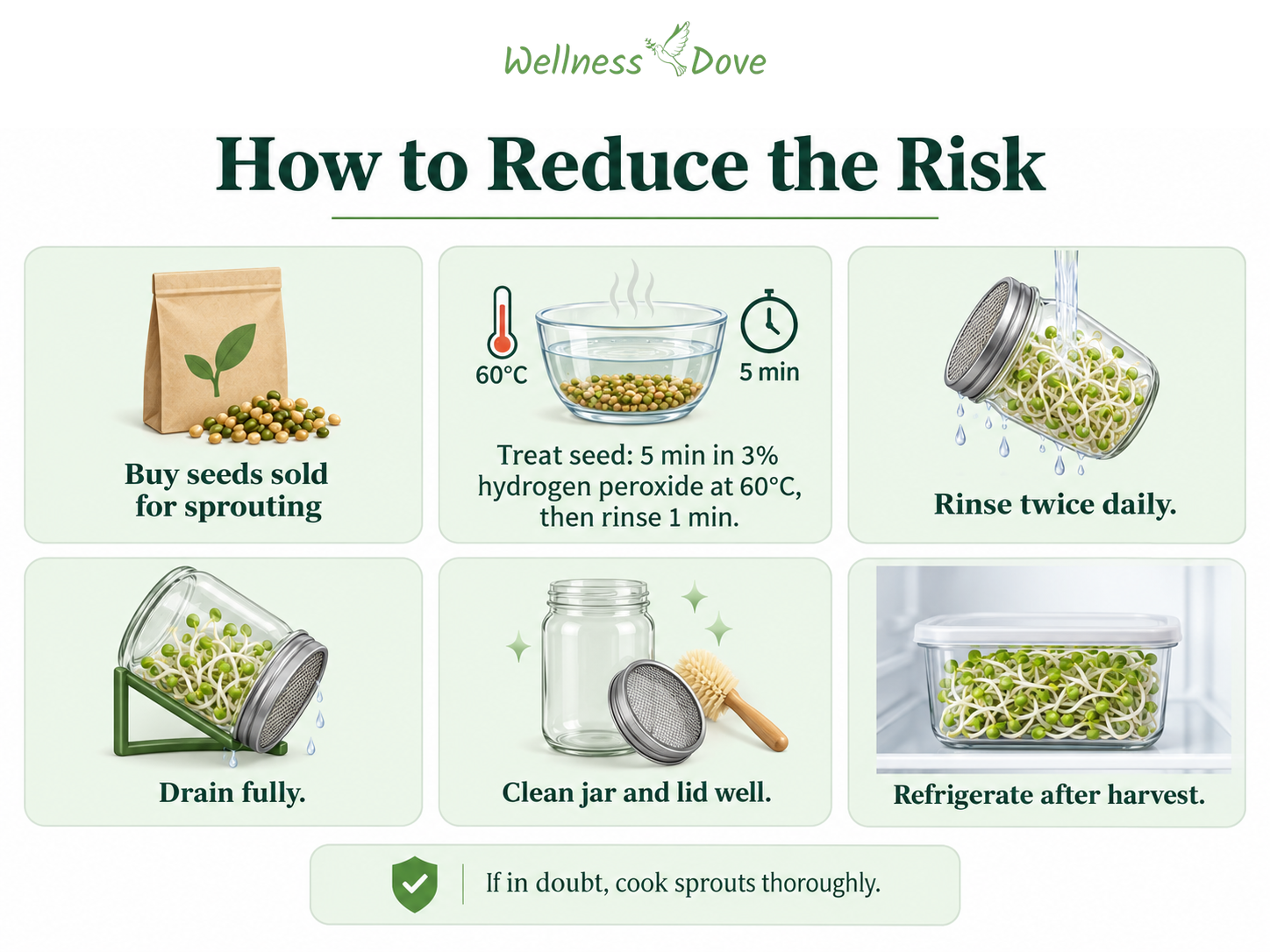
- Buy seed sold for sprouting. Not garden seed, which is not produced to be eaten and is sometimes treated.
- Treat the seed before you soak it. Heat it for five minutes in 3% hydrogen peroxide held at 60°C, checked with a thermometer, then rinse it under running water for a minute and throw the solution away. This is the treatment University of California food-safety specialists recommend for home sprouters, and the one most home guides leave out. It lowers the risk; it does not remove it.
- Rinse twice a day without fail, and three or four times in warm weather. Drain properly each time. Standing water is the problem.
- Keep the jar and lid genuinely clean between batches, the way you would a chopping board that had raw meat on it.
- Use your nose. Sprouts should smell green and faintly sweet. Anything sour, musty or off, and the batch goes in the bin. Do not rinse it and carry on.
- Refrigerate once harvested, and eat them within a few days.
A correction we owe you about alfalfa
We have an alfalfa sprout salad on this site that has been popular for years, and it is enthusiastic about alfalfa in a way we would not write today.
Alfalfa has been linked to more outbreaks than any other sprout, and damaged, wrinkled seed in particular shelters bacteria in the crevices of the seed coat, where rinsing cannot reach. It is also, nutritionally, the least interesting sprout on the list, with the least vitamin C and folate of the common sprouts.
So if you were going to grow alfalfa because a page here told you it was easy, grow broccoli instead. You get a better food and the least troublesome seed in the same swap.
The Chopping Trick That Makes the Sulforaphane
This applies to every crucifer in your kitchen, not just sprouts, and almost nobody knows it.
The enzyme and the precursor are stored in different cells of the plant. They only meet when you break those cells open. The useful compound does not exist in the vegetable. You make it, with a knife or with your teeth.
The enzyme is also destroyed by heat, while the precursor is not. Which produces two practical rules:
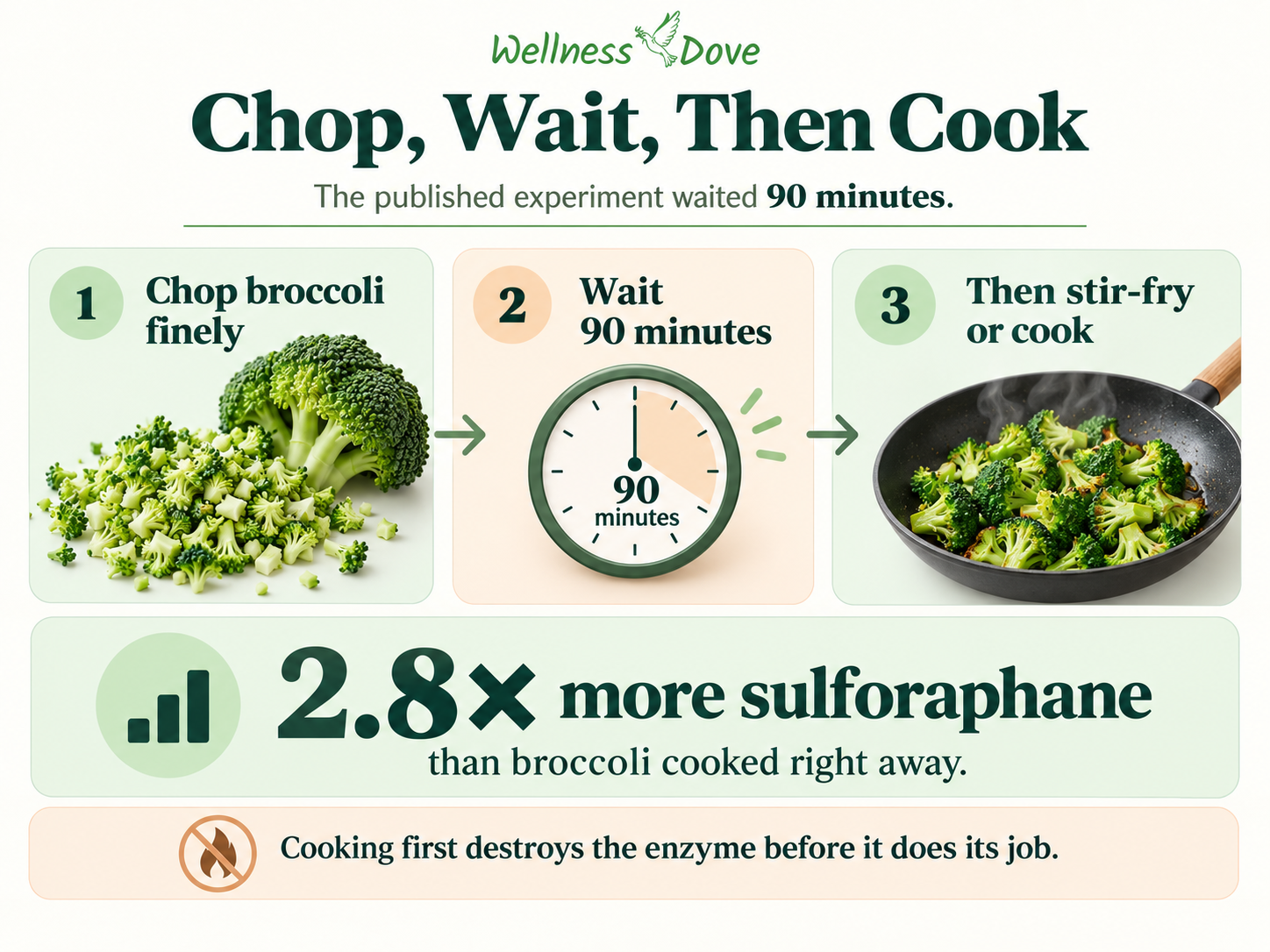
- Chop, then wait, then cook. The published experiment held finely chopped broccoli for ninety minutes before stir-frying and got 2.8 times the sulforaphane of broccoli that went straight into the pan. Shorter waits weren’t tested and probably help less. Once formed, the sulforaphane holds up far better in the pan than the enzyme does, so a short stir-fry keeps most of it. Most people cook first, which destroys the enzyme before it has done its job.
- Or add a pinch of mustard powder at the table. Mustard is a cruciferous seed and it brings its own enzyme. Sprinkled over broccoli you have already cooked, or over frozen greens, it restarts the reaction. Grated daikon radish has been shown to do the same job, and horseradish and wasabi probably do.
Raw sprouts skip the problem entirely, because you are chewing them and nothing was heated. That is the real argument for eating some crucifers raw, and it is a much better one than anything about enzymes being alive.
Sprouting Troubleshooting
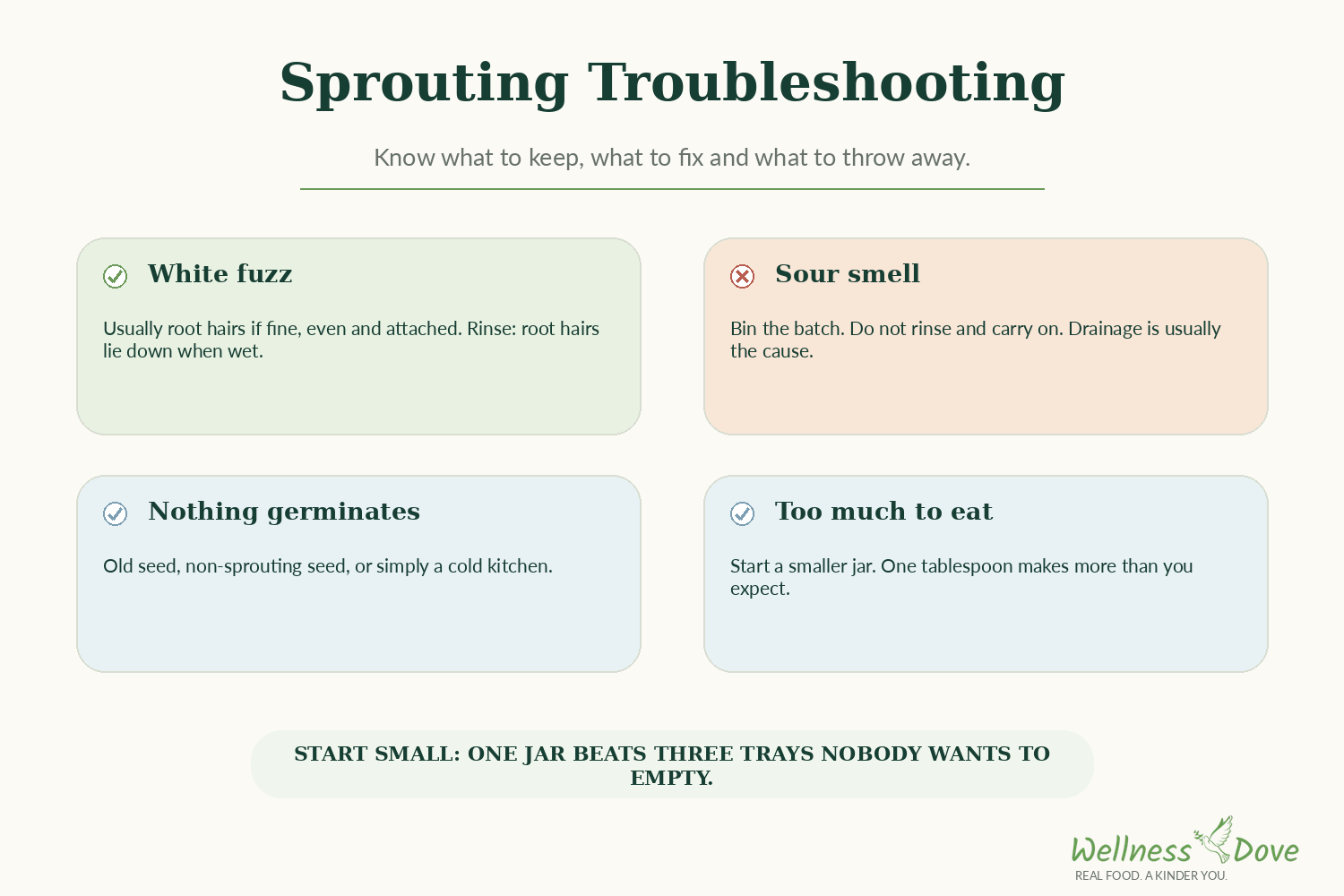
There is white fuzz on my sprouts
Usually root hairs, not mould, and they are a sign of a healthy batch. Root hairs are fine, even, and attached to the sprout itself. Mould is patchy, grey or colored, sits in clumps, and smells wrong.
Rinse and look again in an hour. Root hairs lie down when wet. If it still looks like a spider web across the whole jar, throw the batch away.
They smell sour
Bin them. Do not try to rescue a batch that smells wrong, and do not taste it to check.
The cause is nearly always drainage. Water pooling at the bottom of the jar, or rinsing once a day instead of twice in warm weather.
Nothing is germinating
Old seed, or seed that was never meant for eating. Sprouting seed has a shelf life and garden seed is a different product.
It can also just be cold. A kitchen at 18°C will take noticeably longer than one at 22°C.
I grew far more than we can eat
Start a smaller jar. One tablespoon of broccoli seed makes a surprising amount, and sprouts do not keep well enough to justify a big batch.
What to Do With Them
Sprouts are a finishing ingredient. A handful on top of something already made, not the base of a dish.
- Arugula and Sunflower Sprout Salad: the one where sprouts are the point, with a sunflower seed butter dressing.
- Avocado Chickpea Sandwich Spread: a handful on top of this, in a sandwich, is the easiest place to start.
- Einkorn Nuggets: sprouted grain rather than sprouted seed, and a good use for a jar of wheat berries.
- Scattered over any bowl of soup at the table, where they stay crisp.
Venny is a medical doctor and a specialist in Nutrition and Dietetics; Andy holds a master’s degree in psychology. This is general information rather than medical advice. The guidance on raw sprouts referenced above comes from the US Food and Drug Administration, the Centers for Disease Control and Prevention, and University of California food-safety specialists.
Where to Start With Sprouting
Buy broccoli sprouting seed. Put one tablespoon in a jar tonight with water over it.
Drain it in the morning, rinse it twice a day, and eat it three to five days later. One jar, not three.
And, always, seek health consciously.
Read Next
- Cooking Without Oil: What Actually Replaces It
- Potatoes: The Most Filling of 38 Foods Tested, and the Case Against Them
- Bread Without Flour: How It Works, and Which Loaf to Make
Sources (17)
- Yagishita Y, Fahey JW, Dinkova-Kostova AT, Kensler TW. Broccoli or sulforaphane: is it the source or dose that matters? Molecules. 2019;24(19):3593. View
- Zhang Y, Talalay P, Cho CG, Posner GH. A major inducer of anticarcinogenic protective enzymes from broccoli: isolation and elucidation of structure. Proceedings of the National Academy of Sciences. 1992;89(6):2399-2403. View
- Fahey JW, Zhang Y, Talalay P. Broccoli sprouts: an exceptionally rich source of inducers of enzymes that protect against chemical carcinogens. Proceedings of the National Academy of Sciences. 1997;94(19):10367-10372. View
- Johns Hopkins Medical Institutions. Cancer protection compound abundant in broccoli sprouts [press release]. 19 September 1997. View
- Tian M, Xu X, Hu H, Liu Y, Pan S. Optimisation of enzymatic production of sulforaphane in broccoli sprouts and their total antioxidant activity at different growth and storage days. Journal of Food Science and Technology. 2017;54(1):209-218. View
- Müller L, Meyer M, Bauer RN, et al. Effect of broccoli sprouts and live attenuated influenza virus on peripheral blood natural killer cells: a randomized, double-blind study. PLoS One. 2016;11(1):e0147742. View
- U.S. Department of Agriculture. FoodData Central, SR Legacy: alfalfa (FDC 168384), mung (169957), radish (170095) and lentil (168427) sprouts, raw. View
- U.S. Food and Drug Administration. Selecting and serving produce safely. View
- Taormina PJ, Beuchat LR, Slutsker L. Infections associated with eating seed sprouts: an international concern. Emerging Infectious Diseases. 1999;5(5):626-634. View
- Itoh Y, Sugita-Konishi Y, Kasuga F, et al. Enterohemorrhagic Escherichia coli O157:H7 present in radish sprouts. Applied and Environmental Microbiology. 1998;64(4):1532-1535. View
- Centers for Disease Control and Prevention. E. coli and Salmonella outbreak linked to alfalfa sprouts. Updated 1 September 2026. View
- Suslow TV, Harris LJ. Growing seed sprouts at home. Publication 8151. University of California Agriculture and Natural Resources; 2004. View
- Charkowski AO, Sarreal CZ, Mandrell RE. Wrinkled alfalfa seeds harbor more aerobic bacteria and are more difficult to sanitize than smooth seeds. Journal of Food Protection. 2001;64(9):1292-1298. View
- Ghawi SK, Methven L, Niranjan K. The potential to intensify sulforaphane formation in cooked broccoli using mustard seeds (Sinapis alba). Food Chemistry. 2013;138(2-3):1734-1741. View
- Wu Y, Shen Y, Wu X, et al. Hydrolysis before stir-frying increases the isothiocyanate content of broccoli. Journal of Agricultural and Food Chemistry. 2018;66(6):1509-1515. View
- Okunade O, Niranjan K, Ghawi SK, Kuhnle G, Methven L. Supplementation of the diet by exogenous myrosinase via mustard seeds to increase the bioavailability of sulforaphane in healthy human subjects after the consumption of cooked broccoli. Molecular Nutrition and Food Research. 2018;62(18):e1700980. View
- Dosz EB, Jeffery EH. Modifying the processing and handling of frozen broccoli for increased sulforaphane formation. Journal of Food Science. 2013;78(9):H1459-H1463. View