

Take the oil out of a salad dressing and you are left with lemon juice, which is not a dressing. It is just wet.
The thing that replaces the oil is a whole nut or seed, blended with water until it turns creamy. We have been making dressings this way for years and we have never once written down the ratio.
So here it is, along with the fix for the problem every one of these has at some point, which is coming out too thin.
The short answer: 1 part raw nut or seed to 1 or 2 parts water, blended for several minutes, plus an acid and something salty. Cashews at 1:1 give you a thick sauce. Sunflower seeds at 1:2 give you a pourable dressing. If it comes out too thin, add more nut, never less water, because the water is already in there. It will thicken again in the fridge, and a splash of water and a shake brings it back.
The Ratio Behind Every Oil-Free Salad Dressing
Oil is an emulsion you buy ready-made. A nut is an emulsion you have to build, and water is what builds it.
We went back through every dressing, sauce and dip on this site and measured what we had actually been doing. The pattern is consistent enough to use as a rule.
| Ratio by volume | What you get | Our example |
|---|---|---|
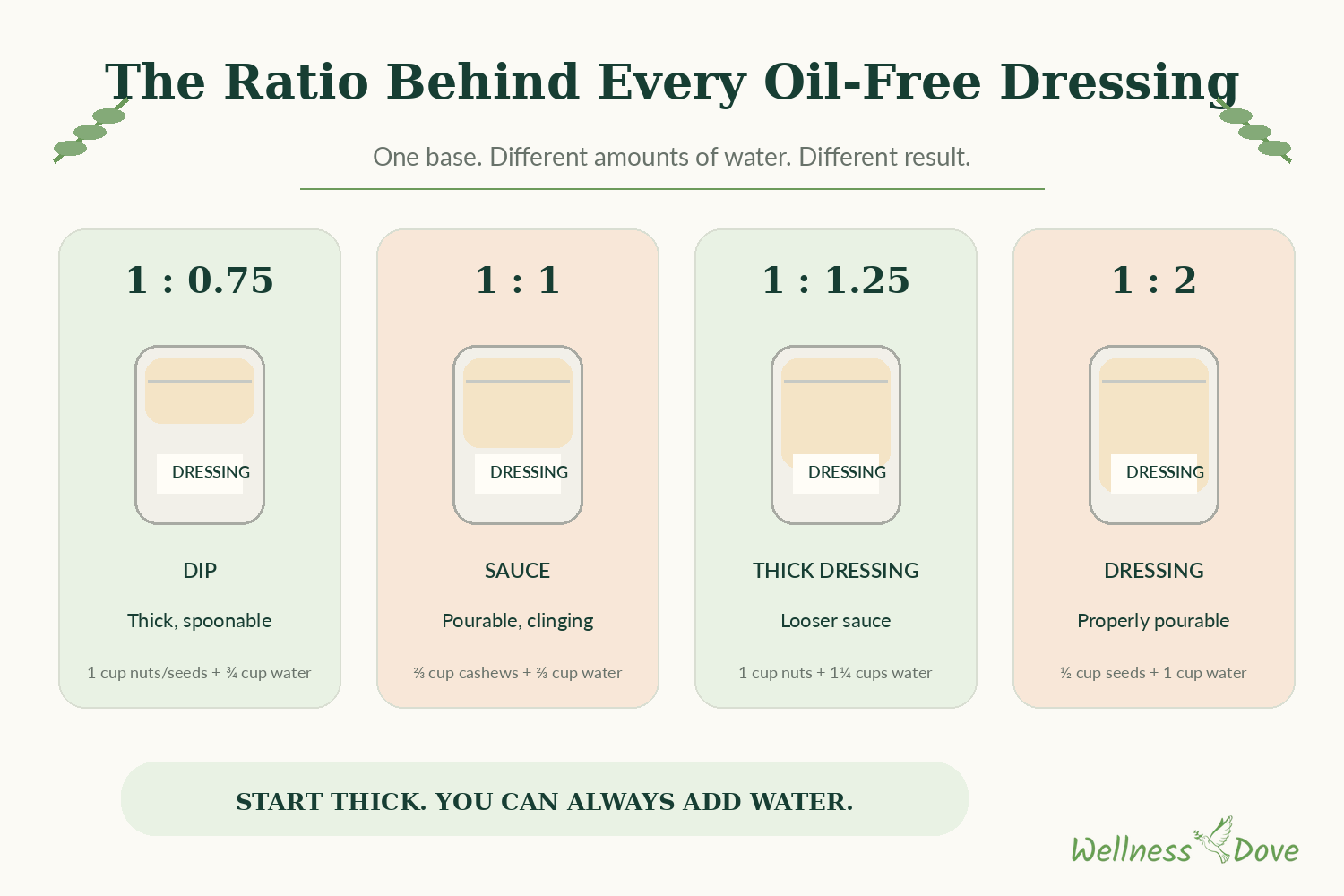
| 1 : 0.75 | Thick, spoonable. A dip | 1 cup nuts and seeds, ¾ cup water |
| 1 : 1 | Pourable but clinging. A sauce | ⅔ cup cashews, ⅔ cup water |
| 1 : 1.25 | Loose sauce, thick dressing | 1 cup walnuts and cashews, 1¼ cups water |
| 1 : 2 | Properly pourable. A dressing | ½ cup sunflower seeds, 1 cup water |
The same jar is a dip, a sauce or a dressing depending on one variable. Nothing else separates them, and it means you never need a separate recipe for each.
Start thick. You can always add water. Going the other way is harder, which is the next section.
How to Thicken an Oil-Free Dressing That Came Out Too Thin
We have never answered this on the site, and we should have, because a reader worked it out for herself in the comments and she was right.
She had made the sunflower seed sauce and found it too loose. Her fix: I added an extra quarter cup of sunflower seeds to make it the perfect salad dressing texture.
That is the right move, and it is counterintuitive. The instinct is to take water out, but you cannot. Once it is blended in, the only way to change the ratio is to add more of the other side.
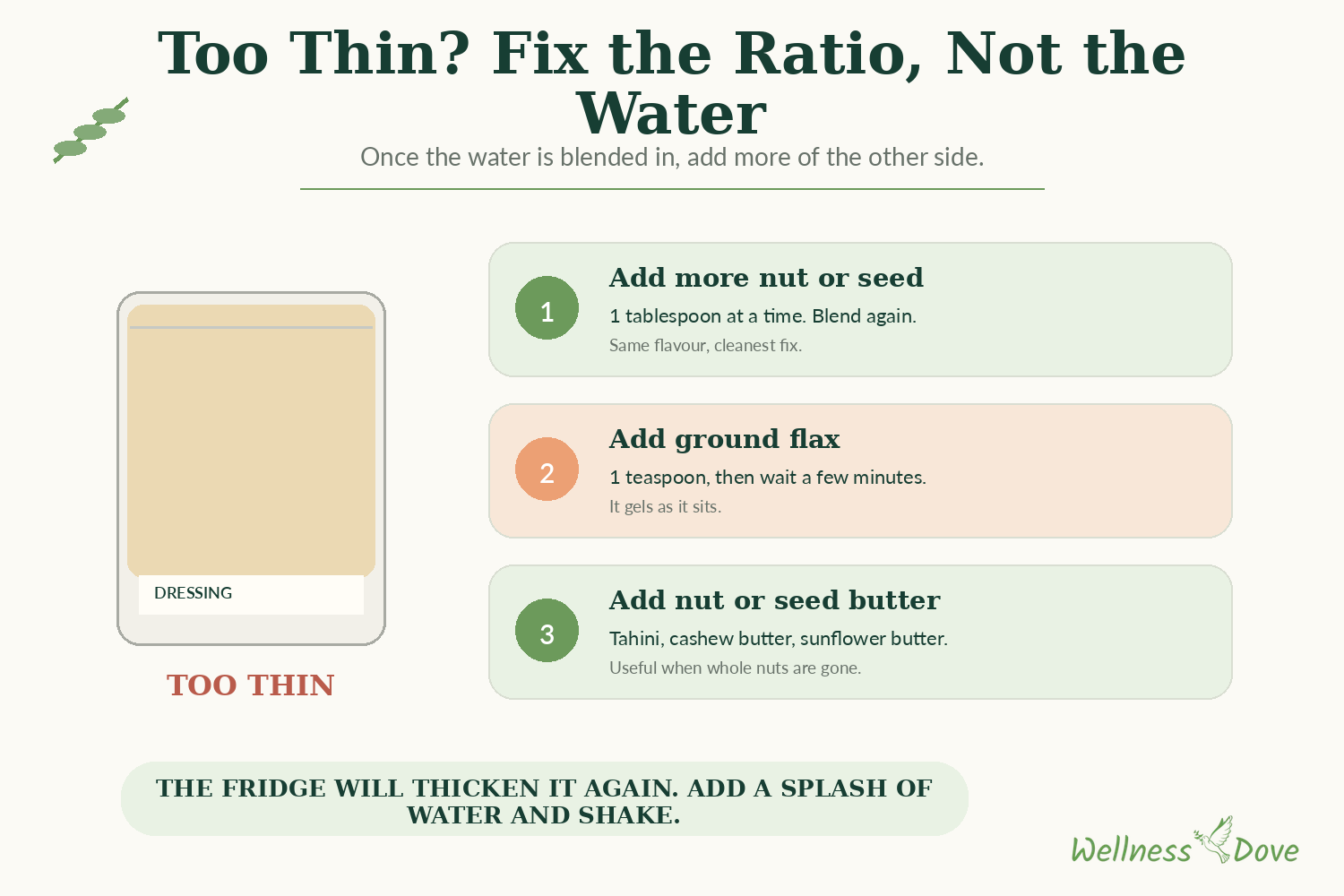
- Add more of the same nut or seed, a tablespoon at a time, and blend again. This is the cleanest fix because the flavor does not change.
- Add 1 teaspoon of ground flaxseed and let it stand for a few minutes. It gels and thickens without adding much taste. Our flagship dressing has flax in it for exactly this reason.
- Add a spoonful of a nut or seed butter if you have no whole nuts left. Tahini works, though it brings a slight bitterness with it.
It will thicken in the fridge, and that is normal. Every one of these does it. It thickens as it chills and stands, so a dressing that poured perfectly on Monday will be a paste by Wednesday. Add a splash of water, put the lid on, and shake.
None of that means it has gone off. Give it four days in the fridge, or three if you blended fresh herbs in. That is the same limit the USDA puts on any prepared leftover, and a nut dressing is wetter and less acidic than a vinaigrette.
Andy: The first oil-free dressing somebody makes is usually thin, and they usually decide that oil-free dressings are thin. One batch becomes a rule about a whole category of food. It was a ratio, and ratios are adjustable. If you have written off eating this way because of one jar that poured like water, that is worth revisiting, because the fix is a tablespoon of cashews.
Which Nut or Seed to Use
They are not interchangeable, and the difference is mostly about how smooth they go and how much they cost.
| Base | Texture | Tastes | Use for |
|---|---|---|---|
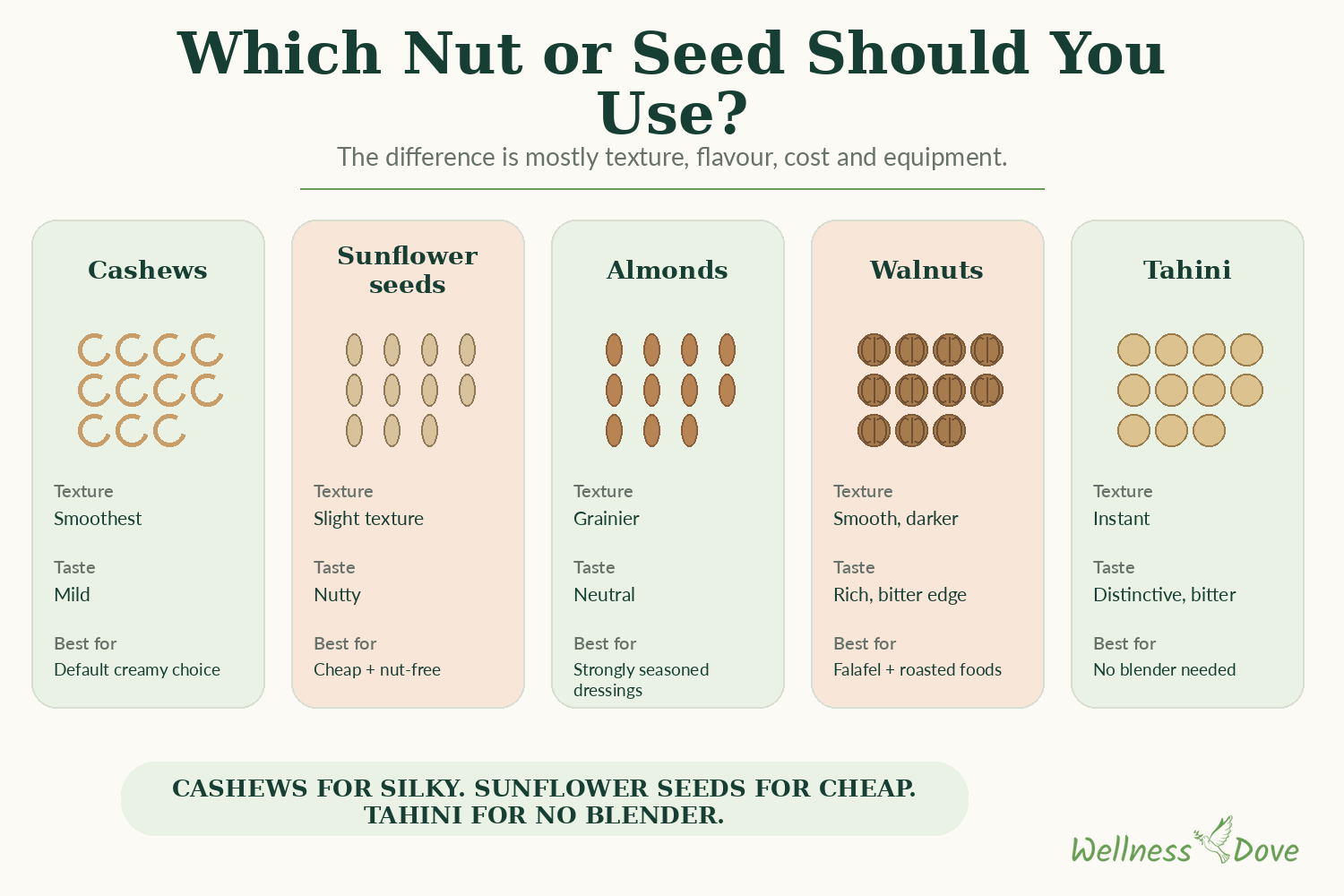
| Cashews | Smoothest of all, no grit | Mild, faintly sweet | Anything creamy. The default |
| Sunflower seeds | Slightly textured | Nutty, a little green | The cheap everyday one, and nut-free |
| Almonds | Grainier unless blended hard | Clean, neutral | Dressings with strong seasoning |
| Walnuts | Smooth but darker | Rich, slightly bitter | Sauces for falafel and roasted things |
| Tahini | Instant, no blending | Bitter, distinctive | When you have no blender |
Cashews if you want it to disappear into the salad. Sunflower seeds if you want it to be cheap. Sunflower seeds are also the answer for anyone avoiding nuts, and they cost a fraction of what cashews do.
Do You Need to Soak the Nuts First?
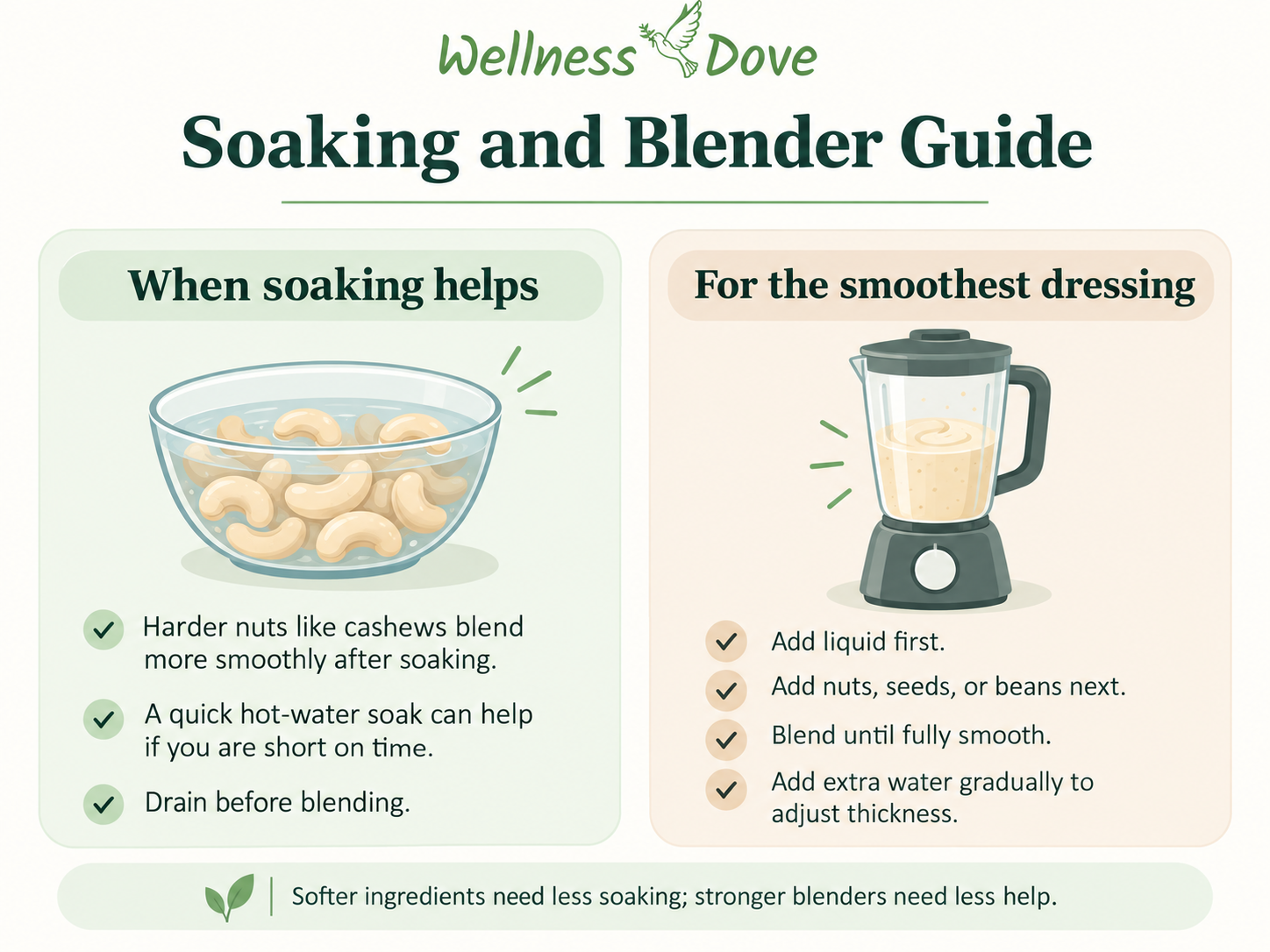
No. A reader asked this on our almond dressing and the answer has not changed: there is no need to soak them first.
Soaking is optional and it does one thing: an hour or two in water softens the nut so a weaker machine can cope. It does not unlock the minerals. When researchers soaked almonds, hazelnuts, peanuts and walnuts three different ways, whole and chopped, phytate barely moved and the mineral content actually fell, because minerals leach into the soaking water. Soaking lowers phytate in some grains and legumes. In nuts, it barely did. Soak for your blender, not for your bloodstream.
If you do soak, use less water in the recipe. The nuts have already taken some on. Our walnut sauce drops from 1¼ cups of water to 1 cup when the nuts have been soaked, which is the sort of adjustment nobody tells you about.
Blender or food processor?
Choice of machine matters more than the soaking, and we have never said so.
A high-powered blender is what turns whole nuts into cream. A food processor chops instead of pulverizing, so it will give you a grainy dressing no matter how long you run it. A reader on our chickpea spread hit exactly this and had to add liquid to get her small processor moving at all.
If a food processor is what you have, start from a butter rather than a whole nut. Tahini, sunflower seed butter, cashew butter. The grinding has been done for you, and all your machine has to do is combine.
Beans and cooked vegetables are different. Hummus and bean dips work perfectly well in a processor, because the solids are already soft.
What Makes It Taste Like a Dressing
Nut plus water is not a dressing. It is nut milk. Four things turn it into something you want on food.
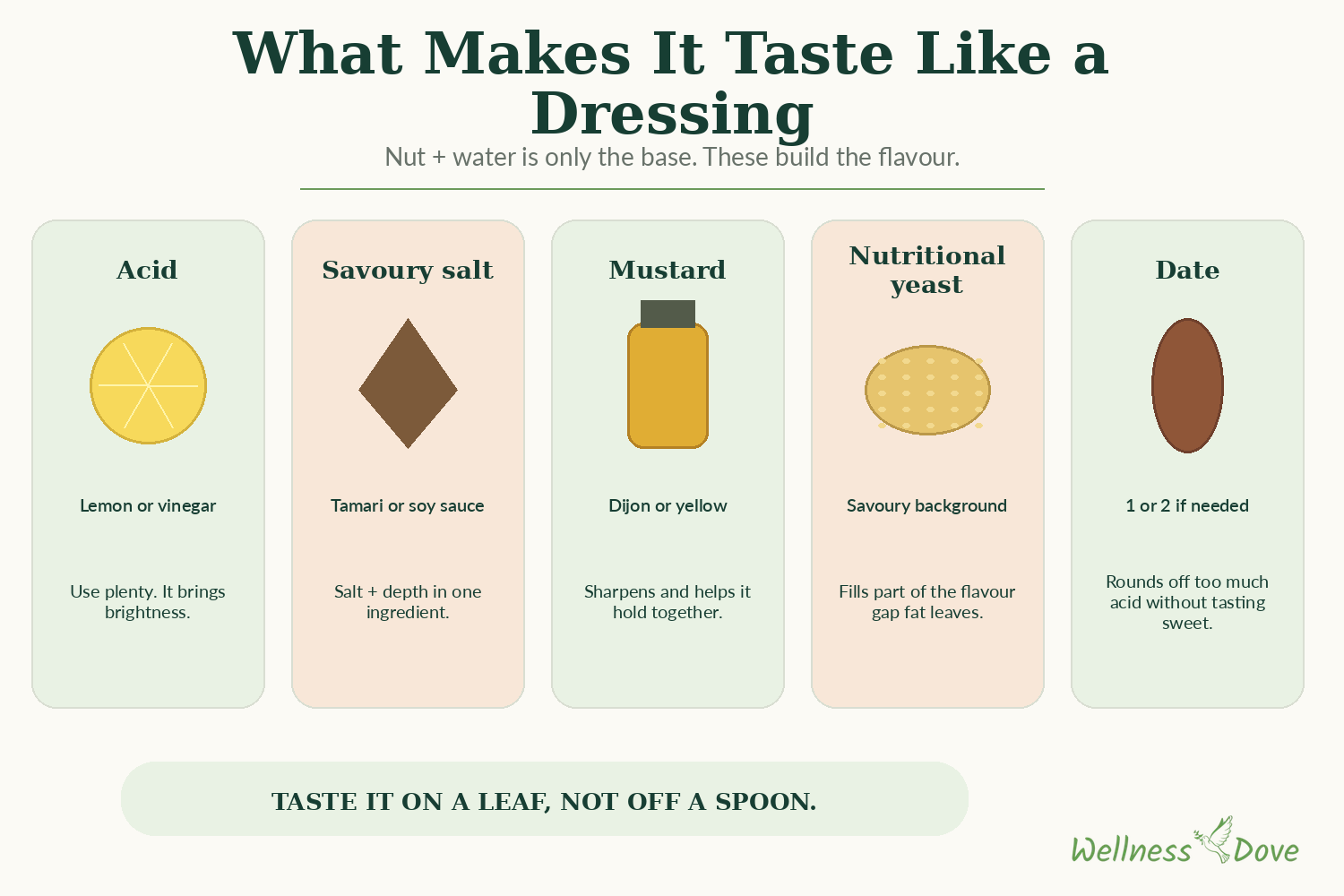
- Acid, and lots of it. A whole lemon in most of ours, freshly squeezed. Without oil there is nothing dulling the sharpness, so you need more than a conventional recipe would use.
- Something salty that is not salt. Our main dressing contains no added salt at all. Soy sauce or tamari does that job and brings savory depth with it.
- Mustard. Dijon or plain yellow. It sharpens and it helps the mixture hold together.
- Nutritional yeast for a savory, faintly cheesy background that fills the gap where fat used to sit.
- One or two dates if the result is too sharp. This is the trick we use most and have explained least. A date does not make a dressing sweet. It rounds off an acid edge the way a pinch of sugar does in a vinaigrette.
Lemon or vinegar is mostly personal. Lemon is softer and we default to it. Apple cider vinegar is sharper and holds up better against strong leaves like arugula.
Oil-Free Dressing Troubleshooting
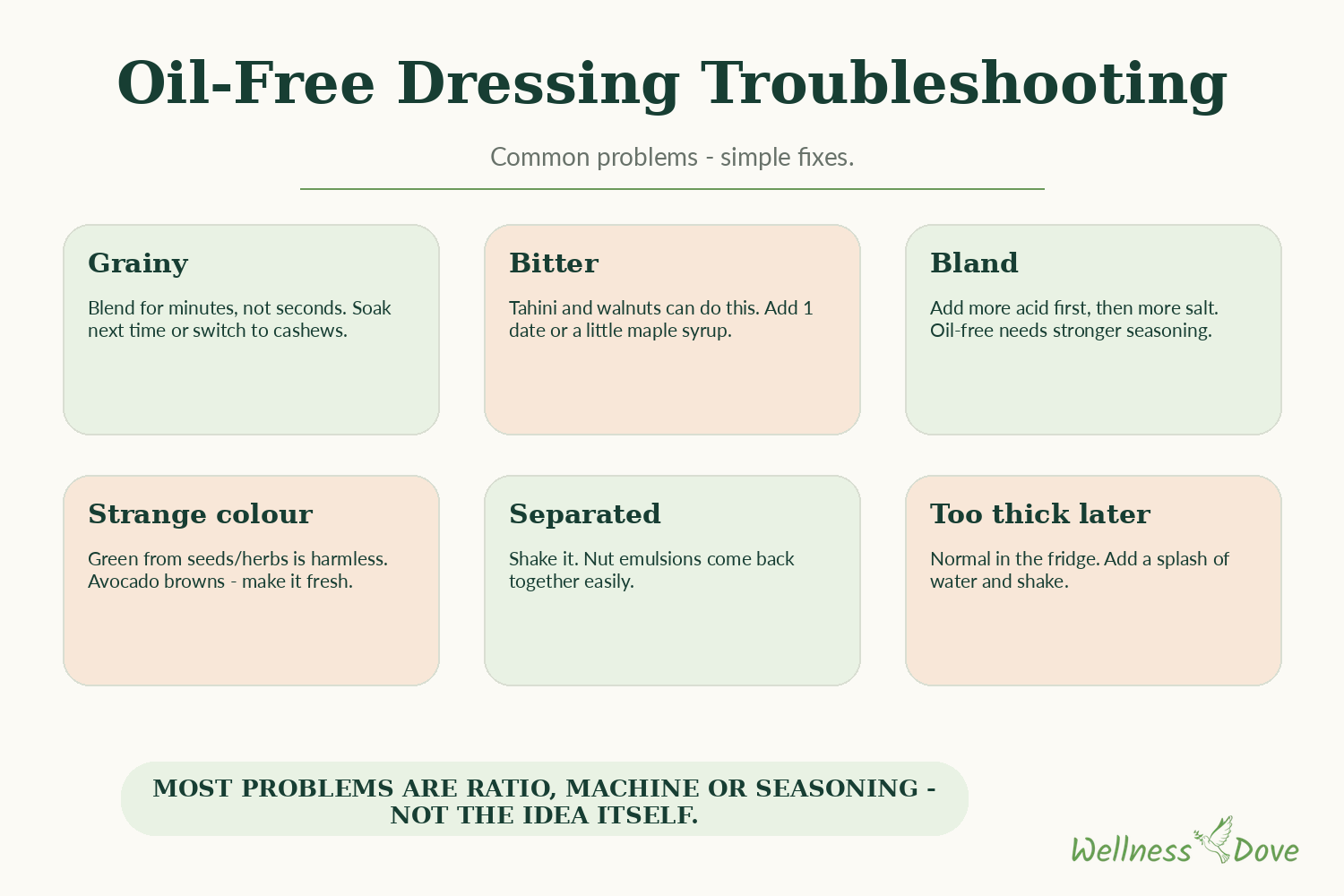
It is grainy and will not go smooth
Almost always the machine rather than the recipe. Blend for several minutes, not seconds, and scrape the sides down at least twice, pushing everything back into the middle.
If it is still grainy, soak the nuts for an hour next time or switch to cashews, which break down more easily than almonds do.
It tastes bitter
Tahini and walnuts both carry a bitterness that oil would have masked. Half a teaspoon of maple syrup or a single date fixes it without making the dressing sweet.
It is bland
More acid first, then more salt. An oil-free dressing needs more seasoning than the version it replaced, not the same amount.
Taste it on a leaf, not off a spoon. On its own it will always seem too strong, and on the salad it usually is not.
It went a strange color
Green tinges come from herbs, or, in a sunflower seed dressing, from a natural compound in the seed reacting with its protein. It is more likely when the dressing is not acidic enough, so a little more lemon helps. Safe to eat.
Anything with avocado in it will brown, and lemon juice slows that down but does not stop it. Make those on the day.
It separated
Shake it. Unlike an oil vinaigrette, a nut emulsion goes back together easily, because the solids are suspended, not floating on top.
The Dressings We Actually Make
- Oil-free Vegan Salad Dressing: almonds and ground flax. The one to learn first.
- Universal Cashew Sauce: ⅔ cup to ⅔ cup, and it becomes a dressing with more water.
- Sunflower Seed Sauce: the cheap nut-free one, at the pourable end.
- Creamy Garlic Sauce: seed butter rather than whole seeds, so no strong blender needed.
- Walnut Falafel Sauce: the one with the soaked-nut water adjustment written into it.
- Five-Ingredient Hummus: tahini and chickpeas, and it works in a processor.
- Creamy Zucchini Dip: cooked vegetable as the liquid, with no added water at all.
- Sunflower Seed Dip: the same base as the sauce, held at the thick end.
- Arugula Sunflower Sprout Salad: the only dressing we whisk in a bowl, for when there is no machine at all.
Venny: There is a reason I will not make a fat-free dressing, and it is not about flavor. When you chew a salad, a lot of the plant cells never break open, and the carotenoids inside them do not dissolve in water.
Fat in the same mouthful changes how much of that you actually absorb, by a large margin. In one small study, almost none of a salad’s carotenoids reached the blood with a fat-free dressing. In another, adding avocado multiplied absorption five- to fifteen-fold. Blended nuts and seeds bring that fat with them.
So the cashews in the jar are not a concession to taste. They are what gets the salad into you. That is also why I would rather see someone use a nut than an oil: you get the fat that helps absorption along with the fiber and minerals, and blending is what releases it.
More on that in cooking without oil, which covers why removing the oil is not the same as removing the fat.
Venny is a medical doctor and a specialist in Nutrition and Dietetics; Andy holds a master’s degree in psychology. This is general information rather than medical advice.
Where to Start With Oil-Free Dressings
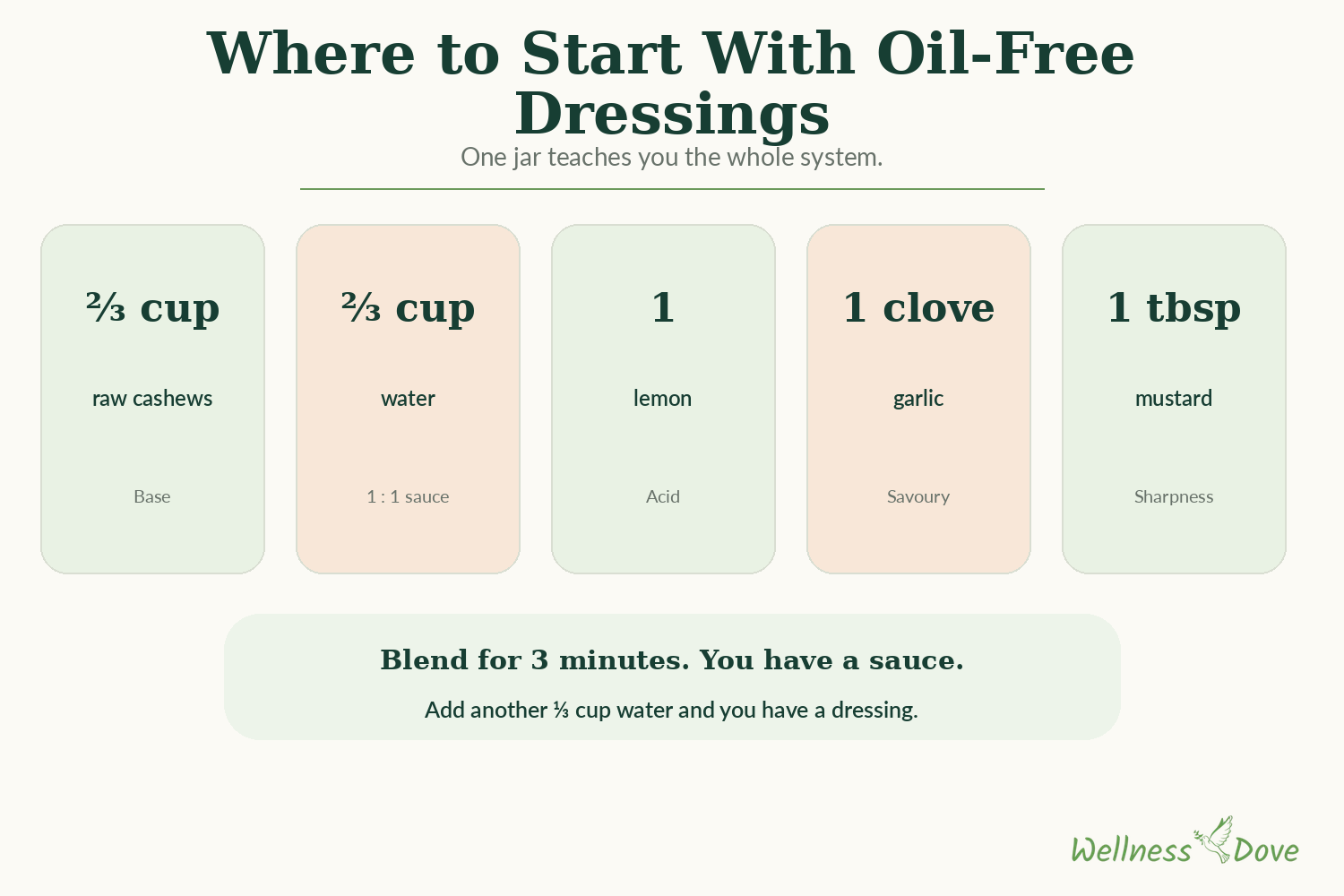
Put ⅔ cup of raw cashews and ⅔ cup of water in a blender with a lemon, a clove of garlic and a spoon of mustard. Blend it for three minutes.
You have a sauce. Add another ⅓ cup of water and you have a dressing. That is the whole system.
And, always, seek health consciously.
Read Next
- Cooking Without Oil: What Actually Replaces It
- Chickpeas: Canned or Dried, and How to Cook Them
- Sprouting at Home: Which Sprouts Are Worth It, and How to Grow Them
Sources (9)
- U.S. Department of Agriculture, Food Safety and Inspection Service. Leftovers and food safety. View
- Kumari S, Gray AR, Webster K, et al. Does ‘activating’ nuts affect nutrient bioavailability? Food Chemistry. 2020;319:126529. View
- Wildermuth SR, Young EE, Were LM. Chlorogenic acid oxidation and its reaction with sunflower proteins to form green-colored complexes. Comprehensive Reviews in Food Science and Food Safety. 2016;15(5):829-843. View
- Atonfack JT, Ataman ZA, Were LM. Acidulant effect on greening, reducing capacity, and tryptophan fluorescence of sunflower butter cookie dough during refrigerated storage. Journal of the Science of Food and Agriculture. 2019;99(5):2186-2193. View
- Tydeman EA, Parker ML, Faulks RM, et al. Effect of carrot (Daucus carota) microstructure on carotene bioaccessibility in the upper gastrointestinal tract. 2. In vivo digestions. Journal of Agricultural and Food Chemistry. 2010;58(17):9855-9860. View
- Yonekura L, Nagao A. Intestinal absorption of dietary carotenoids. Molecular Nutrition and Food Research. 2007;51(1):107-115. View
- Brown MJ, Ferruzzi MG, Nguyen ML, et al. Carotenoid bioavailability is higher from salads ingested with full-fat than with fat-reduced salad dressings as measured with electrochemical detection. American Journal of Clinical Nutrition. 2004;80(2):396-403. View
- Unlu NZ, Bohn T, Clinton SK, Schwartz SJ. Carotenoid absorption from salad and salsa by humans is enhanced by the addition of avocado or avocado oil. Journal of Nutrition. 2005;135(3):431-436. View
- Ellis PR, Kendall CW, Ren Y, et al. Role of cell walls in the bioaccessibility of lipids in almond seeds. American Journal of Clinical Nutrition. 2004;80(3):604-613. View