

The first time you cook without oil, the pan lets you know about it. The onions catch, nothing browns, and the food comes out pale and tastes like something’s missing, because something is.
Nearly every recipe on this site is oil-free, and not one of them stops to explain how that works. This page is the missing instruction. It also covers the part most oil-free writing leaves out, which is that taking the oil out isn’t the same as taking the fat out. If you confuse the two, you lose a good part of the nutrition you were cooking for in the first place.
The short answer: Water or stock replaces oil in the pan, and parchment paper replaces it in the oven. That’s most of it. Where a dish needs to be rich, blended nuts, seeds or tahini take over the job the oil was doing, and in our experience they do it better. Whole fat also carries nutrients out of your vegetables that a naked salad leaves behind. The two things that go wrong most often are overcrowding the tray and not seasoning hard enough.
What Actually Replaces Oil When You Are Cooking Without It
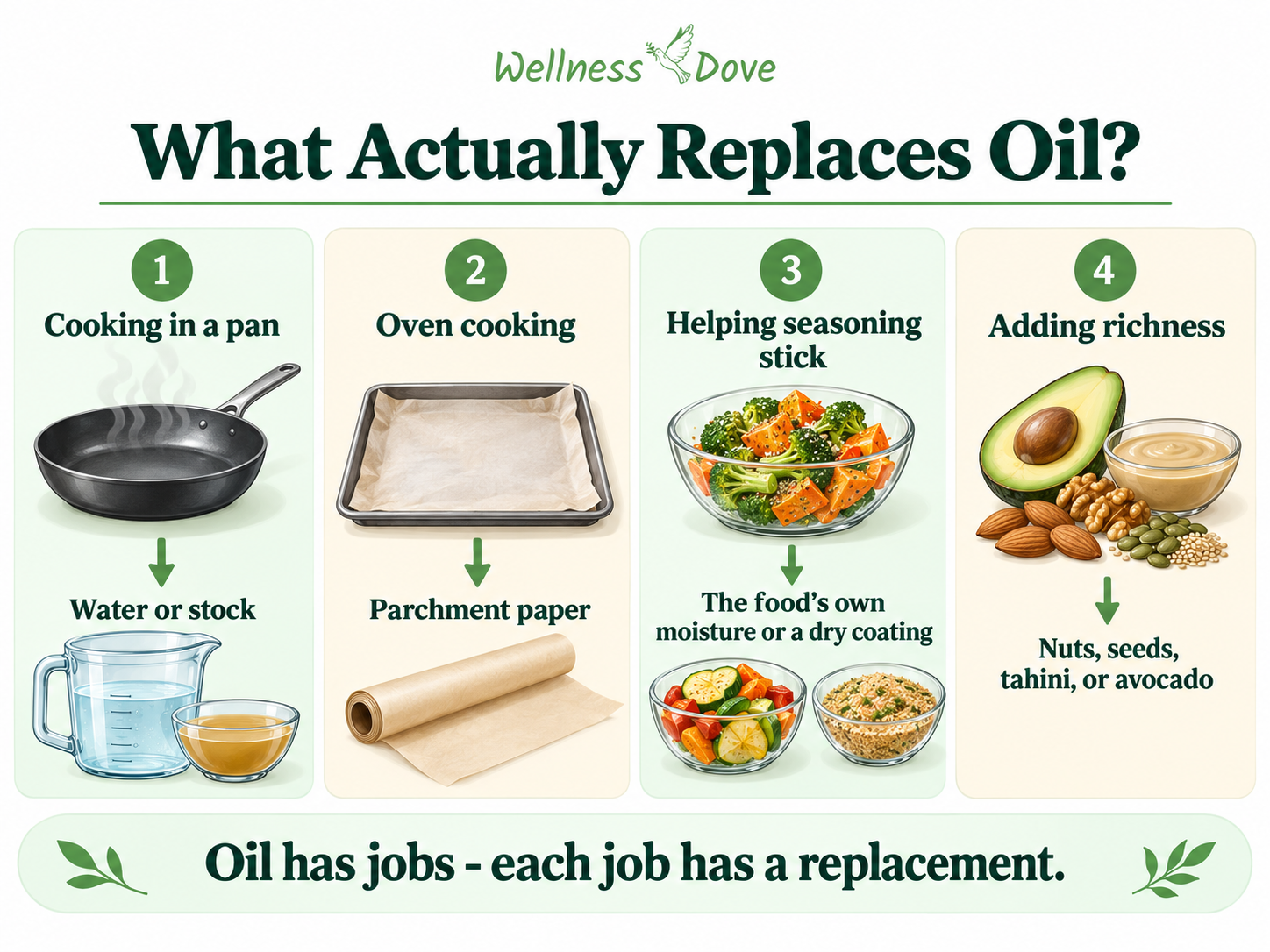
In a conventional recipe, oil is doing three separate jobs at once: it stops food from sticking, it moves heat into the surface so things brown, and it carries flavor. Nothing replaces all three in one go, so you end up swapping in a different answer for each of them. Here’s how that breaks down in our kitchen.
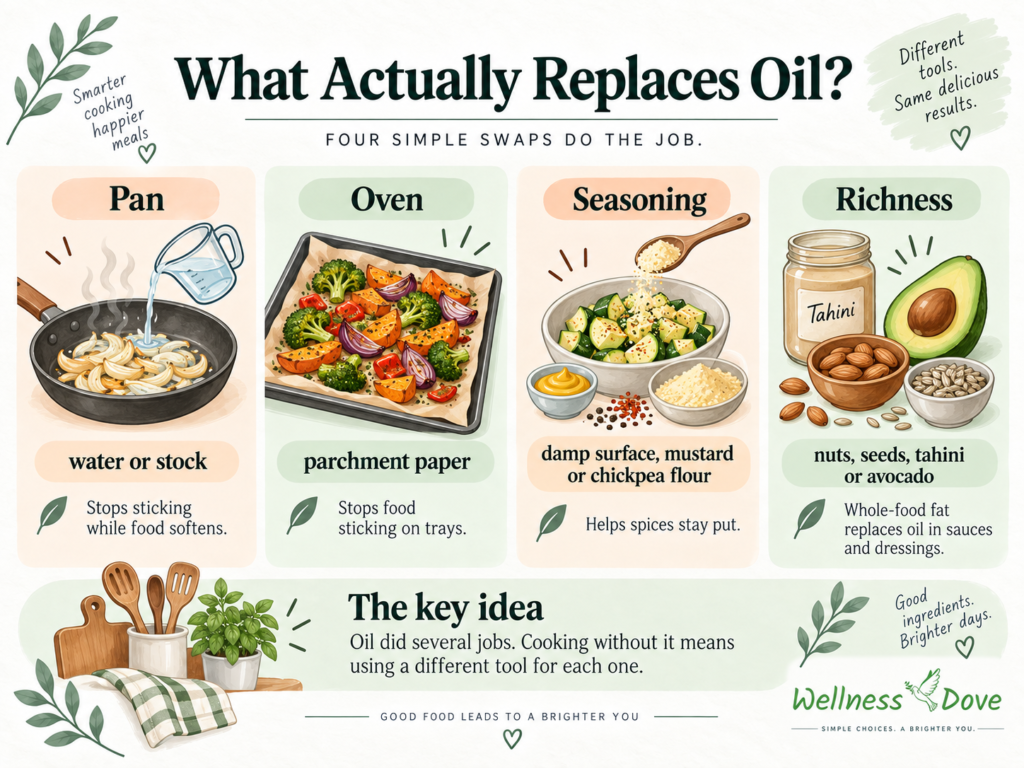
| Oil was doing this | Use instead | Where we use it |
|---|---|---|
| Stopping food sticking in a pan | Water or vegetable stock, a splash at a time | Onions, mushrooms, anything softened before a soup or a bake |
| Stopping food sticking in the oven | Parchment paper | Everything. Roasted vegetables, patties, bread, cookies |
| Making seasoning stick | The food’s own damp surface, or a dry flour coating | Potatoes pressed cut-side into spices, zucchini tossed in chickpea flour |
| Making a dish rich | Blended whole nuts, seeds, tahini or avocado | Every sauce and dressing we make |
Water sauté, with an actual quantity
Most recipes say “sauté in a little water” and leave you to guess what a little means. Ours give you a number, and it’s usually somewhere between two tablespoons and half a cup. Onions want about a quarter cup and five minutes. Mushrooms want just two tablespoons and constant stirring, because they start releasing their own liquid almost as soon as they hit the pan. A pan of stir-fry vegetables wants half a cup and a lid on top.
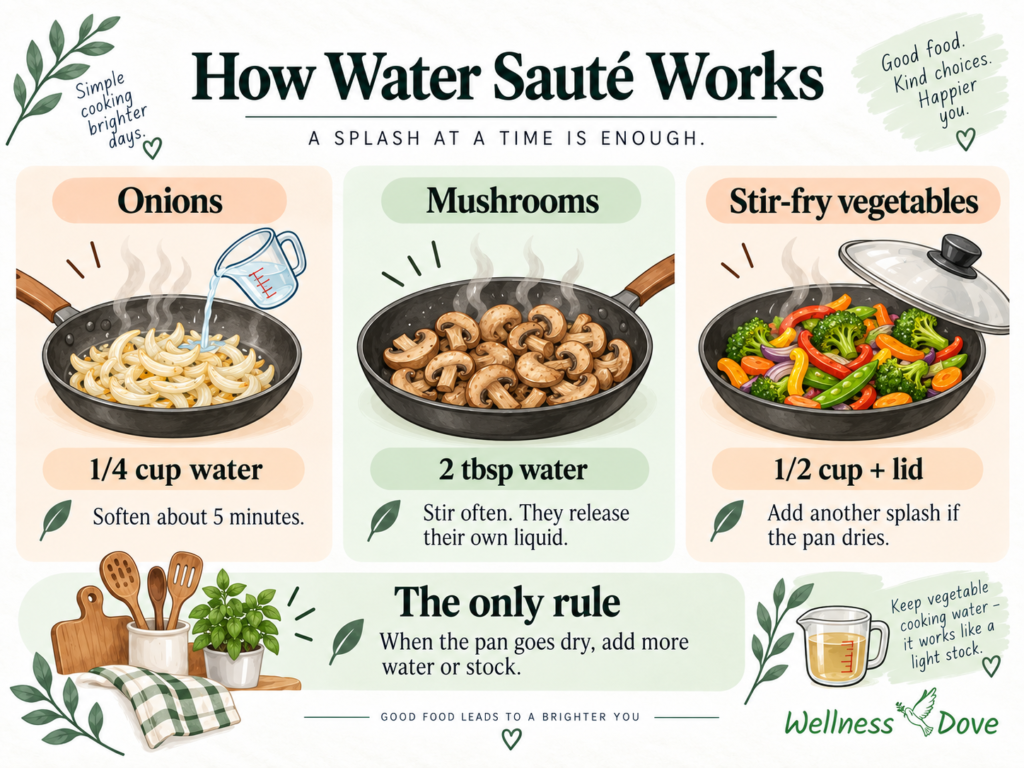
When the pan goes dry, you add another splash and keep going. That’s the whole technique, and after a week or two you stop measuring and just do it by ear.
Keep the water you boiled your vegetables in. That water is stock. It costs nothing, and it holds a good part of what came out of the vegetables while they cooked. In a study of 20 vegetables, boiling cut their antioxidant activity by about 14 percent on average in lab tests. Part of what boiling removes ends up in the water, so keeping it gets some of it back. We use it for the next sauté.
Sometimes you need no liquid at all
This one surprised us too. A good number of our recipes put everything straight into a dry non-stick pan and rely on the water that’s already inside the food. Tofu scrambles work this way, and so do crepes, which we cook on a bare pan. If you season zucchini with salt, it’ll pull out enough of its own liquid to cook in, and then you just carry on until that liquid has evaporated.
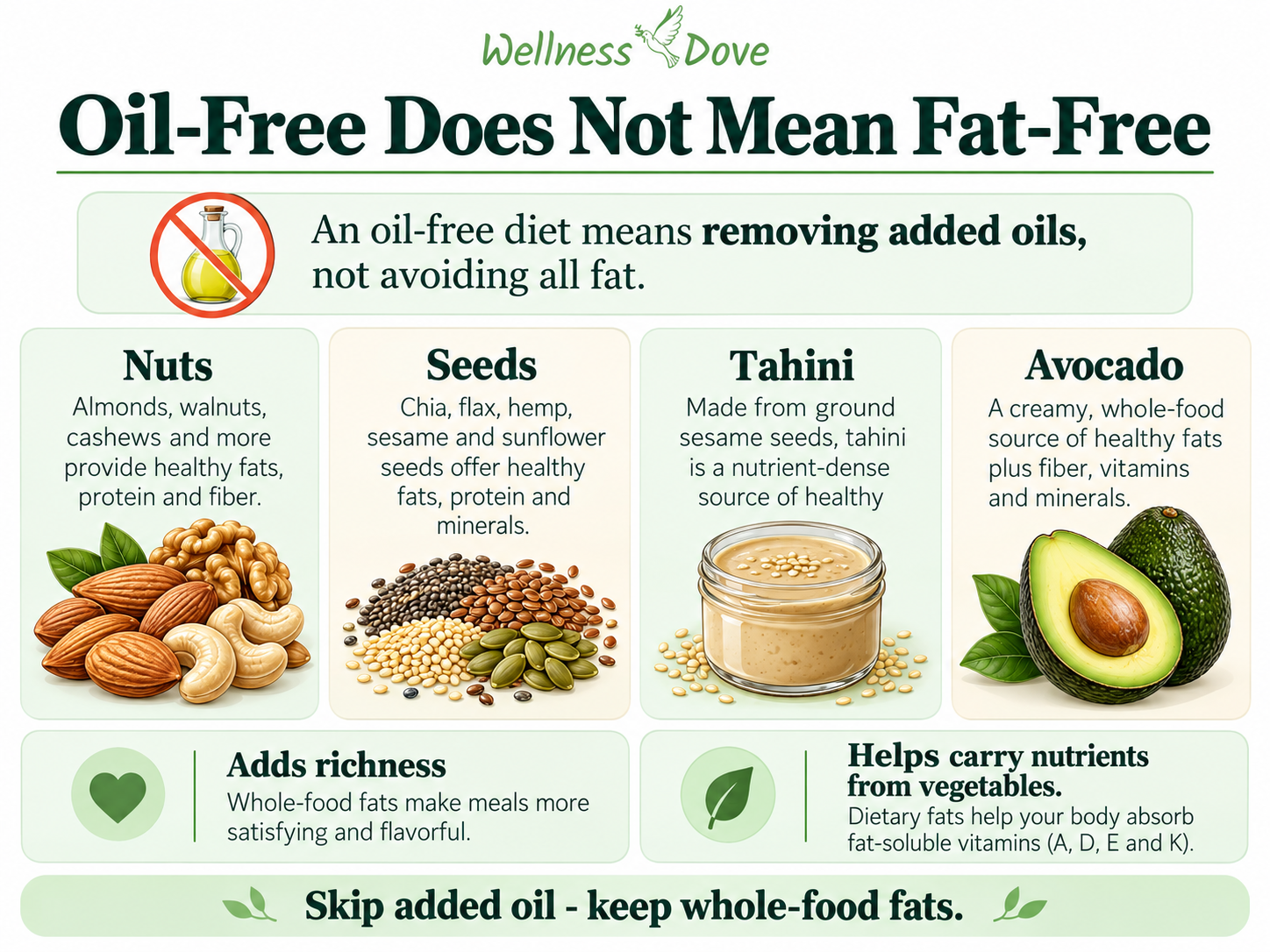
Cooking Without Oil Is Not the Same as Cooking Without Fat
This is the part that gets missed, and it’s the reason a plate of leaves with lemon juice on it is a worse lunch than it looks.
When you chew a salad, a lot of the plant cells never get broken open, and whatever was inside them leaves your body still inside them. In almonds, most of the cells survive chewing with the fat still sealed in. In a 2-millimeter piece of wheat kernel, researchers estimate about six in ten starch cells stay intact, a protection flour has already lost. We don’t have an enzyme for cellulose, so the cell wall is a locked box. Two things help. One is breaking the cells physically, by blending, heating or chopping small. The other is having some fat at the same meal, so the carotenoids that get out can be absorbed, because they don’t travel in water.
Venny: With a fat-free dressing, the carotenoids in a salad barely reach your bloodstream at all. In one trial I like to cite, seven people ate the same salad three times, with dressings containing no fat, a little fat, or a full amount. With the fat-free version, the carotenoids that showed up in the blood were negligible. In another, adding avocado to a salad raised alpha-carotene absorption more than sevenfold.
Those studies used oil and avocado rather than nuts. Whole nuts you chew release only a small part of their fat, so blended nuts or tahini are the version that does the job. Even a little fat beats none, and absorption keeps rising with more, so there is no magic number.
So I don’t see a fat-free dressing as the strictest version of eating well. I see it as the version that throws away what you bought the vegetables for. The fix isn’t oil, though. It’s the whole food the oil was pressed out of. Blended almonds, cashews, sunflower seeds or tahini give you the absorption, the fiber and the minerals all at once. That’s not a license to pour, and it isn’t there to fill you up. It’s there so the salad reaches you.
What we use instead of oil for richness
Look at any dressing or sauce on this site and you’ll find the same shape underneath: a whole fat-bearing food blended with plain water. Almonds and ground flax. Raw cashews. Sunflower seeds. Tahini and lemon. Boiled zucchini and cashews with no added water at all. Not one of them is oil, and not one of them is fat-free. That was never an accident, though we admit we haven’t explained it properly before now.
The ratio does the rest. More water makes a dressing, less water makes a sauce, and it’s the same jar either way.
Why We Cook Without Oil in the First Place
The strongest argument is also the simplest one, and it doesn’t ask you to believe anything contested. Oil is the most calorie-dense thing in your kitchen. A pound of oil carries roughly 4,000 calories. A pound of greens carries about 100. Olive oil isn’t the exception here, at around 4,010 a pound, which is more than butter. And it arrives with no fiber and almost nothing else, which is what “refined” means. The fiber and the water are exactly what got removed to make it.
Then there’s the arithmetic nobody does at the salad bar. A whole bowl of lettuce is about 20 calories. Four tablespoons of an oil-and-vinegar dressing is about 290, and nearly 480 if it’s straight oil. A cup of mashed potato made with nothing but potato is about 190 calories, and the tablespoon of butter stirred into it adds another 100 on top.
Your body barely has to work to store it, either. In a two-week overfeeding trial, people stored 90 to 95 percent of the extra fat calories, against 75 to 85 percent of the extra carbohydrate calories. Fat is the path of least resistance in both directions.
Where we will not overclaim
Oil is the most argued-over position in this whole way of eating, and we’re not going to pretend the argument is settled. There’s real published evidence on the other side, particularly for olive oil as part of a Mediterranean pattern. Our reading is that the vegetables, beans and fish in those diets are doing the work and the oil has been riding on their reputation, but that’s a judgment on our part, not a proof.
What isn’t a judgment is the calorie density. That number isn’t in dispute, and for us it’s enough on its own.
It’s also worth knowing that the clinical programs land stricter than we do. Esselstyn allows no added oil of any kind, and of 198 consecutive heart patients, 177 stuck with it for an average of 3.7 years. Fuhrman caps it at a teaspoon a day, and advises most overweight people to have none. Nobody running a reversal program is relaxed about oil.
The Rule That Matters More Than the Oil
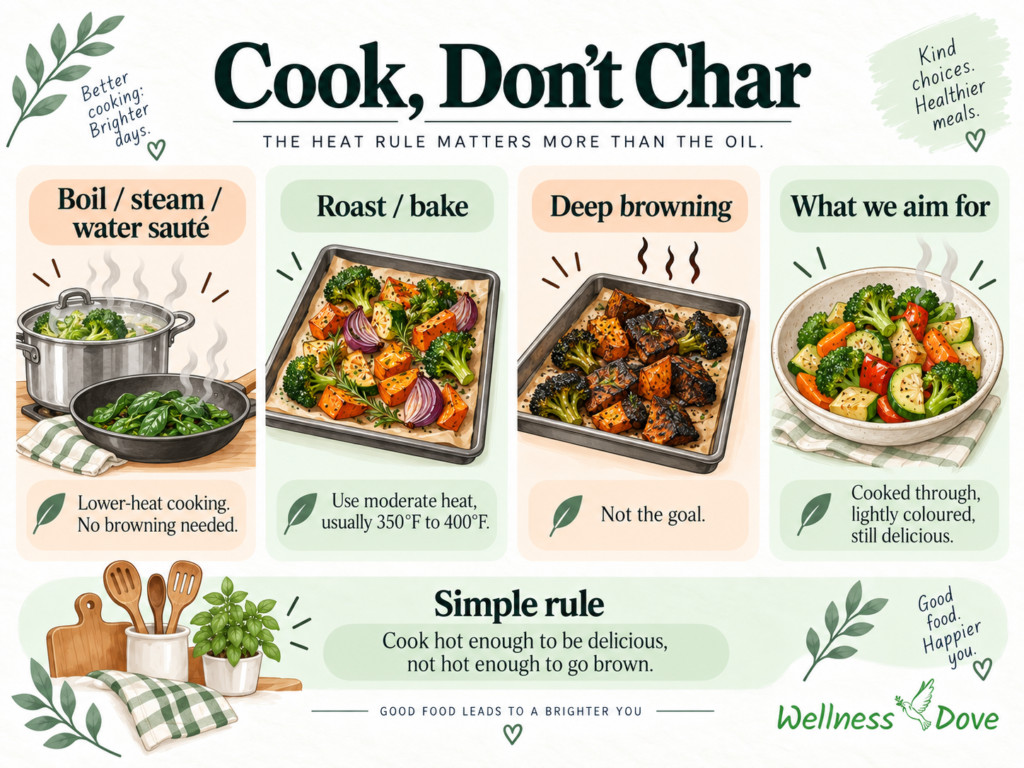
Here’s something we haven’t said plainly enough on this site, and it complicates our own recipes a little. Taking the oil out of roasting doesn’t make roasting harmless. The problem with high dry heat was never only the oil. It’s the browning.
Acrylamide forms when starchy food is cooked at high dry heat, and that means roasting and baking, not just frying. A meta-analysis of four prospective studies found no link with endometrial cancer overall, but among women who had never smoked, the highest intakes went with a 39 percent higher risk. The never-smoking part matters, because smoking is itself a big source of acrylamide. It doesn’t form in boiling, steaming or water-sautéing, and the reason is simple: water cooking can’t get above 212°F, and the reaction needs more heat than that.
So what do we actually do
We roast anyway, but we roast cooler than most food blogs. Look through our oven recipes and you’ll see the temperatures sit between 350°F and 400°F, never the 425°F or 450°F a crisping recipe would call for, and the doneness test is usually “tender when pierced” rather than “deeply golden.” To be clear, 350°F is still well above the temperature where acrylamide starts forming. Roasting cooler reduces it, but it doesn’t switch it off. Only water cooking does that.
That was a deliberate choice, and the reasoning behind it fits in one line: cook hot enough to be delicious, not hot enough to go brown.
We also boil and steam far more than a food blog is supposed to admit, because those methods sidestep the problem entirely. The catch is that boiling costs you antioxidants, so we drink the water back as stock rather than pouring it down the sink. Deep-frying is the one method we don’t do at all, at any temperature, in any oil.
Cooking Without Oil Troubleshooting
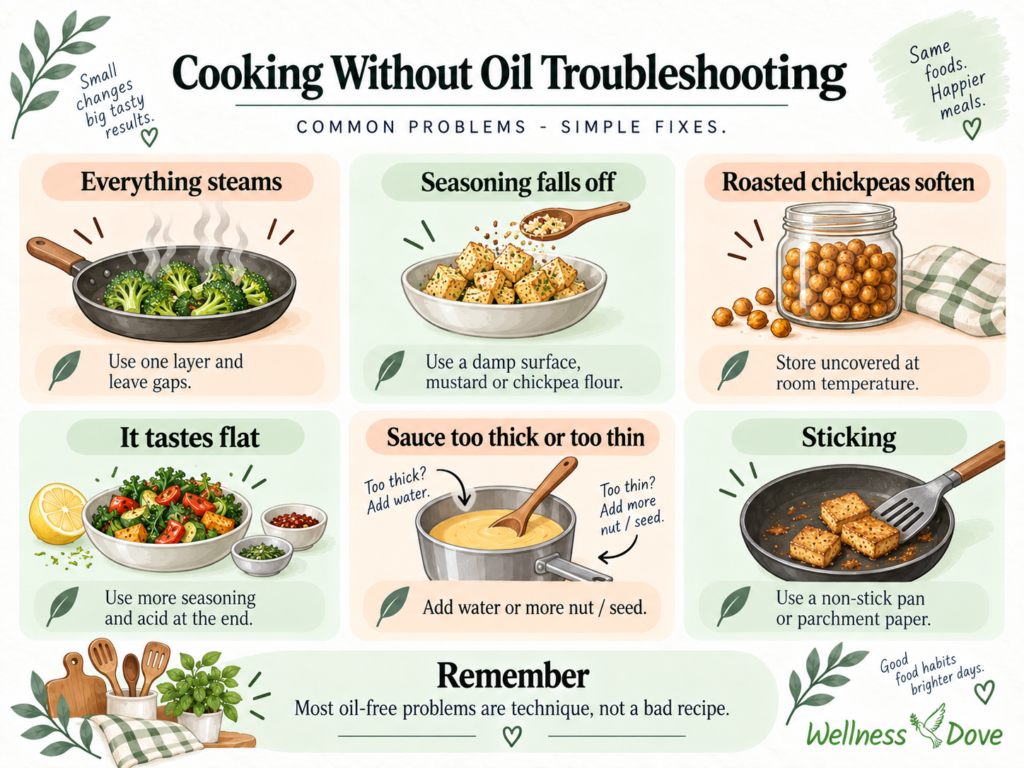
Everything steams and nothing roasts
The tray is too full. Vegetables packed together release steam into each other and then sit in it, and nothing ever dries out enough to roast. Spread them in one layer with gaps between the pieces, and use two trays if you need them. Cut everything roughly the same size so it all finishes at the same time.
The seasoning falls off
Oil was the glue. Without it you need either a damp surface for the spices to cling to, or a dry powder that behaves like a batter. A few things that work for us:
- Press the cut face of a potato straight down into a bowl of spices. It picks up far more than tossing ever does.
- Toss wet-cut vegetables in chickpea flour along with your spices. It sets into a thin crust in the oven.
- A thin smear of mustard works as a coating, and the mustard flavor disappears into everything else.
Roasted chickpeas go soft by the evening
Three things, and the last one is the one nobody expects. Dry them properly on a towel before you season them, and rub off any loose skins. Roast until they feel dry to the touch rather than until the timer says so. Then store them uncovered at room temperature. An airtight container or the fridge will soften them overnight, which is the opposite of what you’d guess, and we learned it the hard way.
It tastes flat
Fat changes how flavor is released and how long it lingers. Take it out and you have to put something back, so oil-free food needs more seasoning than conventional food does, not the polite amount. Acid at the end is the single biggest improvement you can make: lemon, vinegar, lime. After that, dry-toast your whole spices for thirty seconds before they go in. It isn’t identical to blooming them in hot fat, and we won’t pretend otherwise, but it gets you most of the way there. Thirty seconds too long, though, and they turn bitter and you’re starting again.
The sauce went too thick, or too thin
Every nut and seed sauce thickens in the fridge, so add water a tablespoon at a time and shake the jar. Too thin goes the other way: more of the nut or seed, or a spoonful of cornstarch if the sauce is headed for a hot pan anyway.
Do I need a non-stick pan?
For stovetop cooking without oil, it helps a lot, and our recipes assume you have one. Stainless steel can be done, but it wants more liquid and more attention than most people are willing to give it on a weeknight. For the oven, parchment paper is all you need and it costs almost nothing. We’d steer you away from a silicone mat, which insulates the base and leaves it pale.
Recipes to Learn the Technique On
- Stir Fry Noodles: the water sauté with a measured half cup, so you can see what it’s supposed to look like.
- Oil-free Roasted Chickpeas: crisping without fat, plus the storage rule.
- Oil-free Roasted Potatoes: the press-into-the-spices trick.
- Oven Baked Zucchini: chickpea flour standing in for batter.
- Roasted Cauliflower: the one where crowding the tray ruins it.
- Creamy Garlic Potatoes: steam first, then build a tahini sauce right in the pan.
- Oil-free Salad Dressing: almonds and ground flax. Start here for dressings, and see our guide to the dressing ratio for the method behind all of them.
- Universal Cashew Sauce: one jar that becomes a sauce or a dressing depending on how much water you add.
- Five-Ingredient Hummus: tahini and water, no oil, no peeling.
Venny is a medical doctor and a specialist in Nutrition and Dietetics; Andy holds a master’s degree in psychology. This is general information rather than medical advice.
Where to Start With Oil-Free Cooking
Don’t try to convert your whole kitchen this week. Change one thing: the next time you’d reach for the oil bottle to soften an onion, reach for a quarter cup of water instead. It works, and it has always worked. The oil was mostly habit, and once you’ve done it a few times you’ll wonder why you ever thought the onion needed it.
And, always, seek health consciously.
Read Next
- Vegan Meatballs, Patties and Burgers: What Holds Them Together
- Bread Without Flour: How It Works, and Which Loaf to Make
- How to Cook Delicious Food in a Healthy Way
Sources (17)
- Jiménez-Monreal AM, García-Diz L, Martínez-Tomé M, Mariscal M, Murcia MA. Influence of cooking methods on antioxidant activity of vegetables. Journal of Food Science. 2009;74(3):H97-H103. View
- Giambanelli E, Verkerk R, D’Antuono LF, Oliviero T. The kinetic of key phytochemical compounds of non-heading and heading leafy Brassica oleracea landraces as affected by traditional cooking methods. Journal of the Science of Food and Agriculture. 2016;96(14):4772-4784. View
- Tydeman EA, Parker ML, Faulks RM, et al. Effect of carrot (Daucus carota) microstructure on carotene bioaccessibility in the upper gastrointestinal tract. 2. In vivo digestions. Journal of Agricultural and Food Chemistry. 2010;58(17):9855-9860. View
- Grundy MM, Grassby T, Mandalari G, et al. Effect of mastication on lipid bioaccessibility of almonds in a randomized human study and its implications for digestion kinetics, metabolizable energy, and postprandial lipemia. American Journal of Clinical Nutrition. 2015;101(1):25-33. View
- Grundy MM, Edwards CH, Mackie AR, et al. Re-evaluation of the mechanisms of dietary fibre and implications for macronutrient bioaccessibility, digestion and postprandial metabolism. British Journal of Nutrition. 2016;116(5):816-833. View
- Castenmiller JJ, West CE, Linssen JP, van het Hof KH, Voragen AG. The food matrix of spinach is a limiting factor in determining the bioavailability of beta-carotene and to a lesser extent of lutein in humans. Journal of Nutrition. 1999;129(2):349-355. View
- Brown MJ, Ferruzzi MG, Nguyen ML, et al. Carotenoid bioavailability is higher from salads ingested with full-fat than with fat-reduced salad dressings as measured with electrochemical detection. American Journal of Clinical Nutrition. 2004;80(2):396-403. View
- Unlu NZ, Bohn T, Clinton SK, Schwartz SJ. Carotenoid absorption from salad and salsa by humans is enhanced by the addition of avocado or avocado oil. Journal of Nutrition. 2005;135(3):431-436. View
- White WS, Zhou Y, Crane A, Dixon P, Quadt F, Flendrig LM. Modeling the dose effects of soybean oil in salad dressing on carotenoid and fat-soluble vitamin bioavailability in salad vegetables. American Journal of Clinical Nutrition. 2017;106(4):1041-1051. View
- U.S. Department of Agriculture. FoodData Central, SR Legacy: olive oil (FDC 171413), butter (173410), romaine (169247), spinach (168462), boiled potatoes (170440), oil and vinegar dressing (171417). View
- Horton TJ, Drougas H, Brachey A, Reed GW, Peters JC, Hill JO. Fat and carbohydrate overfeeding in humans: different effects on energy storage. American Journal of Clinical Nutrition. 1995;62(1):19-29. View
- Estruch R, Ros E, Salas-Salvadó J, et al. Primary prevention of cardiovascular disease with a Mediterranean diet supplemented with extra-virgin olive oil or nuts. New England Journal of Medicine. 2018;378(25):e34. View
- Esselstyn CB Jr, Gendy G, Doyle J, Golubic M, Roizen MF. A way to reverse CAD? Journal of Family Practice. 2014;63(7):356-364b. View
- Fuhrman J. Eat to Live. Revised edition. New York: Little, Brown; 2011.
- EFSA Panel on Contaminants in the Food Chain. Scientific opinion on acrylamide in food. EFSA Journal. 2015;13(6):4104. View
- Tareke E, Rydberg P, Karlsson P, Eriksson S, Törnqvist M. Analysis of acrylamide, a carcinogen formed in heated foodstuffs. Journal of Agricultural and Food Chemistry. 2002;50(17):4998-5006. View
- Je Y. Dietary acrylamide intake and risk of endometrial cancer in prospective cohort studies. Archives of Gynecology and Obstetrics. 2015;291(6):1395-1401. View