


Andy here. Not long ago I stood in my kitchen at three in the afternoon wanting a wafer. Not food, a wafer. I’d had breakfast, I’d had beans for lunch an hour earlier, and I wasn’t especially hungry. I definitely didn’t want more beans, or anything else that would have counted as sensible. I wanted something tasty, and that was the whole of it.
What I did next accidentally answered the question this whole article is about, so I’ll come back to it.
The short answer: Two completely different things get called being hungry at night. Sometimes you really did under-eat during the day and your body wants fuel. More often you aren’t hungry at all. You want to eat, and that’s a different problem with a different fix. There’s a thirty-second test that tells you which one you’re in, and getting it wrong is the reason most advice about night eating doesn’t work.
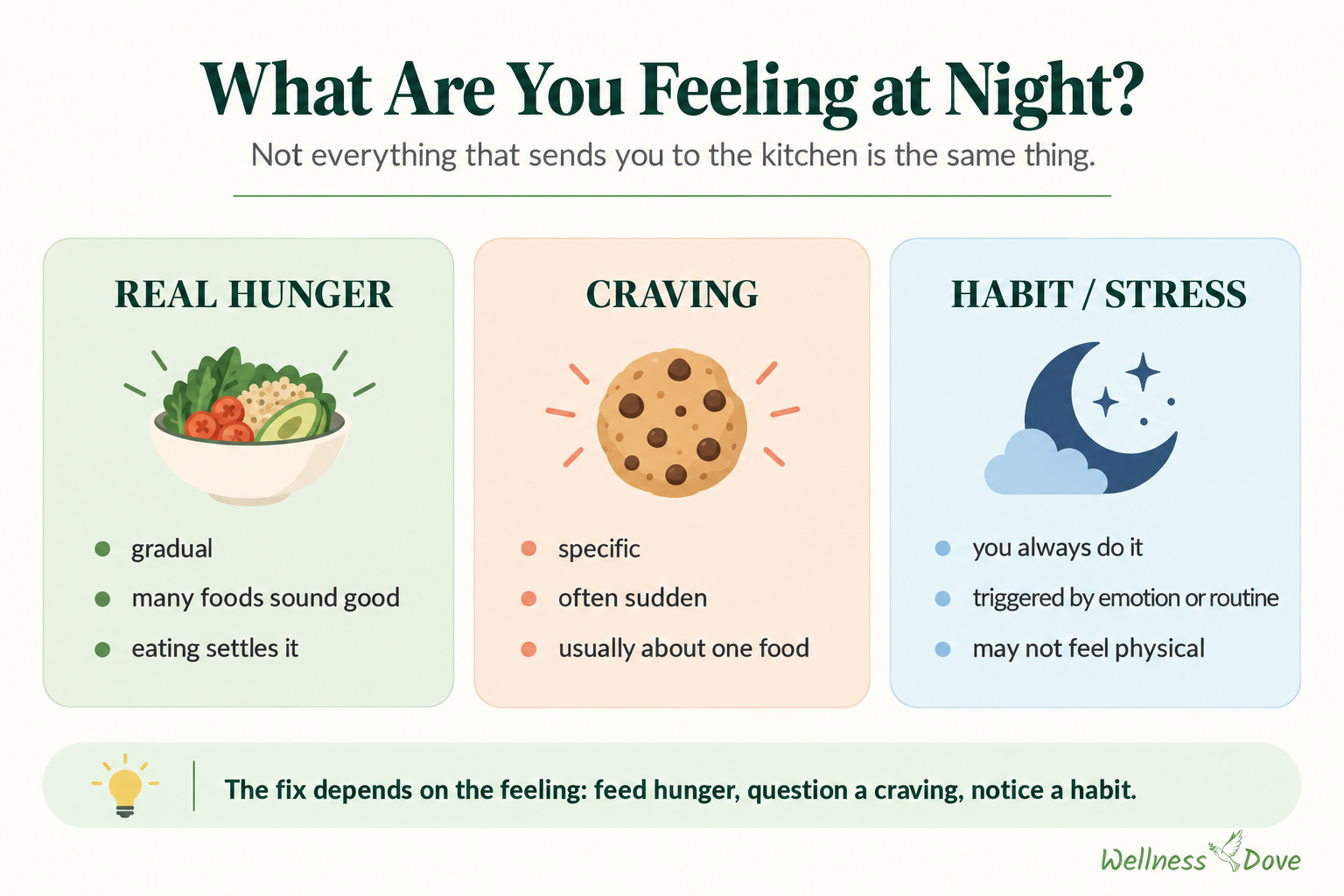
The Thirty-Second Test: Are You Really Hungry at Night?
Before you fix anything, find out what you’re dealing with. Ask yourself one question:
Would I eat a banana right now?
Or a plain apple. Or a bowl of last night’s soup. Something completely boring.
If yes, you’re hungry. Go eat.
If only the specific thing will do (the cookie, the chips, the wafer) it isn’t hunger, and eating won’t settle it.
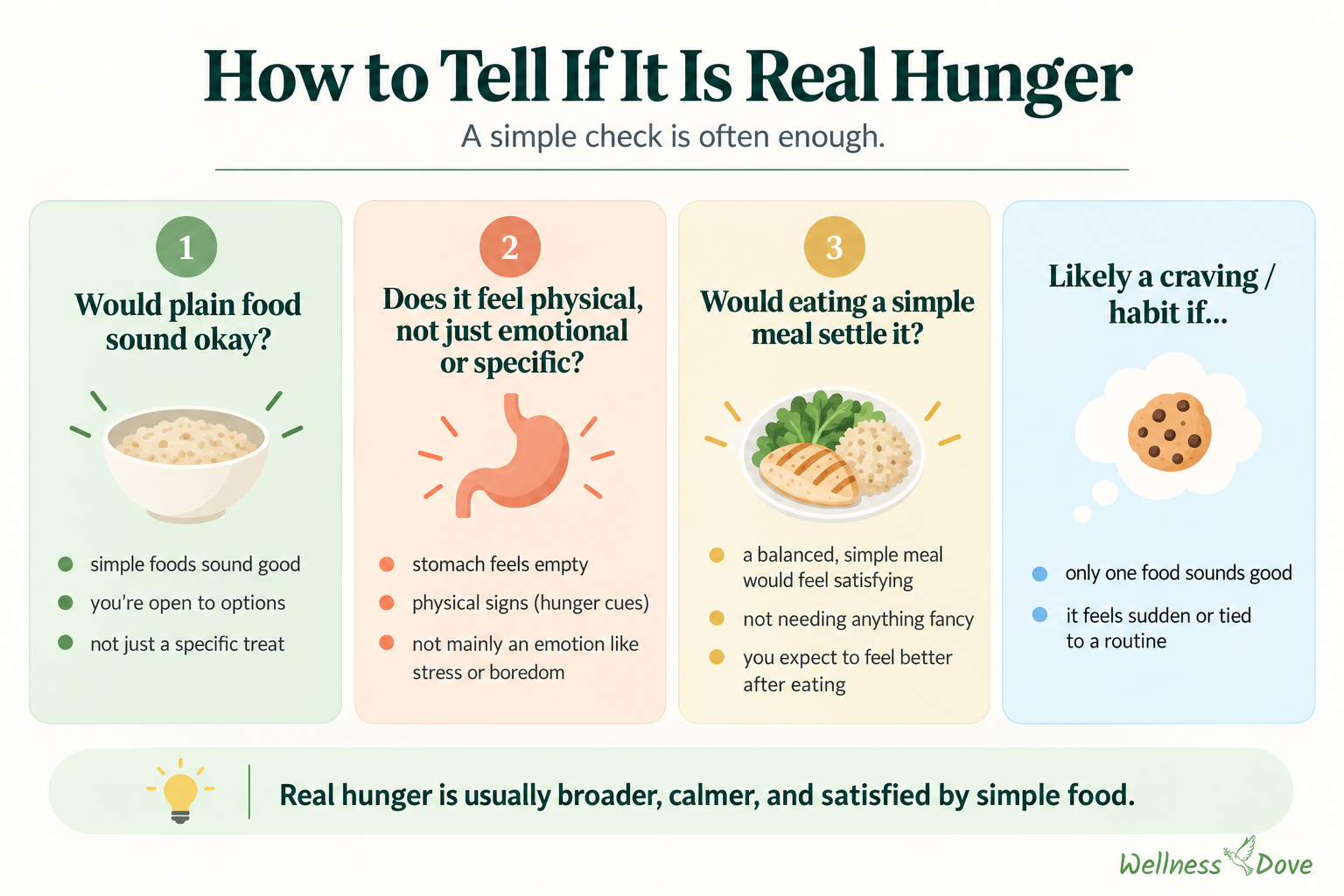
This works because hunger and wanting run on separate machinery. Hunger is your body asking for fuel, and fuel is fuel, so a banana counts. Wanting is your brain asking for a specific reward, and only that reward will do. You can have almost no hunger and enormous wanting at the same time, and most advice about night eating fails because it treats the two as if they were one problem.
If You’re Not Hungry, What’s the Craving Really For?
Back to the wafer. I used willpower, went out, bought bananas, and ate two of them, deliberately boring. Somewhere in the middle of the second one I noticed the thing that mattered: I didn’t want it. The bananas went down fine, but the pull toward the wafer was still there, and that told me it had never been hunger.
So what had I wanted? I was doing boring work, and I wanted food to make the time more interesting. I was reaching for it the way you’d reach for a drug, not for fuel but for a change in how the afternoon felt.
The part that caused it
Here’s the bit I didn’t see coming, and it’s the useful bit. Just before the craving started, I’d taken a break on Facebook. Ten minutes of fast, bright, effortless stimulation, and then I went back to my work, which now felt dramatically more boring than it had before the break. Nothing about the work had changed. What had changed was the thing I was comparing it to.
The break didn’t rest me. It raised the bar my work had to clear. Once the work fell short of that bar, my brain went looking for the next available hit, and the kitchen was eleven steps away.
If your breaks end in the kitchen, look at what the break was. A scroll isn’t rest. It’s more stimulation, and it makes whatever you go back to feel duller than it did before, so food ends up being the next thing on the shelf.
This is the piece most articles about night eating leave out. They assume you’re hungry and under-fed, and sometimes you are. But an enormous amount of eating happens because a tired, bored or understimulated mind is looking for something to change how it feels, and food is the fastest, cheapest, most available tool there is. A tired mind craves. A bored mind craves. That’s a mind doing its job with the tools it has in reach, not a character flaw.
What Works When You Want to Eat but You’re Not Hungry
Here’s what I did instead, and I’ll admit up front that it sounds like nothing. I cleaned the kitchen. Not a deep clean, and it wasn’t disgusting to begin with. A bit of dusting, a few spots that needed doing, fifteen minutes in all.
It worked completely, and not by distraction. My nervous system settled down, and I came back feeling more ready to work rather than more depleted. There was a bonus I didn’t expect, too. While my hands were busy with something undemanding, my mind had some space, and it worked out two things about the job I’d been sitting at my desk feeling pressured to solve quickly. I went to escape the work and came back with the work half done.
Why cleaning beat scrolling
The scroll, the wafer and the clean-up are all attempts to solve the same problem. Only one of them works, and the difference is the direction each one pushes you in.
- Scrolling adds stimulation. It raises the bar, so the next thing feels worse.
- Eating adds stimulation. Same trick, more calories, and it ends with you feeling bad about yourself.
- Cleaning lowers it. It’s physical, undemanding and mildly useful, so your system settles instead of ratcheting up another notch.
What my mind needed was space and calm. What I’d been trying to give it was excitement, and the excitement was making things worse, not better.
Things that work the same way
- Doing the dishes. Warm water, hands busy, nothing to decide.
- Ten minutes outside without your phone. Leaving the phone behind is the whole point.
- Tidying one surface. One. Not the house.
- Sitting still and doing nothing for five minutes. It’s the hardest one, and often the one that works best.
And if you’ve done that and you still want to eat, eat something. That’s fine. The test is there to tell you what you’re dealing with, so you stop applying the wrong fix, not to help you win a standoff with yourself.
If You’re Going to Eat Something Anyway
Let’s be clear about what these are. None of them will fix boredom. Nothing you eat will. But they end the evening better than the alternative, and they don’t leave you hunting for the next thing twenty minutes later.
- 3-Ingredient Energy Balls: sweet and dense, and two of them feels like two of them, not like the start of something.
- Cranberry Oatmeal Energy Bites: keep a jar in the fridge so the decision is already made.
- Sweet Potato Truffles: for the nights when what you want is chocolate.
- A slice of real bread: something dense like our lentil bread, not something that vanishes in three bites.
- A bowl of last night’s soup: warm food closes an evening better than cold food does.
One thing that has nothing to do with the food itself: eat it at the table, with the screen off. That isn’t a punishment. Eating in the cue-place is what taught your brain the ritual in the first place, and eating somewhere else is what starts to unteach it.
If You Really Are Hungry at Night, Count What You Ate
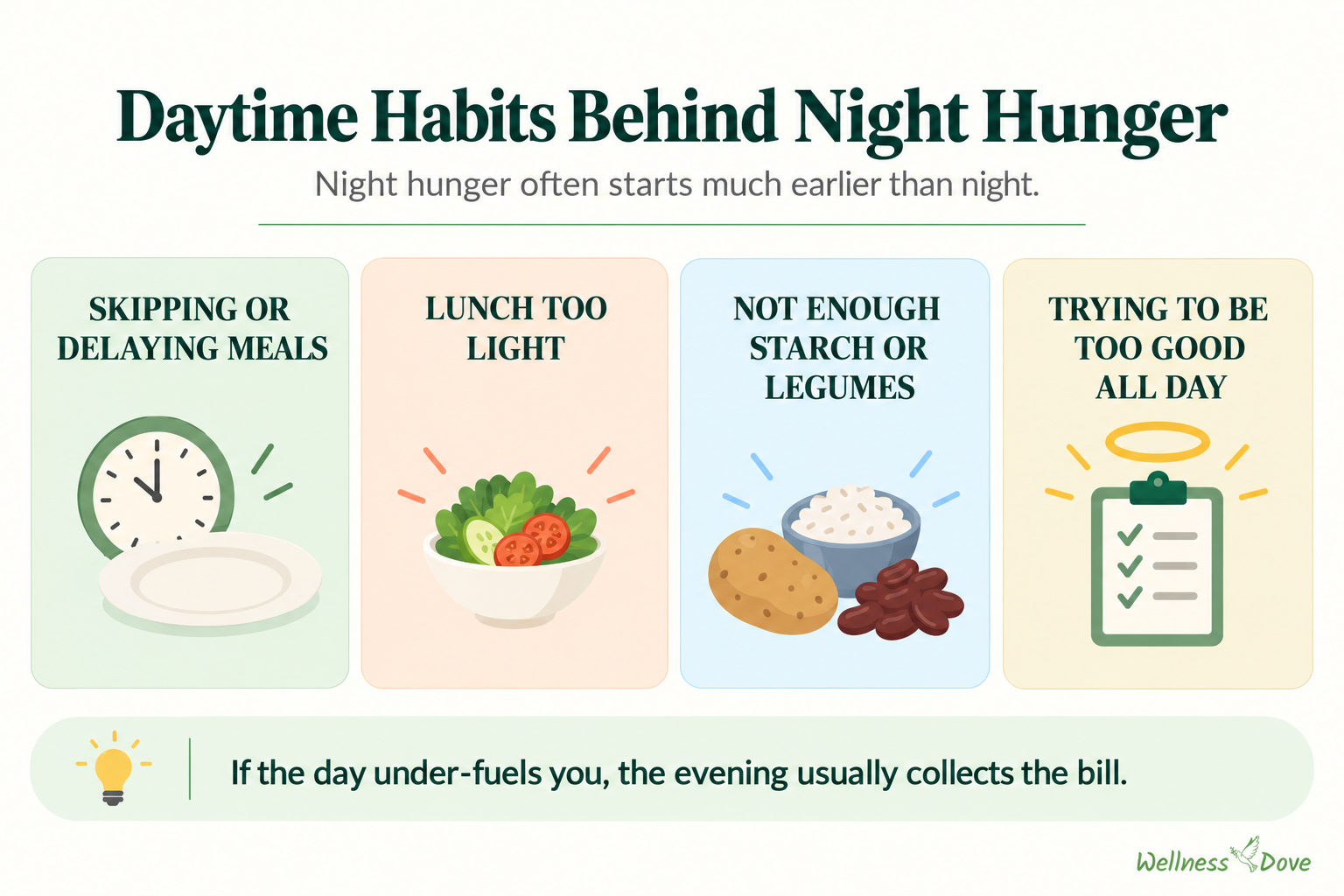
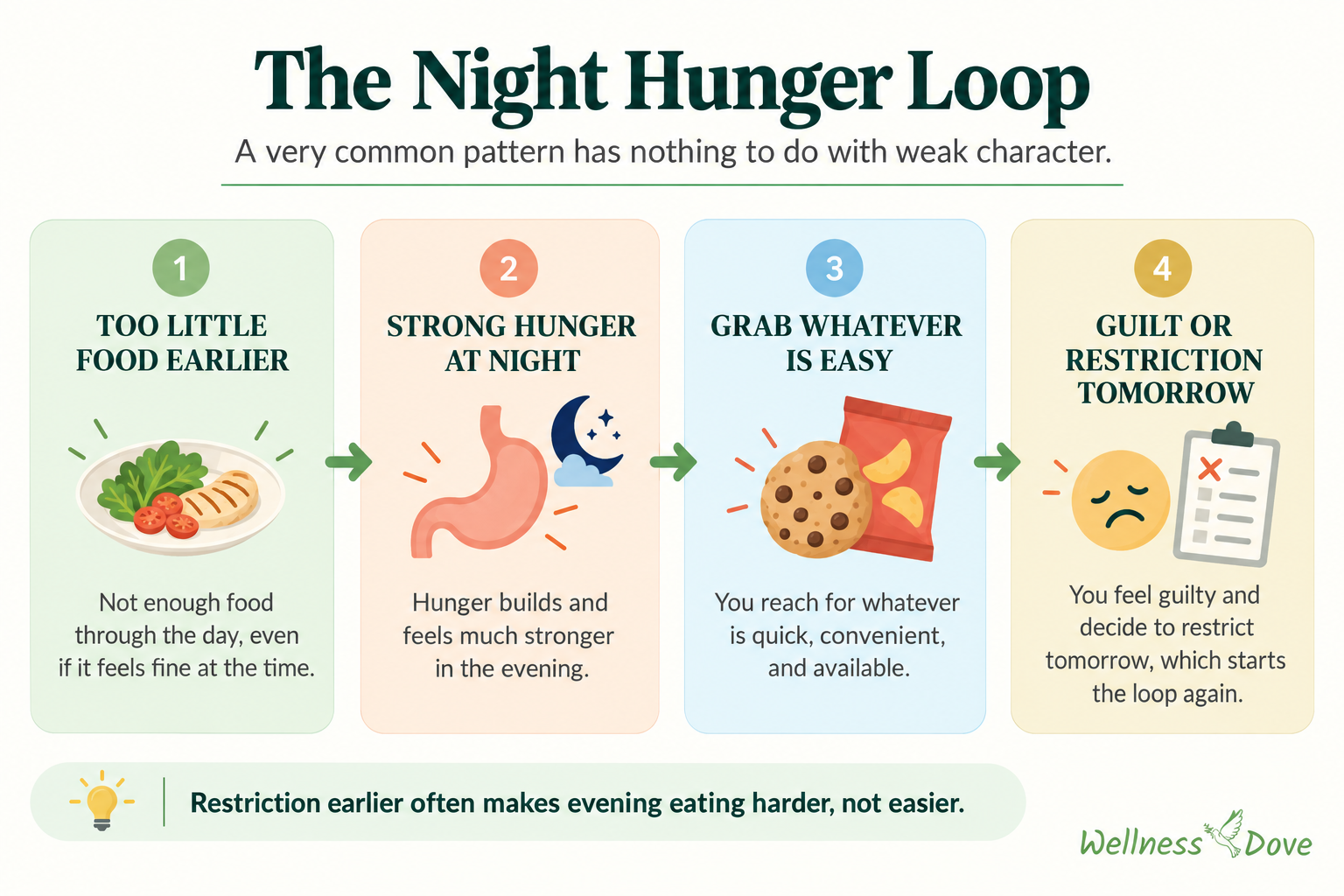
Now the other case, because it’s real too. If you took the banana test and the answer was a clear yes, and this happens most evenings, look at your day. Some people, particularly people who are being careful, really are running on too little.
| A careful day | Roughly |
|---|---|
| Coffee and a small breakfast | 150 to 250 |
| A big vegetable salad, no dressing | ~150 |
| Or a cup of broth-based soup | ~70 to 120 |
| An apple mid-afternoon | ~95 |
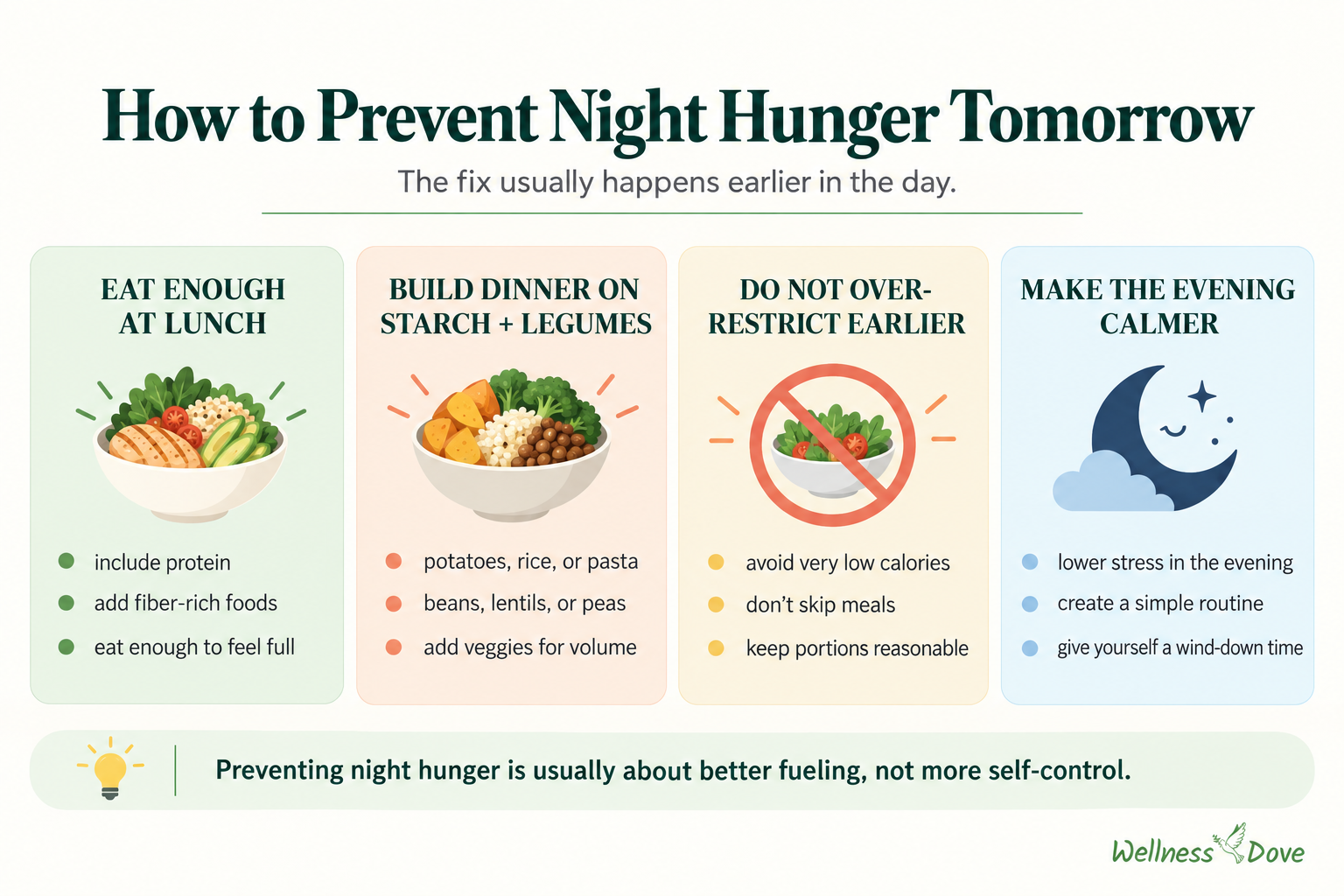
That’s roughly 300 to 500 calories before dinner, when most adults need somewhere between 1,600 and 3,000 a day. If that’s your day, the evening is a bill arriving, not a failure of willpower. The fix is at lunch, not at 9pm. Keep the salad and put a real starch next to it:
| Add one of these | Calories |
|---|---|
| A cup of cooked lentils | ~230 |
| Two fist-sized potatoes | ~300 |
| A cup of cooked rice | ~200 |
People worry that starch is the thing that made them hungry, but the evidence points the other way. Researchers fed people 38 different foods, matched so that every serving delivered the same calories, and then measured how full each one kept them. The winner by a wide margin was the plain boiled potato, ahead of eggs, cheese and every animal food on the list. Refined starch (crackers, white bread, pastry) behaves nothing like a whole potato or a bowl of lentils, though, even if it goes by the same word.
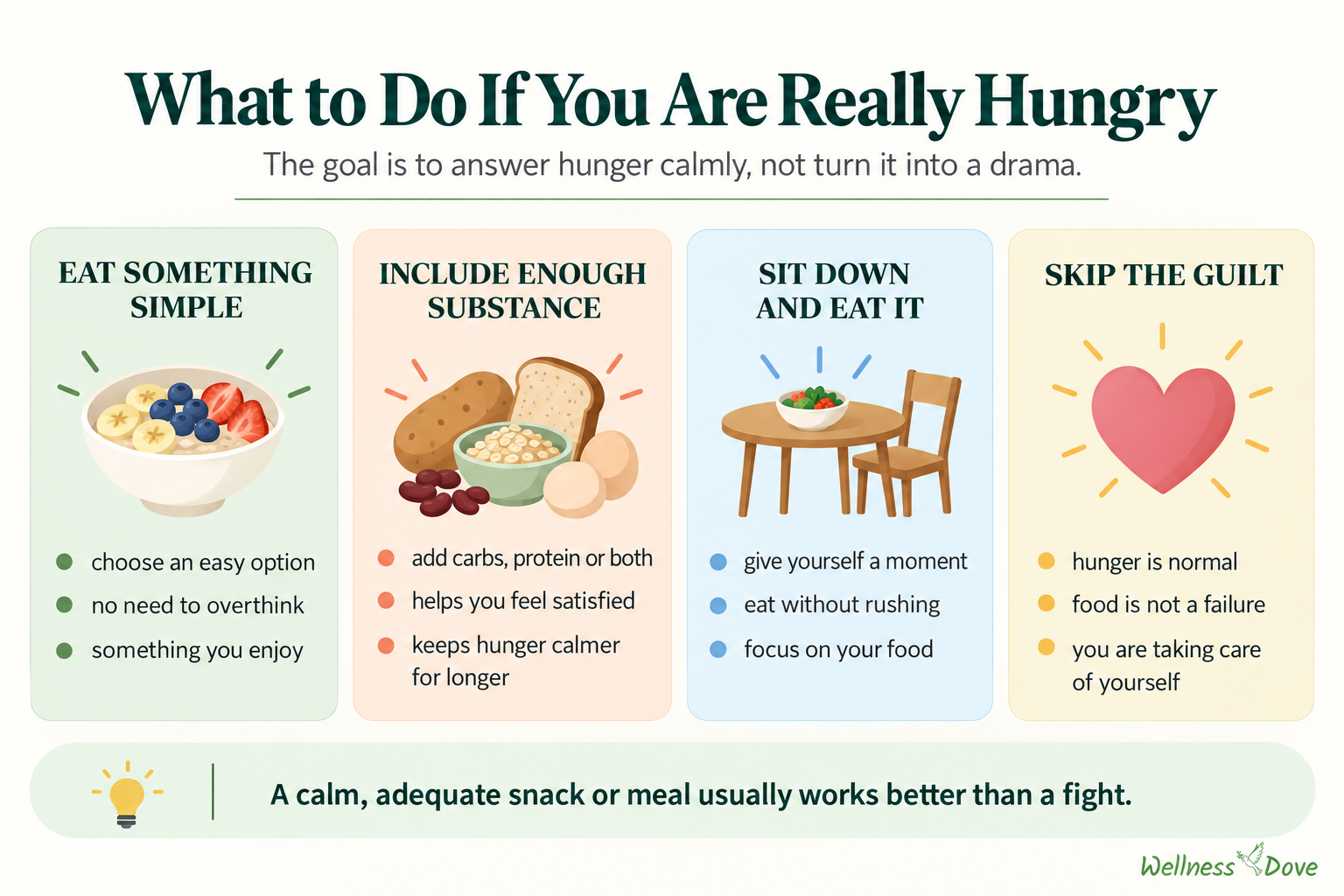
Six Lunches That Hold Until Dinner
These are the ones we come back to. Every one of them is built around a starch, and every one survives being made in advance.
- Easy Red Lentil Soup: the one we make most often. It freezes, it reheats, and many people find lentils easier on the stomach than bigger beans.
- Bean Stuffed Sweet Potatoes: starch and beans in one dish. Bake a few extra and eat them cold the next day.
- Oil-Free Roasted Potatoes: make a tray on Sunday and put them cold on a salad all week.
- Baked Chickpea Balls: four of these turn a bowl of leaves into a proper meal.
- Bean and Lentil Soup: one of the most filling things on this list for its calories.
- Sweet Potato Lentil Curry: for when a plain lunch isn’t going to be enough to keep you interested.
There’s more on why the middle of the day is the weak point here: Lunch Is Where Plant-Based Eating Falls Apart.
Four Things That Stack Up at Night
Whichever case you’re in, four things meet in the evening that weren’t there at breakfast.
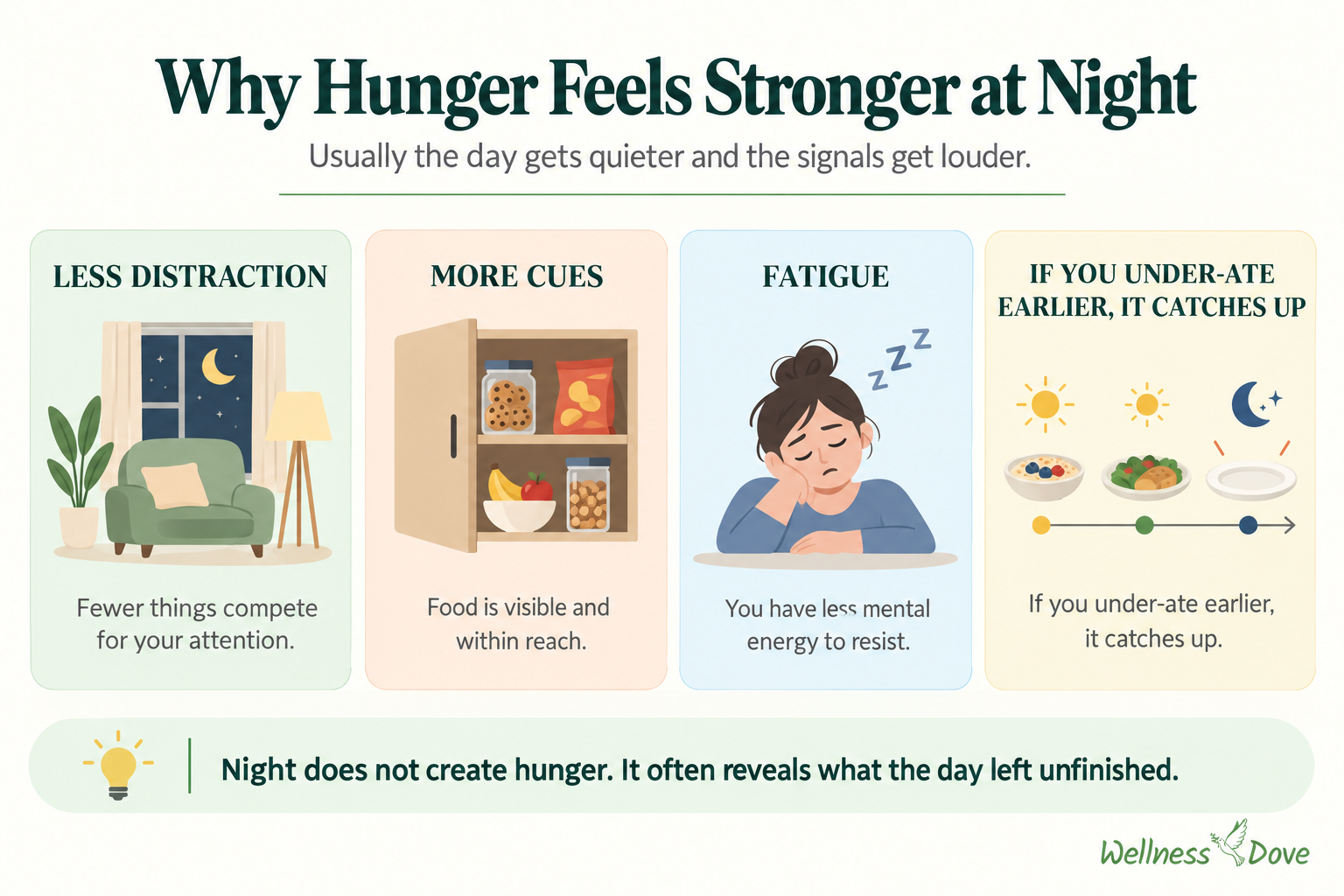
Evening biology
Appetite really does run higher later in the day. That part isn’t psychological, and it isn’t your fault.
The house goes quiet
All day you were too busy to notice much of anything. Then the noise stops, and you notice everything, hunger included.
The room has become a cue
Eat in front of the television forty nights running and the television is now part of the hunger. There’s no weakness in that. It’s the same learning that makes you reach for a seatbelt without thinking, and it’s the reason the table matters more than it sounds. The fix for a cue is changing the room, and willpower has very little to do with it.
You didn’t sleep enough. This is the one nobody connects to the fridge, and it’s the most measurable of the four. Short sleep makes you hungrier. Across dozens of lab trials, people rated their hunger higher after short nights. The popular explanation, that leptin falls and ghrelin rises, has held up only for ghrelin.
The effect isn’t vague, either. Underslept people eat roughly 300 calories more a day. In one small lab study, two short nights raised young men’s appetite for sweets, salty snacks and starchy foods by a third or more, while their appetite for fruit and vegetables rose much less. There’s a harder detail for anyone trying to lose weight on short sleep. In a two-week study of 10 dieters, when they had only 5.5 hours in bed, just a quarter of the weight they lost was fat and the rest was lean tissue and water. With 8.5 hours in bed, more than half was fat.
A tired body keeps asking for food even when there’s plenty of it. If the nine o’clock kitchen has become a nightly event and none of the food fixes have touched it, the problem may not be in the kitchen at all.
When Being Hungry at Night Isn’t About Any of This
Most night eating is a pattern problem, but some of it isn’t. Talk to your doctor if:
- You wake from sleep to eat and can’t settle until you do
- You have little appetite in the morning, and a quarter or more of your day’s food comes after dinner. That’s a recognized pattern with a name and a treatment.
- It arrived alongside thirst, weight change or unusual fatigue, which is worth a blood sugar and thyroid check
- You started a new medication recently. Several classes increase appetite, and it isn’t your imagination. Don’t stop it on your own; ask whoever prescribed it.
- Eating at night feels out of your control, or is followed by shame. That deserves real support, not a blog post.
Venny is a medical doctor and a specialist in Nutrition and Dietetics; Andy holds a master’s degree in psychology. This is general information, not a diagnosis, and it doesn’t replace advice from someone who knows your history.
Try This for One Week
Don’t add a rule about not eating after eight, and don’t throw anything out. Just run the test. Every time you find yourself heading for the kitchen and you’re not sure why, ask: would I eat a banana right now?
Yes → eat, and take a look at your lunch tomorrow.
No → you’ve learned something more useful. Ask what the last thing you did was, and whether it added stimulation or took it away. Then go and do something quiet with your hands for ten minutes and see what happens.
You may find the answer is “no” more often than you expected, and that isn’t bad news. It means the thing you’ve been trying to fix with discipline was never a discipline problem in the first place.
Read Next
- What Actually Happens When You Switch to a Plant-Based Diet: An Honest Timeline
- Lunch Is Where Plant-Based Eating Falls Apart
- 23 Easy Vegan Recipes for Beginners, by Meal
- Super Quick Sweet Potato Red Lentil Soup
- Bean Stuffed Sweet Potatoes
- Creamy Kale Potato Soup
- 7 Oil-Free Vegan Recipes for Healthy Dinners
Sources (14)
- Holt SH, Miller JC, Petocz P, Farmakalidis E. A satiety index of common foods. Eur J Clin Nutr. 1995;49(9):675-90. View
- Scheer FA, Morris CJ, Shea SA. The internal circadian clock increases hunger and appetite in the evening independent of food intake and other behaviors. Obesity (Silver Spring). 2013;21(3):421-3. View
- Al Khatib HK, Harding SV, Darzi J, Pot GK. The effects of partial sleep deprivation on energy balance: a systematic review and meta-analysis. Eur J Clin Nutr. 2017;71(5):614-24. View
- Zhu B, Shi C, Park CG, Zhao X, Reutrakul S. Effects of sleep restriction on metabolism-related parameters in healthy adults: a comprehensive review and meta-analysis of randomized controlled trials. Sleep Med Rev. 2019;45:18-30. View
- Lin J, Jiang Y, Wang G, et al. Associations of short sleep duration with appetite-regulating hormones and adipokines: a systematic review and meta-analysis. Obes Rev. 2020;21(11):e13051. View
- Spiegel K, Tasali E, Penev P, Van Cauter E. Sleep curtailment in healthy young men is associated with decreased leptin levels, elevated ghrelin levels, and increased hunger and appetite. Ann Intern Med. 2004;141(11):846-50. View
- Nedeltcheva AV, Kilkus JM, Imperial J, Schoeller DA, Penev PD. Insufficient sleep undermines dietary efforts to reduce adiposity. Ann Intern Med. 2010;153(7):435-41. View
- Lowe MR, Butryn ML. Hedonic hunger: a new dimension of appetite? Physiol Behav. 2007;91(4):432-9. View
- Berridge KC. ‘Liking’ and ‘wanting’ food rewards: brain substrates and roles in eating disorders. Physiol Behav. 2009;97(5):537-50. View
- Neal DT, Wood W, Wu M, Kurlander D. The pull of the past: when do habits persist despite conflict with motives? Pers Soc Psychol Bull. 2011;37(11):1428-37. View
- Tam KYY, Inzlicht M. Fast-forward to boredom: how switching behavior on digital media makes people more bored. J Exp Psychol Gen. 2024;153(10):2409-26. View
- Allison KC, Lundgren JD, O’Reardon JP, et al. Proposed diagnostic criteria for night eating syndrome. Int J Eat Disord. 2010;43(3):241-7. View
- U.S. Department of Agriculture. FoodData Central (lentils, apple, white rice, boiled potato). View
- U.S. Department of Agriculture, U.S. Department of Health and Human Services. Dietary Guidelines for Americans, 2020-2025. 9th ed. 2020. View