

Almost everything written about switching to a plant-based diet describes where you end up. Very little of it describes the road there, and the road is where people get lost.
So people set off, hit a rough patch in week two that nobody warned them about, decide the diet doesn’t suit them, and stop. In our experience they usually stop about two weeks before the part where it starts to feel good.
This post is the map we wish someone had given us in 2017. There are two rough patches, and we’ll tell you roughly when each one arrives and roughly when it ends.
The short version: Days 2 to 6 can be physically rough, mostly from your gut getting used to more fiber and from anything you quit at the same time, especially caffeine. By the end of week one you’ll see the first measurable wins. Weeks 2 to 3 are when the food tastes boring, and this is where most people quit. Somewhere around week four it flips. By about two months it stops taking effort. So the plant-based diet timeline has two dips in it, and both of them end.
The Plant-Based Diet Timeline at a Glance
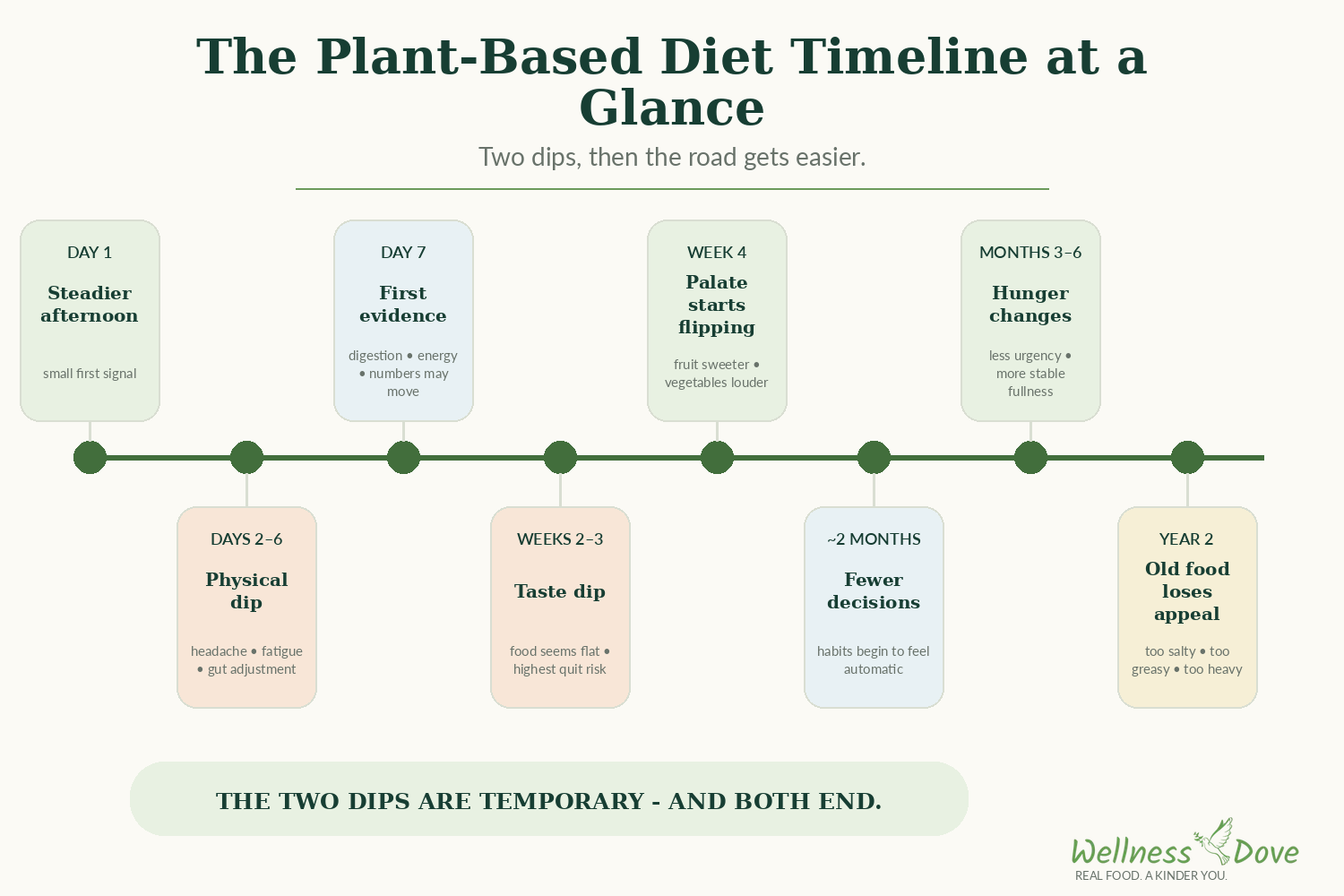
| When | What’s happening |
|---|---|
| Day 1 | A steadier afternoon than you expected |
| Days 2 to 6 | Headaches, fatigue, irritability. The physical dip. |
| Day 7 | First measurable changes: energy, digestion, blood pressure |
| Weeks 2 to 3 | Food tastes bland. The dangerous stretch. |
| Week 4 | Taste starts coming back. Fruit gets sweeter. |
| ~2 months | It stops needing decisions |
| Months 3 to 6 | Hunger itself changes |
| Year 2 | The old food stops being appealing |
Day 1: Something Small and a Little Odd
The first thing most people notice isn’t their weight or their energy. It’s that the afternoon doesn’t fall off a cliff the way it used to. If you eat beans or lentils at lunch, your blood sugar runs steadier for the rest of the day, and it’s still steadier after the next meal too. This has a name, the second-meal effect, and it was first measured in 1982: when seven volunteers ate lentils for breakfast, their blood sugar rise after a standard lunch four hours later was 38 percent flatter than after a bread breakfast. A 1988 follow-up found the same kind of effect overnight, with lentils and other slow-digesting foods at dinner steadying blood sugar after the next morning’s breakfast.
It’s a small thing, but it’s real, and it happens on day one. We tell people to watch for it because it’s the first sign that something is working.
Days 2 to 6: The Part Where You Feel Worse
Here’s the question we get more than any other, usually on about day three:
“If this diet is so healthy, why do I feel so terrible?”
Headache, a flat and heavy kind of tiredness, a short temper, and sometimes a couple of days of unsettled digestion. We remember it well. Most of it has a boring explanation, and it’s worth going through the list because none of it is your body objecting to vegetables:
- Caffeine. If you cut coffee at the same time (and a lot of people do, because they want to change everything at once), withdrawal headaches peak around 24 to 48 hours in and can drag on for the better part of a week.
- Fiber. Your gut bacteria are being asked to do a job they haven’t done in years. Gas and bloating in the first week are a population of bacteria adjusting to new work, not a sign that you can’t digest beans.
- Everything else you took out, each on its own clock. Caffeine withdrawal usually runs its course in two to nine days. Cheese, sugar and salt each lose their pull at their own pace rather than all at once, and that’s why the week feels messy instead of like one clean withdrawal.
- The habits themselves. Taking away the 4pm chocolate changes the shape of your day, not just your nutrition, and you feel that as much as anything physical.
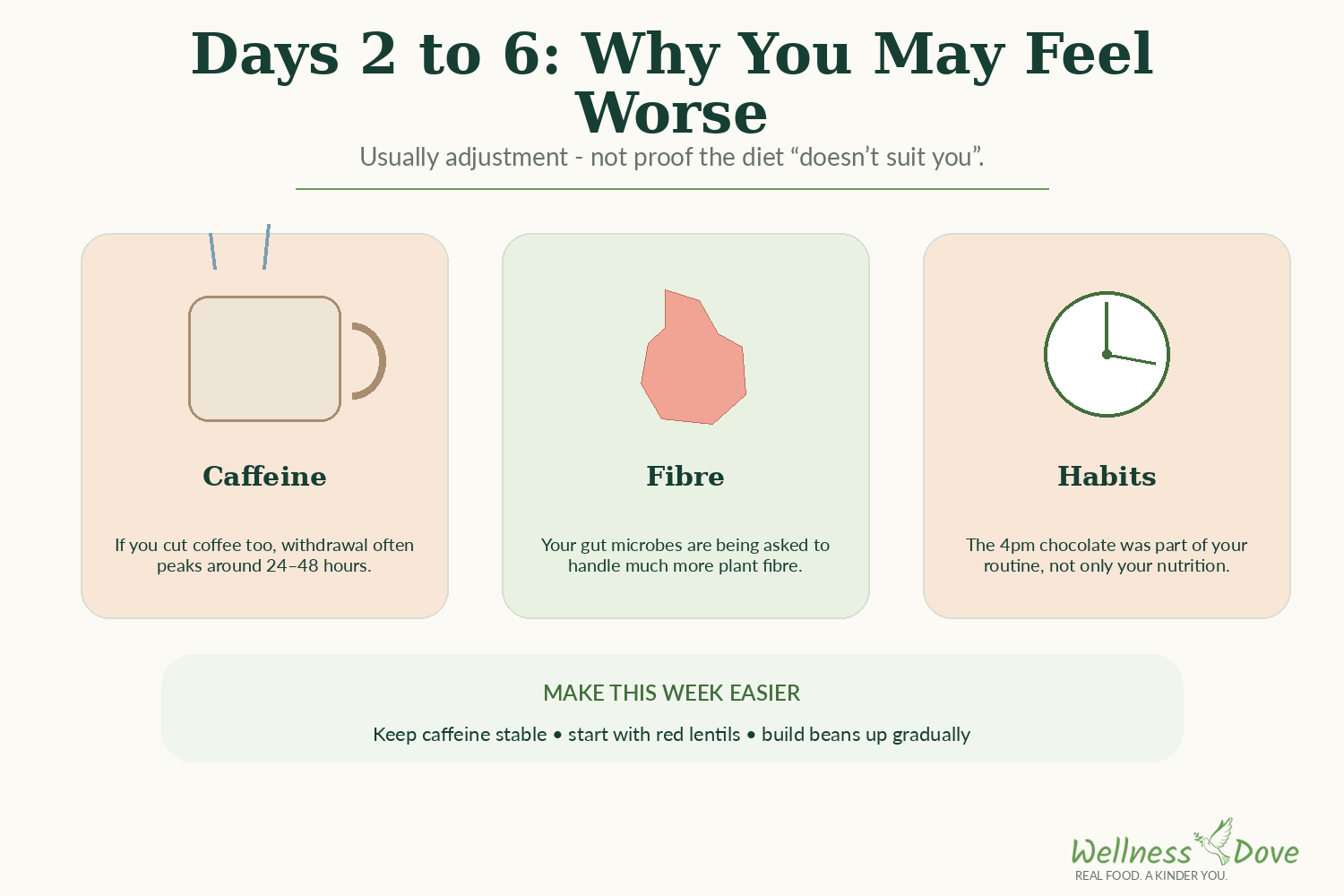
Two things that make this week much easier: don’t quit caffeine in the same week you change your food, and go slowly with the beans. Start with small portions and build up over two weeks rather than over a weekend.
One caveat, because this is the stage where the internet gets irresponsible: not everything that happens in week one is “detox.” Feeling rough for a few days is common. Feeling seriously unwell is not, and if that’s you, please get it looked at rather than pushing through.
Day 7: The First Real Evidence
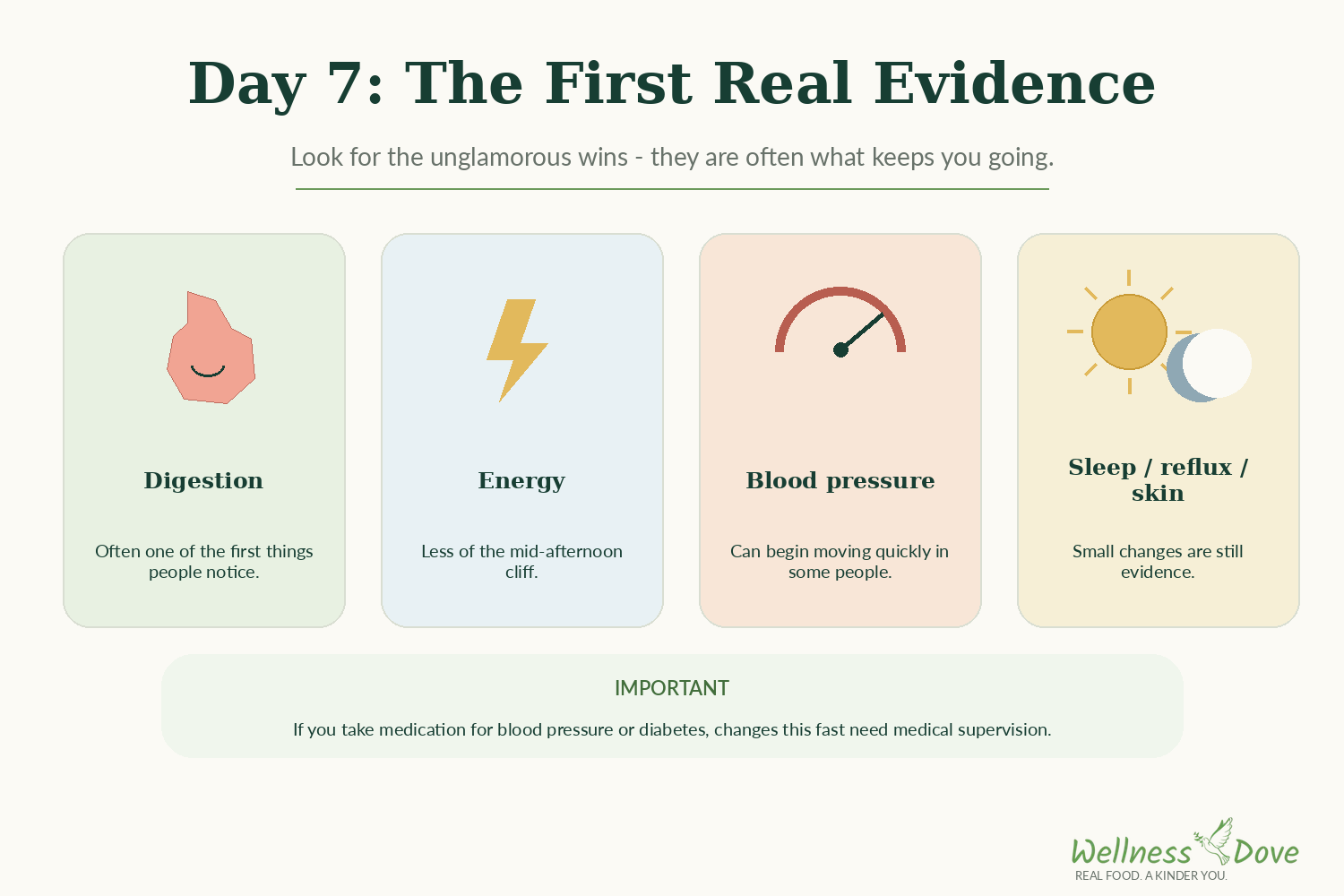
One week in, things start showing up that you can point at. Digestion is usually first, often within a day or two, and unmistakably by the end of the week. Then there’s energy that doesn’t collapse in the middle of the afternoon. Blood pressure often starts to move within the first seven days as well.
There are numbers on this, and they’re better than most people expect. Researchers followed 1,615 people through a seven-day residential program and published the results in Nutrition Journal. Eating as much as they wanted, the average person lost 3.1 pounds. Average cholesterol fell by 22 mg/dL. Among those who came in with high blood pressure, the typical drop was 18 points on the top number and 11 on the bottom. That happened even though the program’s doctors cut back or stopped most blood pressure and diabetes medication on day one, to keep levels from falling too low.
We should be fair about that study, though. Those people were fed, in a residential setting, for a week. No shopping, no cooking, no birthday party on Thursday. That’s the best-case version of a first week rather than the ordinary one, so treat those numbers as the ceiling and not the expectation.
The wins that matter more than people expect are the unglamorous ones: reflux settling down, better skin, sleeping through the night. Nobody puts those in a before-and-after photo, but in our experience they’re often what makes someone stay. So watch for them deliberately. They’re going to be your evidence when week two gets boring.
If you take medication for blood pressure or diabetes, this is exactly the point where it needs supervising. This way of eating can move those numbers fast enough that doses need adjusting, and that’s a conversation to have with your doctor, not something to manage on your own.
Weeks 2 to 3: The Stretch Where Most People Quit
If this timeline is useful for one thing, we hope it’s this section.
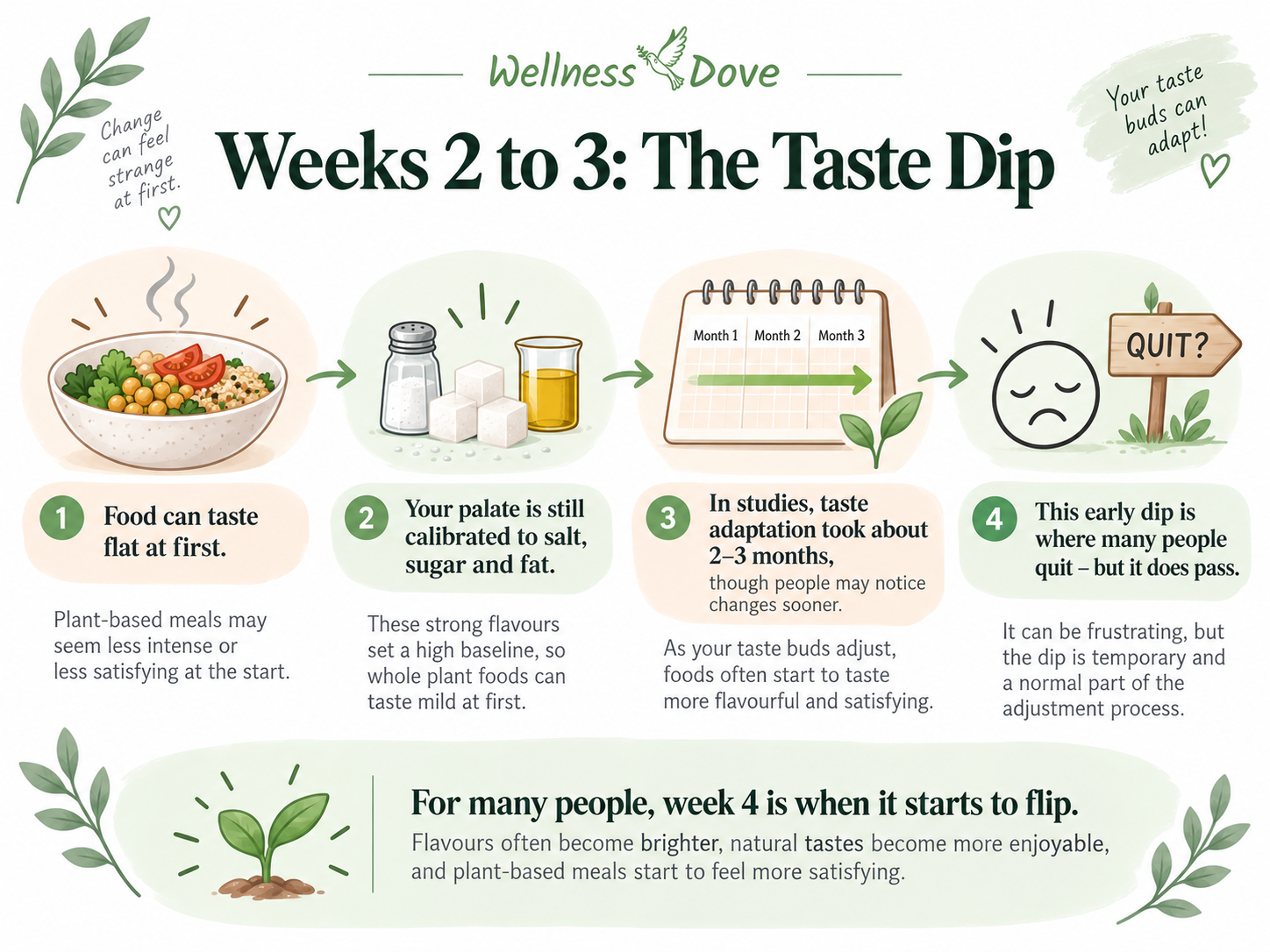
By the second week the headaches have gone, and the novelty has gone with them. What you’re left with is a plate of food that tastes like almost nothing. People describe it as boring, or flat, or like eating with a cold. It’s not in your head, and it’s not permanent.
Processed food is engineered to hit salt, sugar and fat harder than anything that grows out of the ground. Against that reference point a bowl of lentils really does taste faint. Your palate has been calibrated to a very loud signal, and it takes time to recalibrate to a quieter one. In the studies that took about two to three months for salt and sugar, though many people notice the first signs sooner, and the worst of it is early on.
The cruel part is the timing. This dip lands after the initial motivation has worn off and before the payoff arrives, and that’s why so many attempts die in week three rather than week one.
What to do while you wait
- Finish with acid. Lemon or vinegar added at the end of cooking does what salt does, but from a different direction.
- Salt the surface, not the pot. Salt on top hits your tongue first, so a little on the plate tastes saltier than the same amount stirred into the pot.
- Use more spice than feels reasonable. Most people under-spice by about half, in our experience.
- Eat something hot and savory. Soup gets you through a bland couple of weeks much better than salad does.
And if there’s one thing to hold onto, it’s this: give it two to three months. The gas usually settles within two or three weeks, but in the studies taste took about two to three months to recalibrate, and new habits took a median of about nine weeks.
Week 4: It Flips
Somewhere around the fourth week people report the same odd experience: fruit tastes sweet again. Aggressively sweet, sometimes. A roasted sweet potato stops being something you eat because it’s good for you and starts being something you look forward to, and vegetables turn out to have flavors you’d assumed they didn’t have.
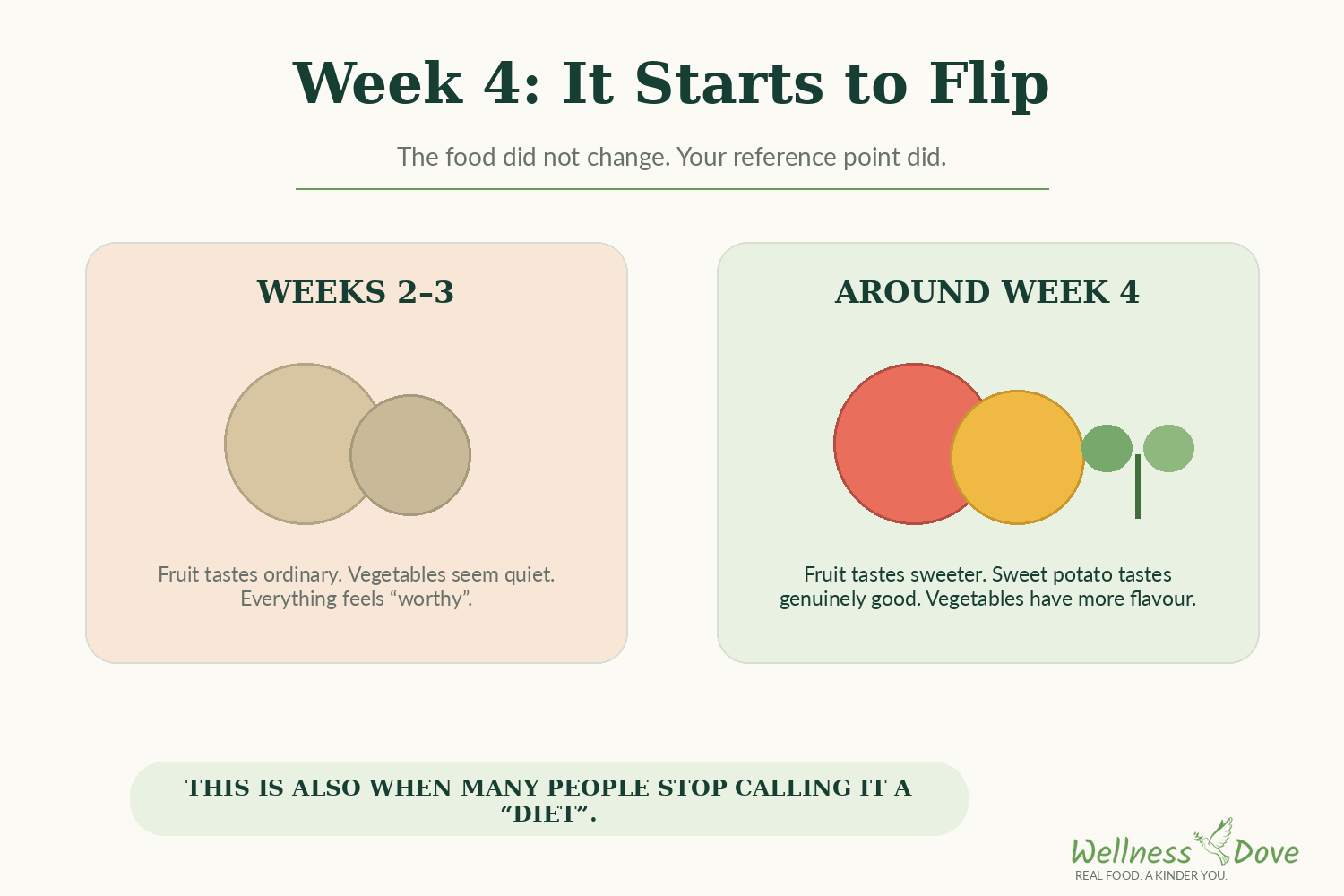
The food hasn’t changed at all. What’s changed is your sense of taste, which has finally caught up. This is also, usually, the point where people stop calling what they’re doing a diet.
Around Two Months: It Stops Taking Decisions
You’ve probably heard that habits take 21 days to form. That number comes from a plastic surgeon’s observations in the 1960s, and it isn’t right. When a London study followed 96 people building one simple daily habit, the median was 66 days, with an enormous spread, from 18 days to an estimated 254 depending on the person and the habit.
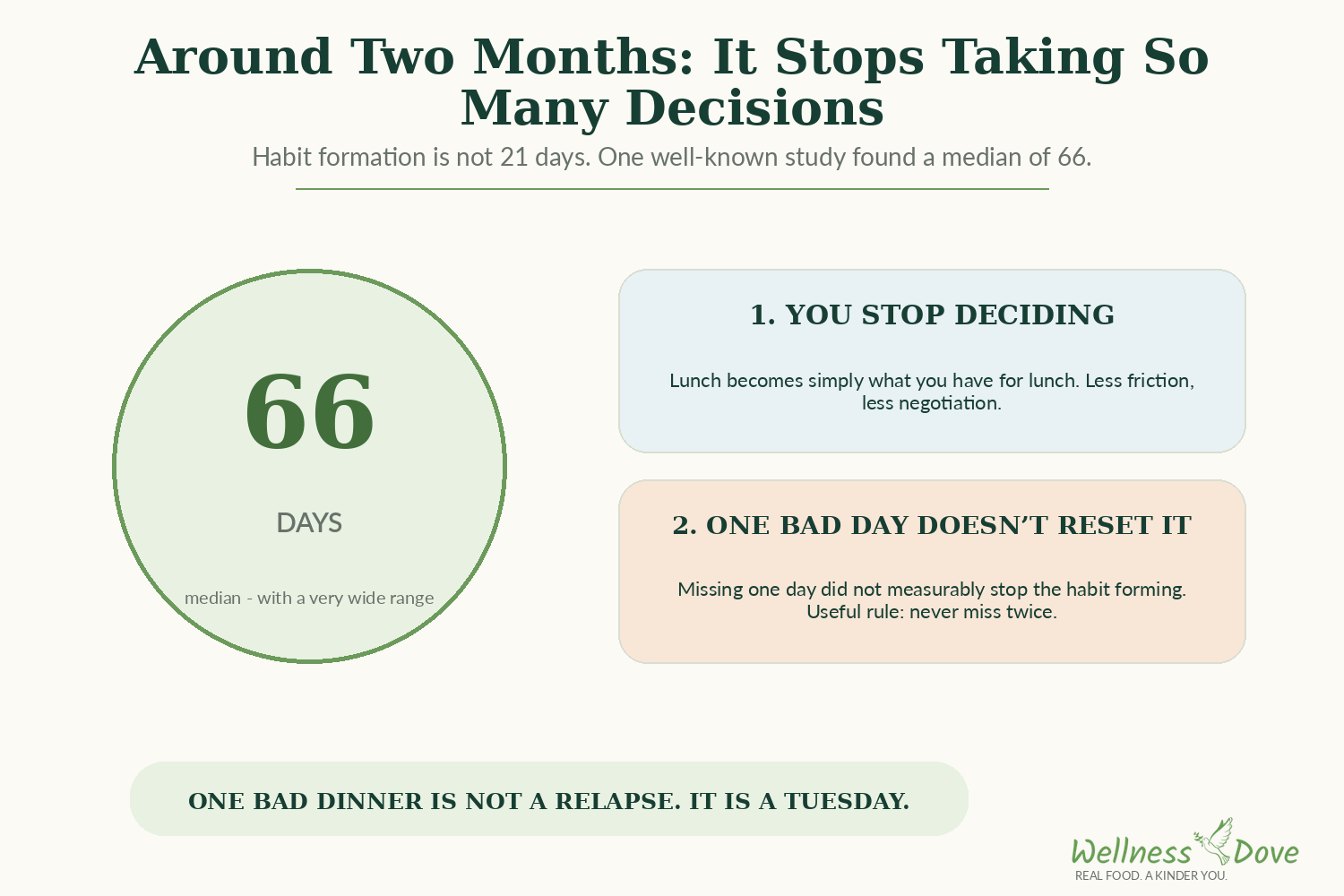
Two useful things fall out of that. First, at around two months this really does get easier, and the change is that you stop deciding. Lunch is just what you have for lunch, the same way it was before you started, and there’s no willpower involved anymore.
Second, and this is the finding we’d write on the fridge: missing a single day made no measurable difference to whether the habit formed. One bad dinner isn’t a relapse. A good rule of thumb that follows from it: never miss twice. That’s a much easier rule to live with than perfection.
Months 3 to 6: Hunger Changes Shape
This one is harder to describe, and it’s the change people find strangest. Hunger stops being an emergency. It shows up as information rather than urgency, so you notice that you should eat instead of feeling that you need to eat right now.
It even moves location, which sounds absurd until it happens to you. In a 2010 online survey of 768 people eating a high-nutrient, mostly plant diet, nearly 80 percent said their hunger felt different than before, and about 3 in 10 now felt it in the throat and mouth instead of only in the stomach. The people surveyed were readers of the diet author’s own website, so take it as what people report rather than proof of why.
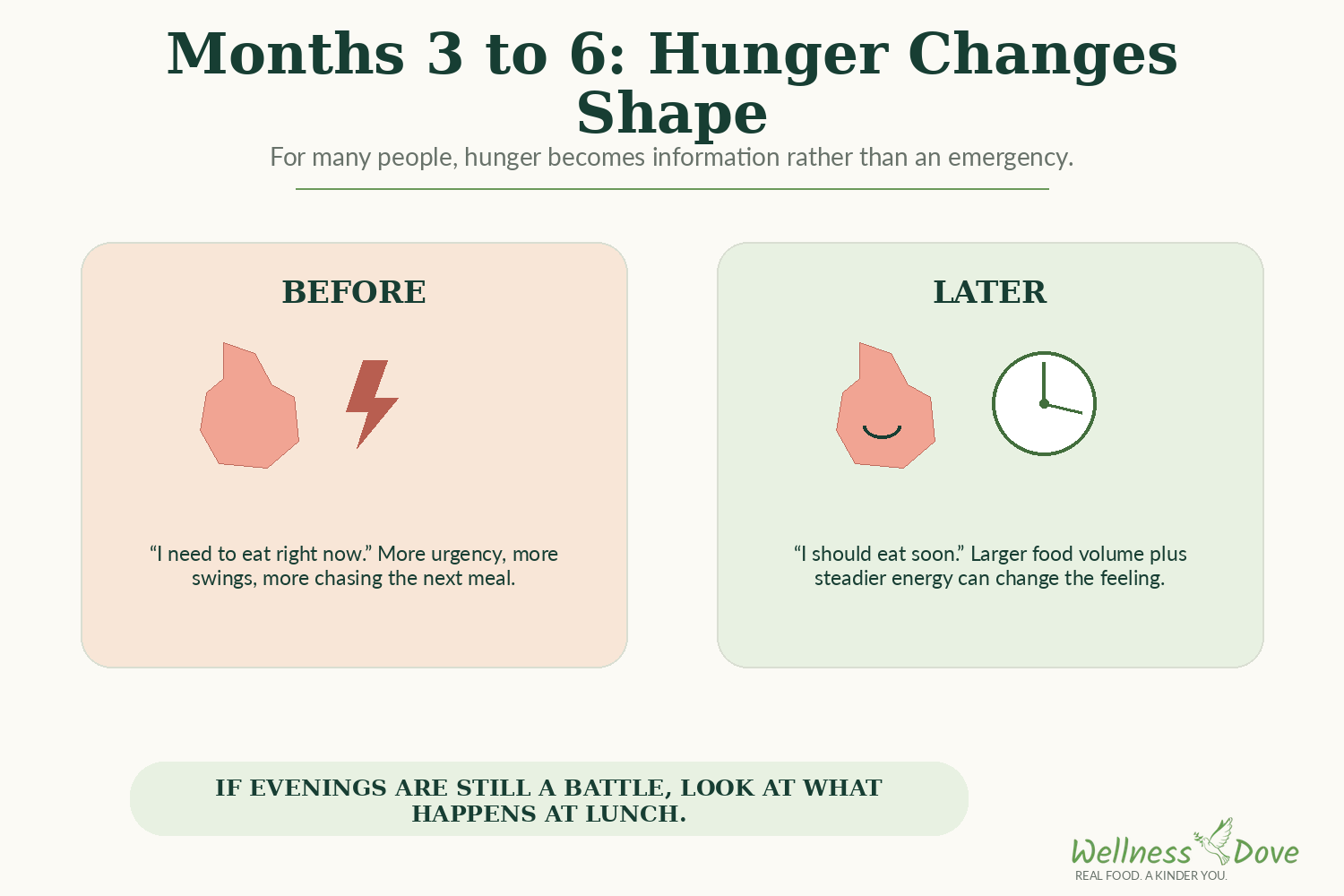
Part of it is the food. Whole plant foods carry far fewer calories per mouthful, so you eat a larger volume, and the stretch receptors in your stomach are a big part of how fullness gets registered. You are, quite literally, filling up. And part of it is likely that the big blood-sugar swings have calmed down, so there’s no crash to mistake for hunger.
If you’re still fighting the evenings at this stage, the problem is almost always in the middle of the day. We wrote about that here: why you’re so hungry at night.
Year Two: The One-Way Street
The long-term change isn’t discipline. It’s that the old food stops being attractive. People who go back to a favorite takeout after a year or two mostly report the same thing, and they’re usually surprised by it: too salty, too greasy, and a heavy hour afterward that they’d forgotten was part of the deal.
There’s no virtue in it. It’s the same recalibration that made week two hard, only now it’s working for you instead of against you. We wrote about the longer view here: What This Looks Like After a Year.
The Two Things Worth Remembering
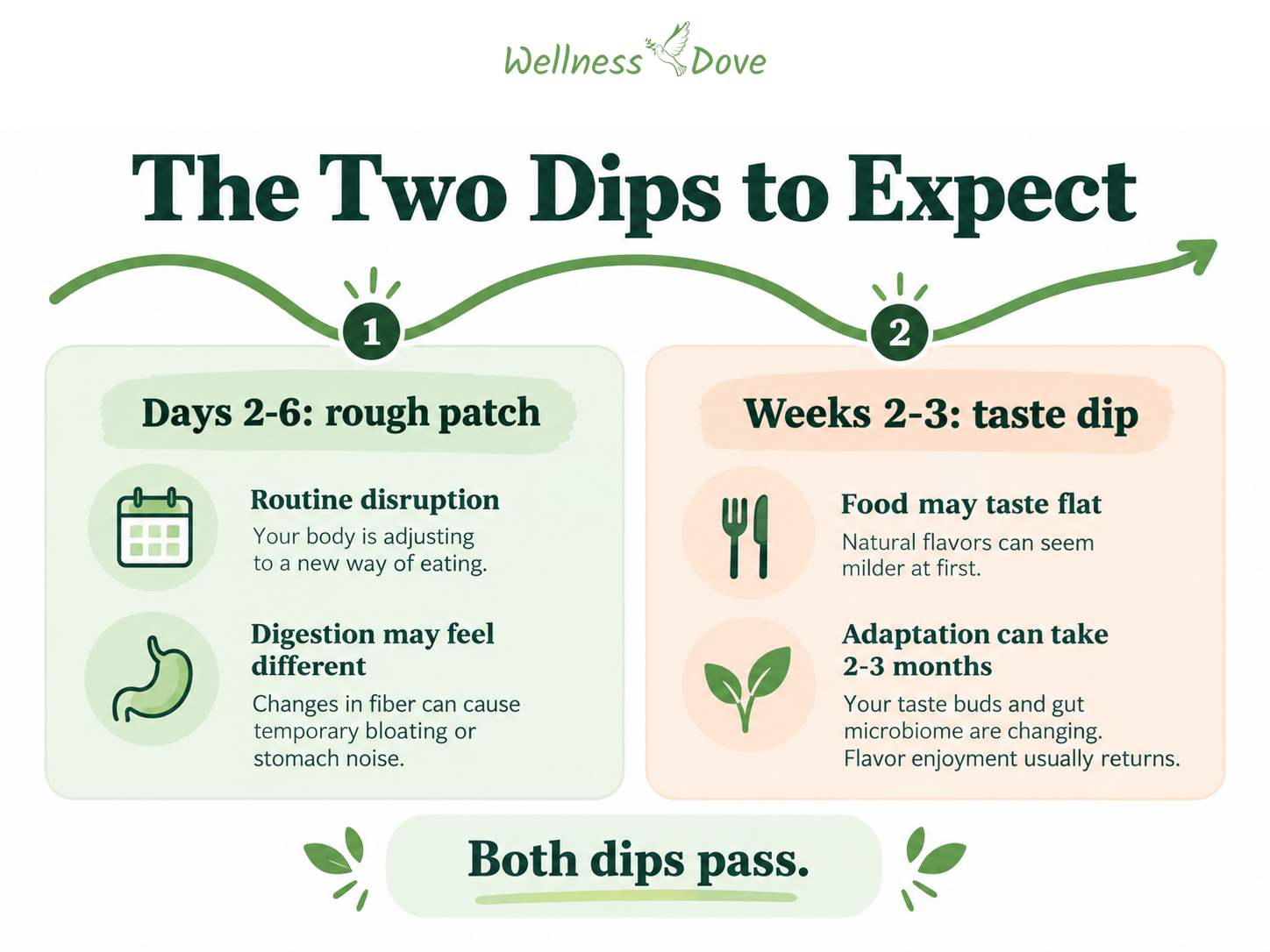
There are two dips, not one. Days 2 to 6 is physical and short. Weeks 2 to 3 is about taste, and that’s the one that ends most attempts, because by then nothing hurts. The food is just dull, and dull turns out to be much harder to push through than painful.
Both are temporary, and both are your body adjusting rather than rejecting. If you’re in one of them right now, you’re not doing anything wrong. You’re on schedule.
Venny is a medical doctor and a specialist in Nutrition and Dietetics; Andy holds a master’s degree in psychology. This is general information rather than medical advice, and anyone taking medication for blood pressure, diabetes or heart disease should make these changes with their own doctor involved.
Read Next
- Why Am I So Hungry at Night? (You Might Not Be)
- Lunch Is Where Plant-Based Eating Falls Apart
- 23 Easy Vegan Recipes for Beginners, by Meal
- Easy Red Lentil Soup: a soft, quick first bean dish
Sources (15)
- McDougall J, Thomas LE, McDougall C, et al. Effects of 7 days on an ad libitum low-fat vegan diet: the McDougall Program cohort. Nutr J. 2014;13:99. Erratum: Nutr J. 2017;16:12. View
- Jenkins DJ, Wolever TM, Taylor RH, et al. Slow release dietary carbohydrate improves second meal tolerance. Am J Clin Nutr. 1982;35(6):1339-46. View
- Wolever TM, Jenkins DJ, Ocana AM, et al. Second-meal effect: low-glycemic-index foods eaten at dinner improve subsequent breakfast glycemic response. Am J Clin Nutr. 1988;48(4):1041-7. View
- Mollard RC, Wong CL, Luhovyy BL, Anderson GH. First and second meal effects of pulses on blood glucose, appetite, and food intake at a later meal. Appl Physiol Nutr Metab. 2011;36(5):634-42. View
- Juliano LM, Griffiths RR. A critical review of caffeine withdrawal. Psychopharmacology (Berl). 2004;176(1):1-29. View
- Winham DM, Hutchins AM. Perceptions of flatulence from bean consumption among adults in 3 feeding studies. Nutr J. 2011;10:128. View
- Lally P, van Jaarsveld CHM, Potts HWW, Wardle J. How are habits formed: modelling habit formation in the real world. Eur J Soc Psychol. 2010;40(6):998-1009. View
- Maltz M. Psycho-Cybernetics. Englewood Cliffs (NJ): Prentice-Hall; 1960.
- Wise PM, Nattress L, Flammer LJ, Beauchamp GK. Reduced dietary intake of simple sugars alters perceived sweet taste intensity but not perceived pleasantness. Am J Clin Nutr. 2016;103(1):50-60. View
- Bertino M, Beauchamp GK, Engelman K. Long-term reduction in dietary sodium alters the taste of salt. Am J Clin Nutr. 1982;36(6):1134-44. View
- Mattes RD. Fat preference and adherence to a reduced-fat diet. Am J Clin Nutr. 1993;57(3):373-81. View
- Noort MWJ, Bult JHF, Stieger M, Hamer RJ. Saltiness enhancement in bread by inhomogeneous spatial distribution of sodium chloride. J Cereal Sci. 2010;52(3):378-86. View
- Powley TL, Phillips RJ. Gastric satiation is volumetric, intestinal satiation is nutritive. Physiol Behav. 2004;82(1):69-74. View
- David LA, Maurice CF, Carmody RN, et al. Diet rapidly and reproducibly alters the human gut microbiome. Nature. 2014;505:559-63. View
- Fuhrman J, Sarter B, Glaser D, Acocella S. Changing perceptions of hunger on a high nutrient density diet. Nutr J. 2010;9:51. View