


In our kitchen, tahini is a seasoning. Across our seven tahini recipes, no serving gets more than 2 tablespoons, and the smallest gets half a teaspoon.
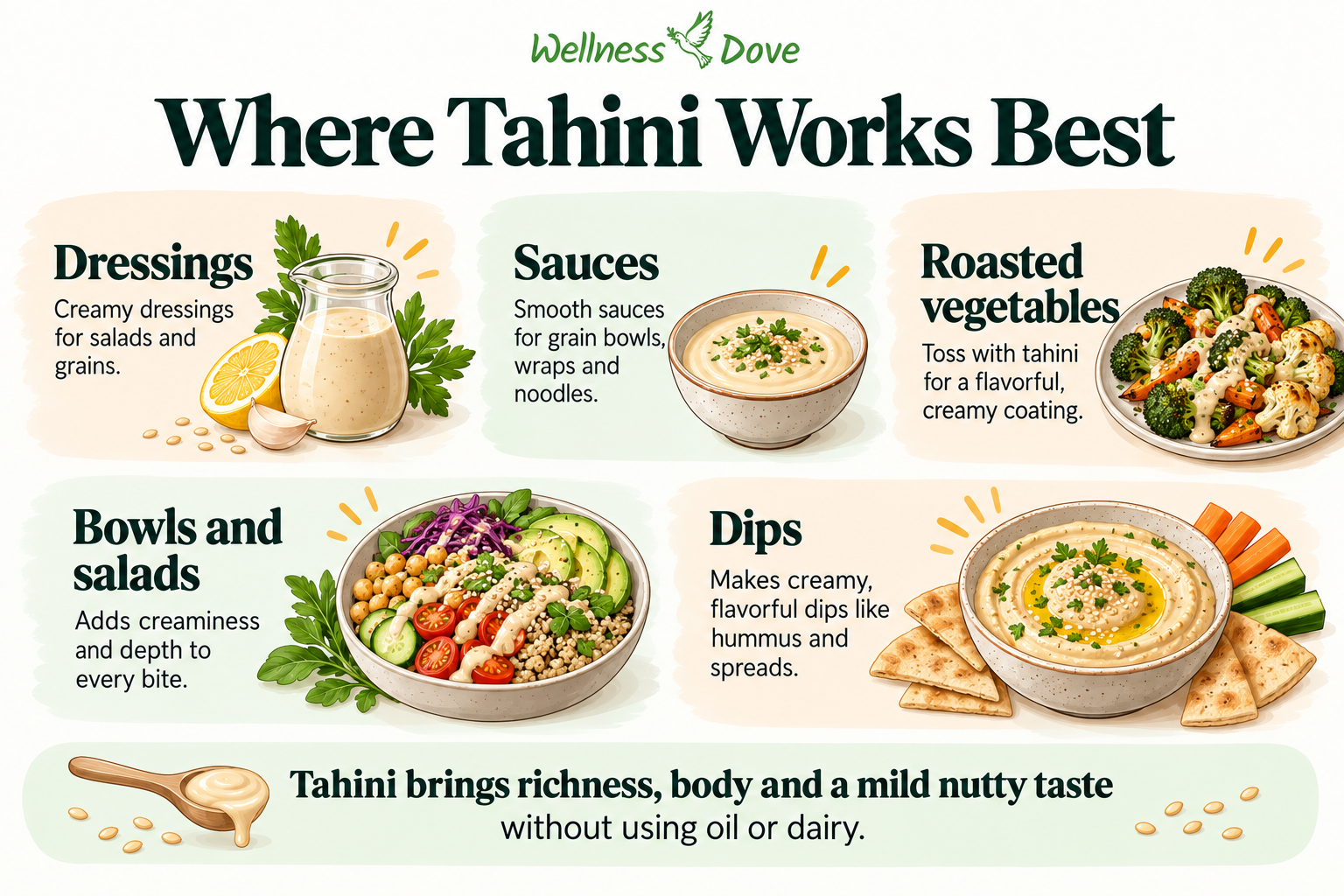
It’s sesame seeds ground to a paste, and most of what it does for us happens in a sauce: whisked with lemon or lime, garlic and water, then tossed with potatoes, stirred into chickpeas or blended into a dip.
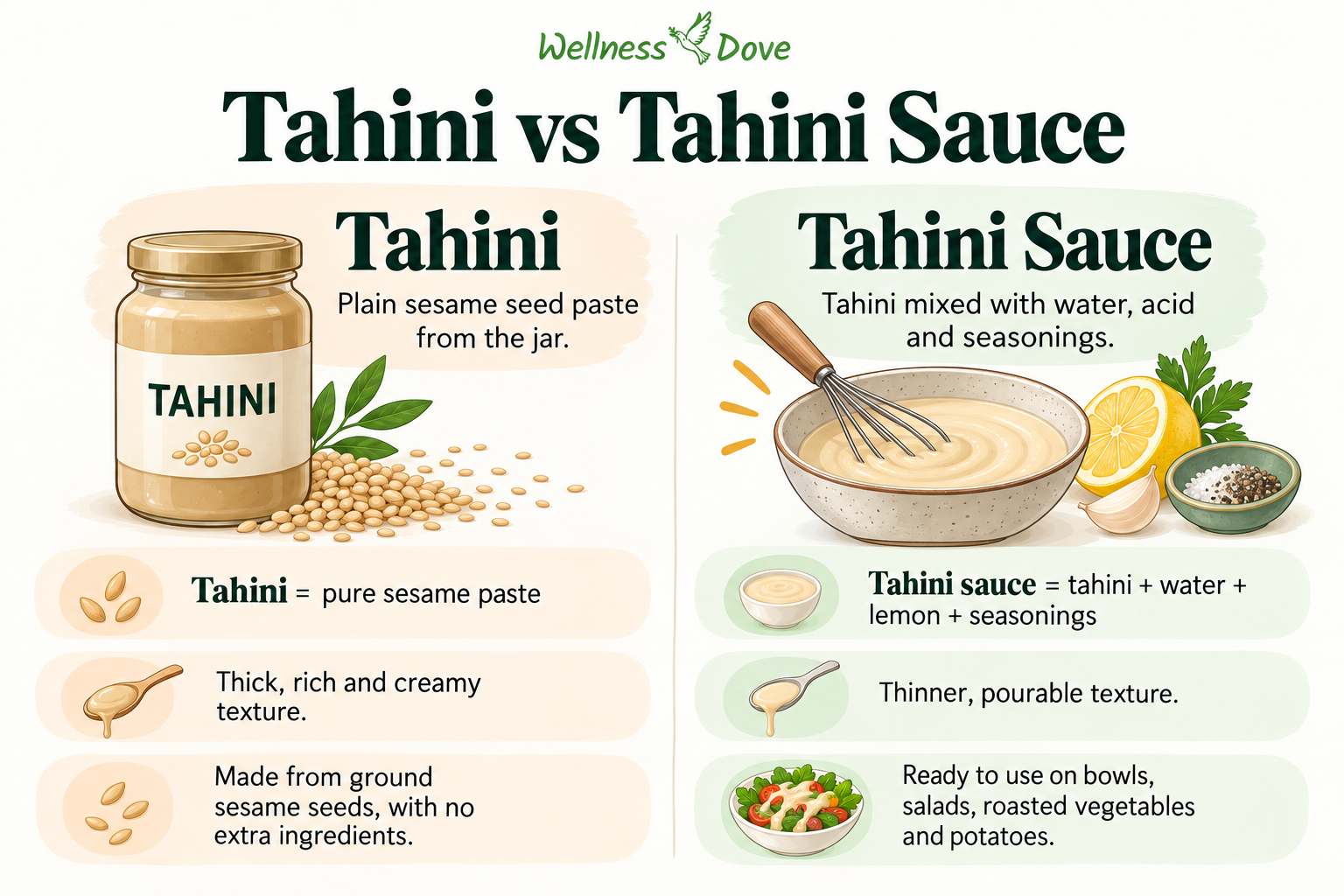
The short answer: tahini sauce is tahini whisked with lime or lemon juice, garlic, water and salt. Our version for potatoes is ¼ cup tahini, 3 garlic cloves, the juice of half a lime, ½ cup water and ⅔ teaspoon of salt.
For a substitute, use sunflower seed butter, or almond or cashew butter, with the same lemon, garlic and water. If you’re avoiding sesame because of an allergy, check the label of anything you swap in: sesame has been a labeled major allergen in the US since 2023.
How to Make Tahini Sauce
Our recipes make tahini sauce three slightly different ways, and they share one pattern: tahini, an acid and salt, whisked until smooth. Two of the three also add water; the roasted peppers dressing doesn’t.
| Recipe | Tahini | Acid | Water | Also |
|---|---|---|---|---|
| Creamy garlic potatoes | ¼ cup | Juice of ½ lime | ½ cup | 3 garlic cloves, ⅔ tsp salt |
| Chickpea tuna salad | 3 tbsp | Juice of ½ lime | 3 tbsp | 1 tsp Dijon mustard, 1 tsp date syrup, ½ tsp salt |
| Roasted peppers quinoa salad | 1 tbsp | 2 tbsp lemon juice and 1 tbsp cider vinegar | None | 2 garlic cloves, ½ tsp salt |

Water sets the thickness. Our potato sauce uses twice as much water as tahini, the chickpea salad dressing uses equal amounts, and the roasted peppers dressing uses none. Heat thickens it: for the potatoes, the sauce is stirred in a skillet for 3 to 5 minutes until it thickens a little, with more water if it goes too far, before the steamed potatoes and dill go in. It keeps thickening as it stands, so loosen leftovers with a splash of water.
Tahini can also taste a little bitter on its own, so two of our recipes add something sweet: a teaspoon of date syrup in the chickpea salad dressing, and two dates in the bean dip.
How We Use Tahini
| What we make | Recipes | Tahini per recipe |
|---|---|---|
| Dips and hummus | 3 | 1 tsp to 2½ tbsp |
| Salads and dressings | 3 | 1 to 3 tbsp |
| A sauce for potatoes | 1 | ¼ cup |
Our easy hummus blends 2 tablespoons of tahini with 2½ cups of cooked chickpeas, lemon, garlic, soy sauce and water, and our 10-minute bean dip uses 2½ tablespoons with a can of butter beans.
In the salads it goes into the dressing: a tablespoon in each quinoa salad (heaping, in the peach one) and 3 in the chickpea tuna salad. In the creamy garlic potatoes, it is the sauce.
Three of these recipes (the garlic potatoes, the chickpea tuna salad and the bean dip) call for whole sesame tahini, made from unhulled seeds (the seed coat left on). The hull is where most of the seed’s calcium is: USDA lists 975 mg per 100 grams for whole sesame seeds, against 60 for hulled ones.

Tahini is just over half fat by weight: a tablespoon (15 grams) has about 8 grams of fat, along with 1.4 grams of fiber and 1.3 mg of iron, according to the USDA. So we use it the way we use all nuts and seeds, as an ingredient rather than a snack.
That fat also does a job. In a small Ohio State trial, adding avocado to a salad raised the carotenoids (plant pigments such as beta-carotene) that people absorbed from it 5 to 15 times. That trial used avocado, not tahini, but it’s why we’d rather use a spoonful of tahini than strip every bit of fat out of a dressing. Cooking Without Oil has the rest of that evidence.
Andy: A sauce is often what gets a vegetable tasted in the first place. In a small Penn State study, preschoolers were three times as likely to refuse a raw vegetable served alone as one served with a flavored dip, and ate more of vegetables they had disliked when the dip came too. The dips weren’t tahini, and a spice company’s research institute supported the work. The same lab found a dip didn’t make children like a vegetable more than repeated tasting alone did.
Tahini Substitutes
If you’re replacing tahini because of a sesame allergy, use a butter you already know you can eat: most people with a sesame allergy have another food allergy too, most often peanut. When a reader allergic to both nuts and seeds asked about our garlic potatoes, Venny suggested silken tofu, a non-dairy yogurt, or a blend of roasted cauliflower or sweet potato for the creaminess.
- Sunflower seed butter, or almond or cashew butter, with the same lemon, garlic and water. Our creamy garlic sauce is built this way: ¼ cup sunflower seed butter, ½ cup water, lemon juice, garlic and two dates, blended. Its recipe card works the other way too: tahini can go in instead, with a slightly bitter flavor.
- Raw sunflower seeds, blended with water. Our sunflower seeds sauce is ½ cup seeds, a cup of water, garlic, lemon, soy sauce and dill, blended until smooth.
- Ground sesame seeds, for when you’re out of tahini, not for an allergy. Eight of our recipes already use them: two breads, nuggets, patties, Cajun balls, a spinach pie, a zucchini casserole and a vegetable spread. Ground at home, they won’t be as smooth as tahini.

Sesame Allergy and Tahini Safety
From Venny, a medical doctor and a specialist in Nutrition and Dietetics: tahini is sesame, and sesame is now one of the nine major food allergens in the US. Since January 1, 2023, packaged foods have had to label it as an allergen. In a national survey of about 79,000 people, about 2 in every 1,000 Americans had a sesame allergy with the kind of reactions that mark a true food allergy, and four in five of them had another food allergy too, most often peanut.
It can be serious: about a third of them had used epinephrine (the emergency adrenaline shot) for a sesame reaction. If sesame has ever given you a reaction, see a doctor about it, and if you already have a diagnosis, your allergist’s plan comes before anything on this page.
Two things trip people up. Some manufacturers have added small amounts of sesame to foods that didn’t have it before, so read the label even on a product you’ve bought for years. And when you swap tahini out, look for a “may contain sesame” or “made in a facility” line on the substitute. Those lines are voluntary in the US, so a label without one isn’t a guarantee. If you’re not sure, ask the manufacturer.
There’s also a rarer risk. Salmonella can survive for long periods in oily, low-moisture foods, and tahini is one of them, usually eaten without cooking. In New Zealand in 2012, hummus made with contaminated tahini imported from Turkey was linked to 27 cases of Salmonella, 16 of them a laboratory match to the tahini. The outbreak ended after a recall. If a tahini or hummus you have is recalled, throw it away. [SIGN-OFF: Venny]
Venny is a medical doctor and a specialist in Nutrition and Dietetics; Andy holds a master’s degree in psychology. This is general information rather than medical advice.
Where to Start With Tahini
Make our creamy garlic potatoes in a skillet: 1.2 pounds of steamed potatoes in the ¼-cup sauce from the table above. Then make our easy hummus, which uses 2 tablespoons of tahini.
And, always, seek health consciously.
Read Next
- Oil-Free Salad Dressing: The Ratio That Makes It Work
- Chickpeas: Canned or Dried, and How to Cook Them
- How to Cook Quinoa for Salads, Bowls, Burgers and Bread
- Potatoes: The Most Filling of 38 Foods Tested, and the Case Against Them
- 22 Oil-Free Dips and Sauces, by What Makes Them Creamy
Sources (9)
- U.S. Department of Agriculture. Seeds, sesame butter, tahini, from roasted and toasted kernels (FDC 170189); Seeds, sesame seeds, whole, dried (FDC 170150); Seeds, sesame seed kernels, dried (decorticated) (FDC 169412). FoodData Central, SR Legacy. View
- Unlu NZ, Bohn T, Clinton SK, Schwartz SJ. Carotenoid absorption from salad and salsa by humans is enhanced by the addition of avocado or avocado oil. Journal of Nutrition. 2005;135(3):431-436. View
- Warren CM, Chadha AS, Sicherer SH, Jiang J, Gupta RS. Prevalence and severity of sesame allergy in the United States. JAMA Network Open. 2019;2(8):e199144. View
- U.S. Food and Drug Administration. The FASTER Act: sesame is the ninth major food allergen. View
- U.S. Food and Drug Administration. Food allergies. View
- Olaimat AN, Osaili TM, Al-Holy MA, et al. Microbial safety of oily, low water activity food products: a review. Food Microbiology. 2020;92:103571. View
- Paine S, Thornley C, Wilson M, et al. An outbreak of multiple serotypes of Salmonella in New Zealand linked to consumption of contaminated tahini imported from Turkey. Foodborne Pathogens and Disease. 2014;11(11):887-892. View
- Savage JS, Peterson J, Marini M, Bordi PL Jr, Birch LL. The addition of a plain or herb-flavored reduced-fat dip is associated with improved preschoolers’ intake of vegetables. Journal of the Academy of Nutrition and Dietetics. 2013;113(8):1090-1095. View
- Anzman-Frasca S, Savage JS, Marini ME, Fisher JO, Birch LL. Repeated exposure and associative conditioning promote preschool children’s liking of vegetables. Appetite. 2012;58(2):543-553. View