

In 1995 a group of Australian researchers fed people 240 calories of each of 38 different foods and then measured how hungry they were for the next two hours.
White bread was set at 100. Croissants came in at 47. Fish, which people think of as filling, reached 225.
Where the potato landed
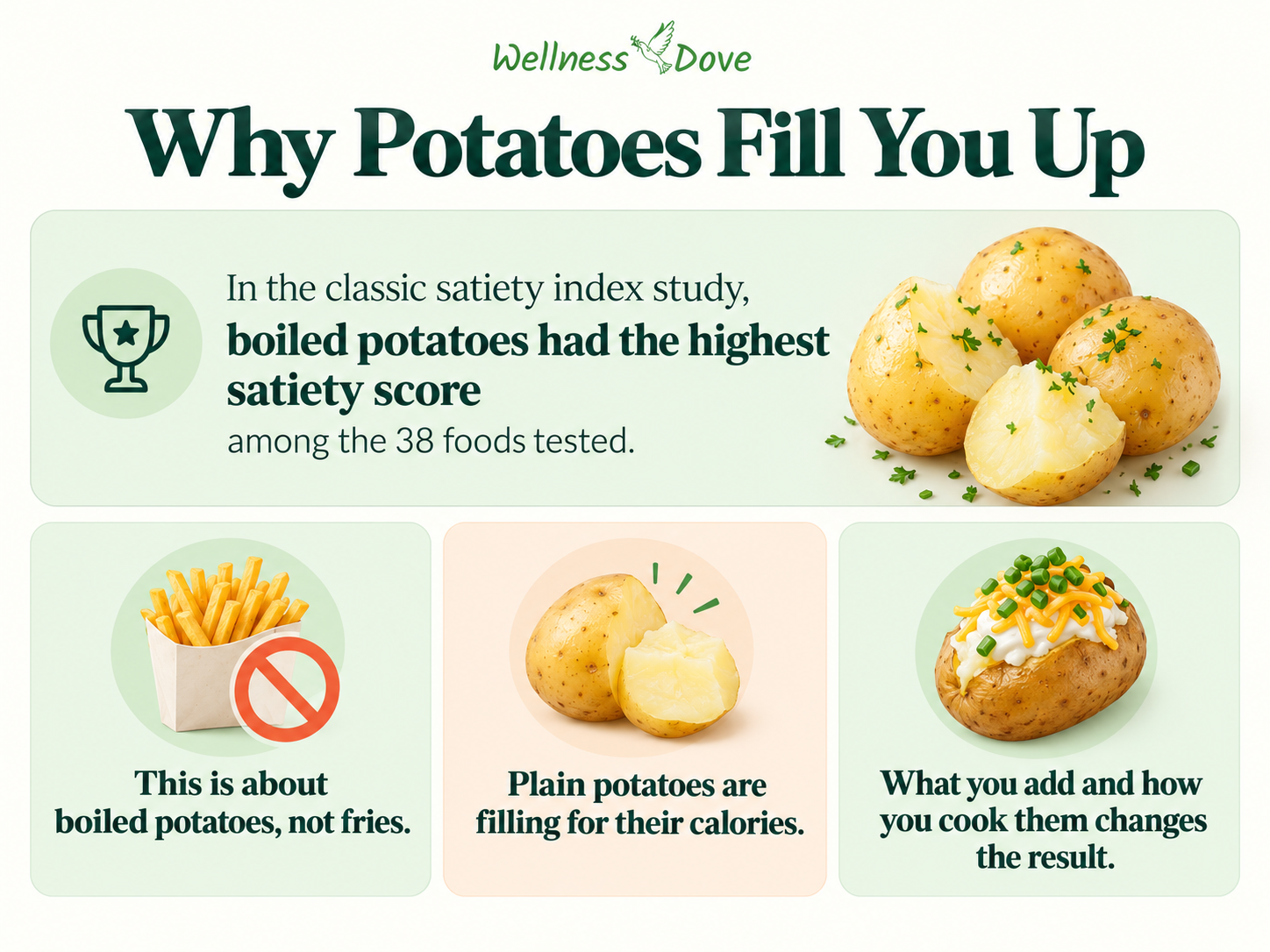
The plain boiled potato scored 323. It beat everything else on the list, including every animal food tested, and it was not close. It was a small study, 11 to 13 people per food, and no one has repeated the full ranking since. It is still the only ranking of its kind we have.
Which sits oddly beside the potato’s reputation. So this page does both halves: what the potato is genuinely good at, and the objections that deserve a straight answer rather than a defensive one.
The short answer: A plain boiled potato was the most filling of 38 foods in the only study that has ranked them this way, at about 350 calories a pound against 2,500 for potato chips. Cook it, then let it go cold before you eat it, and some of its starch turns into fiber your gut bacteria live on.
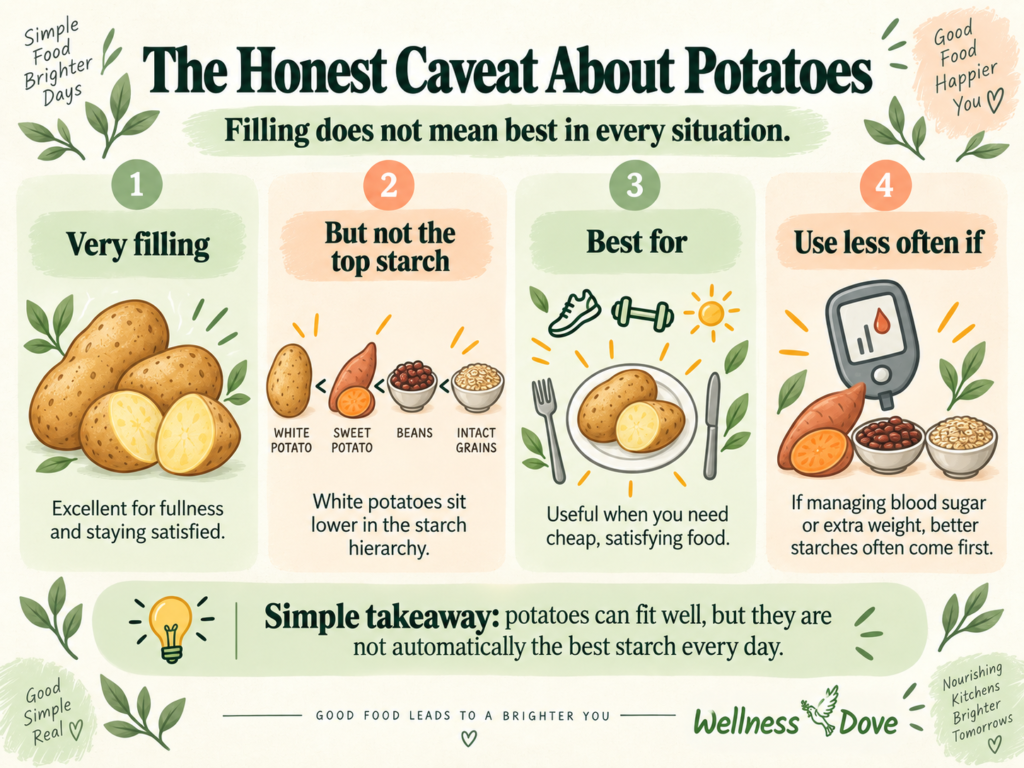
The honest caveat: the white potato sits at the bottom of the starch hierarchy, below sweet potatoes, beans and intact grains, and there is real observational data behind that. What is doing the damage in most diets is not the potato. It is the fryer.
Why Potatoes Fill You Up More Than Anything Else
Two things are happening, and neither is mysterious.
A potato is mostly water and starch wrapped in fiber, so it takes up a lot of room in your stomach for very few calories. A pound of potatoes carries roughly 350 calories. A pound of potato chips carries about 2,500, from the same plant.
And in that study, the fattier the food, the less filling it was, which is why a meal can be enormous in calories and still leave you looking in the fridge.
Put those together and you get the 1995 result. Two hundred and forty calories of boiled potato is roughly two-thirds of a pound of food. Two hundred and forty calories of croissant is about one croissant.
What a potato is not. It is not a nutritional powerhouse and we are not going to claim otherwise. On one nutrient-density scale, Dr. Joel Fuhrman’s ANDI score, the baked white potato scores 43 and brown rice 41, so they sit close together. A sweet potato scores 83, about double. Worth switching for, not a different category of food. Eat potatoes because they fill you up cheaply, not because they are packed with vitamins. The greens on the side are doing that job.
Cook Your Potatoes, Then Let Them Go Cold
This is the one instruction on this page that changes the food itself, and almost nobody does it deliberately.
When you cook a starch and then cool it, the starch molecules rearrange into a tighter structure. The process is called retrogradation, and the result is resistant starch: starch your small intestine can no longer break down.
It travels on to your large intestine instead, where your bacteria ferment it. So it behaves like fiber, not like starch.
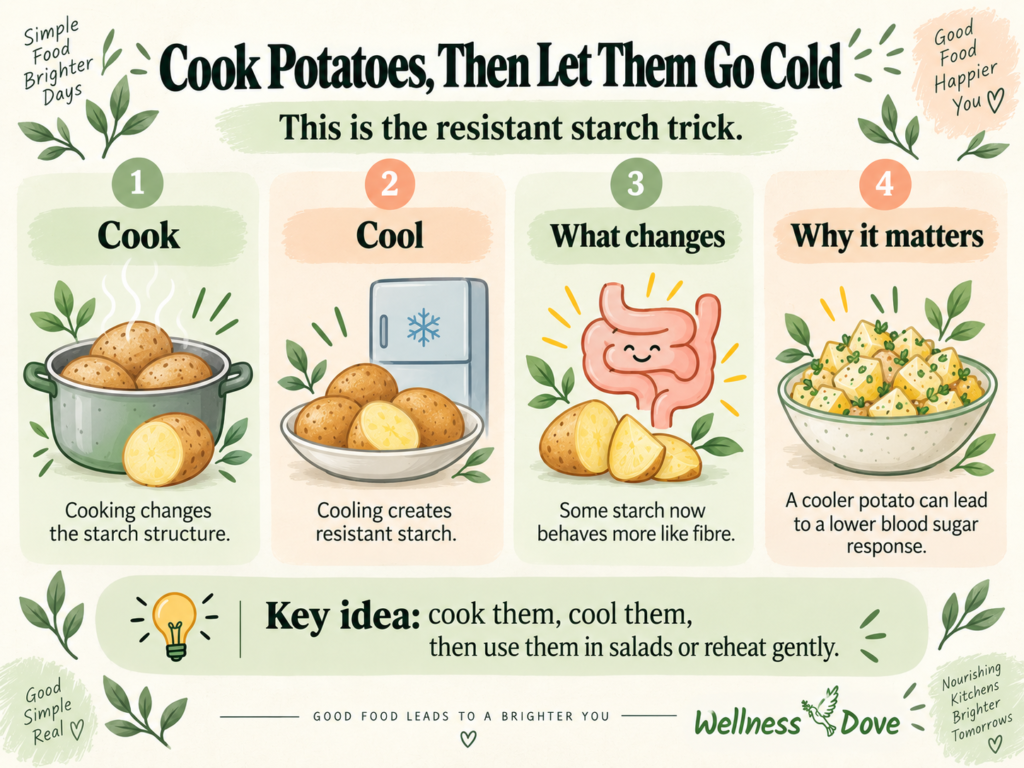
Two things follow. The blood sugar response from that same potato is lower. The calorie change is smaller than you would guess. Ordinary starch carries 4 calories a gram. When researchers measured a resistant starch directly in a metabolic chamber, it still delivered about 2.7 to 3.
Cooling a large potato adds somewhere between about 1 and 8 grams of resistant starch, depending on how it is measured. That is a few calories off a two hundred calorie potato, ten at most. The blood sugar effect is the real one. The calorie saving is a footnote.
Potato salad, it turns out, was ahead of us. Our no-mayo potato salad tells you to steam the potatoes and set them aside to cool, and until now the recipe never said why.
The same chemistry is why a flourless loaf has to cool before you cut it. Different food, identical mechanism, and we explain it properly in the bread guide.
Reheating keeps some of the benefit in some potatoes, but reheated potatoes hold less resistant starch than cold ones, and results vary by variety. Cold in a salad is the reliable version.
The Case Against Potatoes, Taken Seriously
This is where most plant-based writing goes quiet, and we would rather not.
There are two findings that a fair reading has to include:
- The Nurses’ Health Study followed 84,555 women for twenty years and found an 18 percent higher risk of type 2 diabetes for each daily serving of potatoes, with the association strongest in the women who were obese.
- The North Carolina Colon Cancer Study compared 945 rectal cancer cases with 959 controls. Among the white participants it found 57 percent higher odds of rectal cancer at about three servings of potatoes a week than at one, 83 percent at nearly six, and about two and a half times at nine. Among the African American participants in the same study it found nothing at all, and the trend there was flat.
Both are observational, which means they show association and not cause. And the diabetes question has since been asked again, much larger. In 2025 the same group went back to three cohorts, 205,107 people and 22,299 cases, and the picture split in two: french fries carried a 20 percent higher risk per three servings a week, while baked, boiled and mashed potatoes carried no measurable risk at all.
In American dietary data “potato” is heavily fries and potato chips, which is exactly why the newer study split the fries out, and why the answer changed when it did.
Those are real mitigations. They are not a dismissal, and pretending the data does not exist would be the easy thing to do here.
Venny: Where this lands clinically is a hierarchy, not a ban. Starch belongs at the center of the plate, and within starches the white potato is the weakest option. If you are carrying extra weight or managing blood sugar, sweet potatoes, beans, lentils and intact grains should come first, and potatoes become the sometimes food rather than the daily one.
If you are hungry, active and at a comfortable weight, the potato is the most filling thing you can put on a plate. Both of those are true at the same time.
What about the glycemic index?
There is no single number for a boiled potato. The international tables run from 56 for a waxy Marfona to 118 for a Sava, averaging around 82, and the waxy potatoes this page tells you to buy sit at the bottom of that range. Meanwhile supreme pizza scores about 30, chocolate cake 38, premium ice cream 37.
Any measurement that ranks ice cream above a potato is measuring the wrong thing. What lowers those numbers is mostly fat and protein, which slow digestion. Cheddar on a baked potato brought its index down to 39, and that is not a reason to add cheese.
Blood sugar rising after a meal is the system working. That is what eating is for. The question is what happens over years, and there the fryer, not the boiled potato, is where the data points.
If you are on medication for diabetes or blood pressure, changes to how you eat can move your numbers quickly and your prescription may need to move with them. That is a conversation to have with your own doctor rather than with a website.
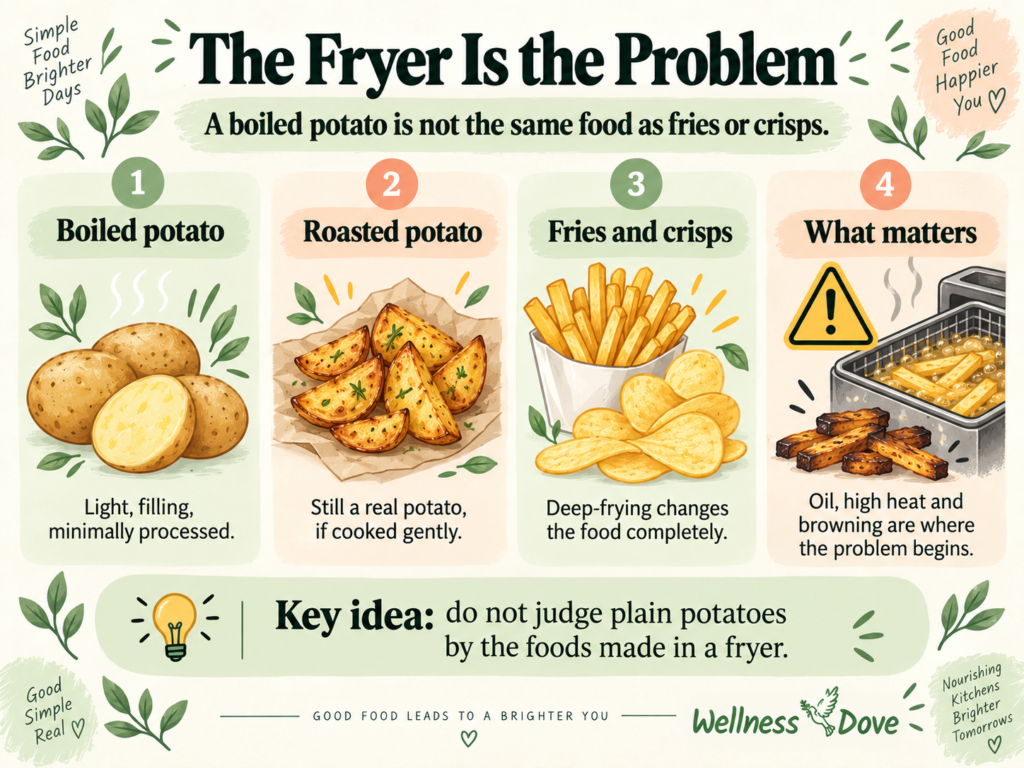
The Fryer Is the Problem, Not the Potato
Roughly 30 percent of the vegetables in the American food supply are white potatoes, and about two-thirds of the potato supply goes to fries, chips and other processed products. When a study finds potatoes associated with something bad, that is usually the food it is describing.
Deep-frying is its own category of problem. Deep-fried foods, plant or animal, have been linked with prostate cancer in observational research, and frying starchy food makes acrylamide.
A boiled potato is not a crisp. They are not the same food and they should never share a sentence without that being said.
Andy: There is a study I think about whenever someone tells me they lack willpower. Offer people a lunch menu of fries, chicken nuggets or a baked potato, and in a pilot study about one in ten took the fries. Add a side salad to the same menu, changing nothing else, and the fries rose to about a third.
The presence of a virtuous option seems to license the indulgent one, and a follow-up study found the effect strongest in the people who scored highest on self-control, exactly the ones who believe they have this handled. So the useful move is not to try harder in the moment. It is to decide what is in the house on Saturday, when you are not hungry and nothing is at stake.
Which Potato to Buy, and Whether to Peel It
Our recipes keep telling you to use waxy potatoes without ever explaining what that means. Here is the difference, because it decides whether your dish works.
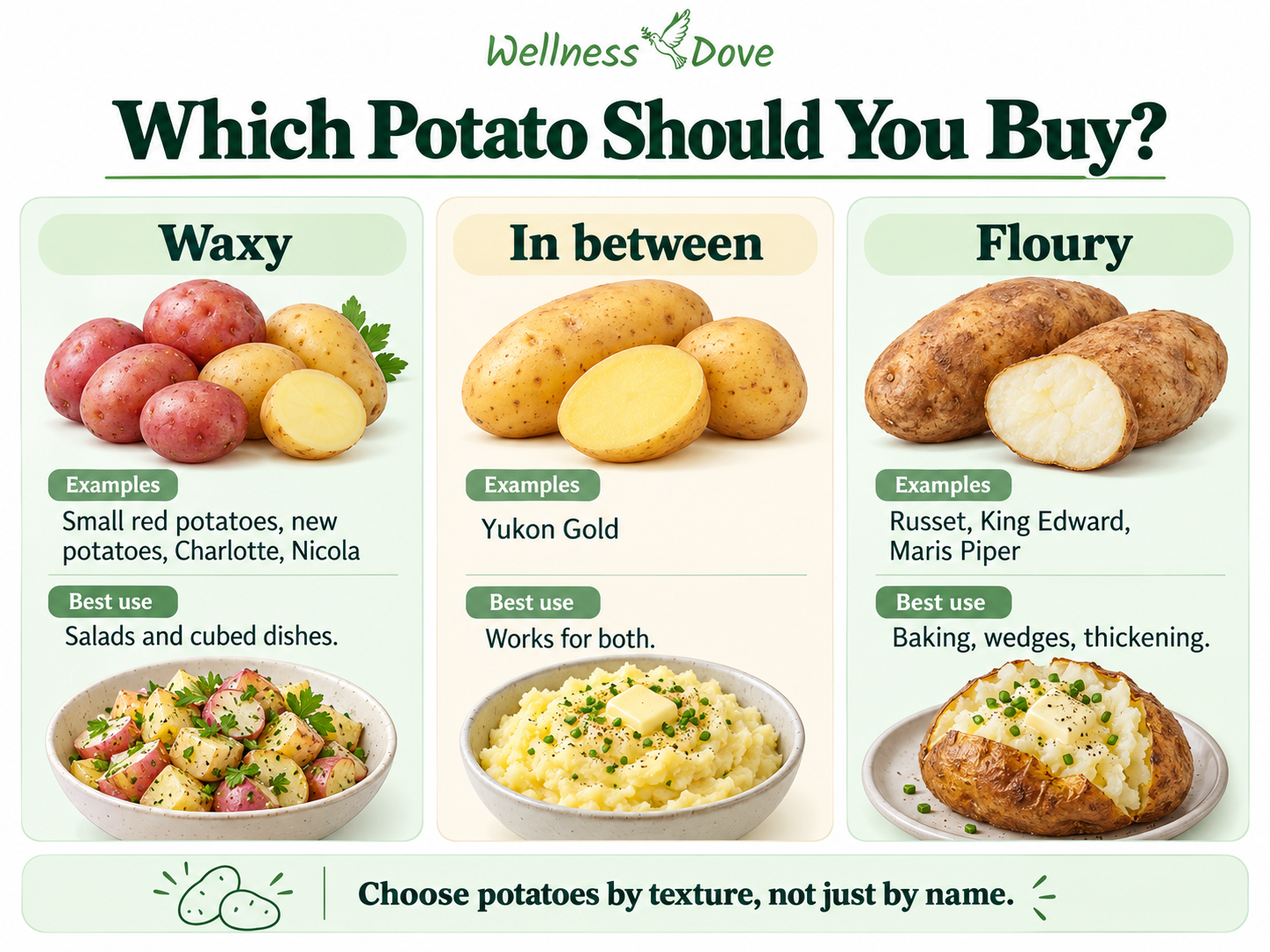
| Type | Examples | Behavior | Use for |
|---|---|---|---|
| Waxy | Small red, new potatoes, Charlotte, Nicola. Yukon gold sits in between and works for both | Less starch, more moisture. Holds its shape when cooked | Potato salad, skillet dishes, anything sliced or cubed |
| Floury | Russet, King Edward, Maris Piper | More starch, drier. Falls apart and goes fluffy | Wedges, baking whole, thickening a soup |
Use a floury potato in a potato salad and you get mush. That is the single most common potato mistake and it is a shopping mistake, not a cooking one.
Leave the skin on
Almost all of our recipes leave it on, and only one asks you to peel. Scrub it, do not peel it, and cut away anything green.
With sweet potatoes this matters more than most people realize, because the skin carries several times the antioxidants of the flesh, up to ten times in one study. And go gently on them: in the same study, baking cut the skin’s phenolic antioxidants by about 55 percent, against 37 percent for boiling.
A note on purple potatoes
If you see them, buy them. In one small crossover trial, eighteen people with high blood pressure ate six to eight small purple potatoes twice a day, microwaved, for four weeks. Systolic pressure fell about 3.5 percent and diastolic about 4.3 percent, in people mostly already on medication, with no weight gain. It is a small study and it is a lot of potatoes, but it is not something an ordinary white potato has been shown to do.
How to Cook Potatoes Without Ruining Them
Ranked roughly by how gently they treat the potato.
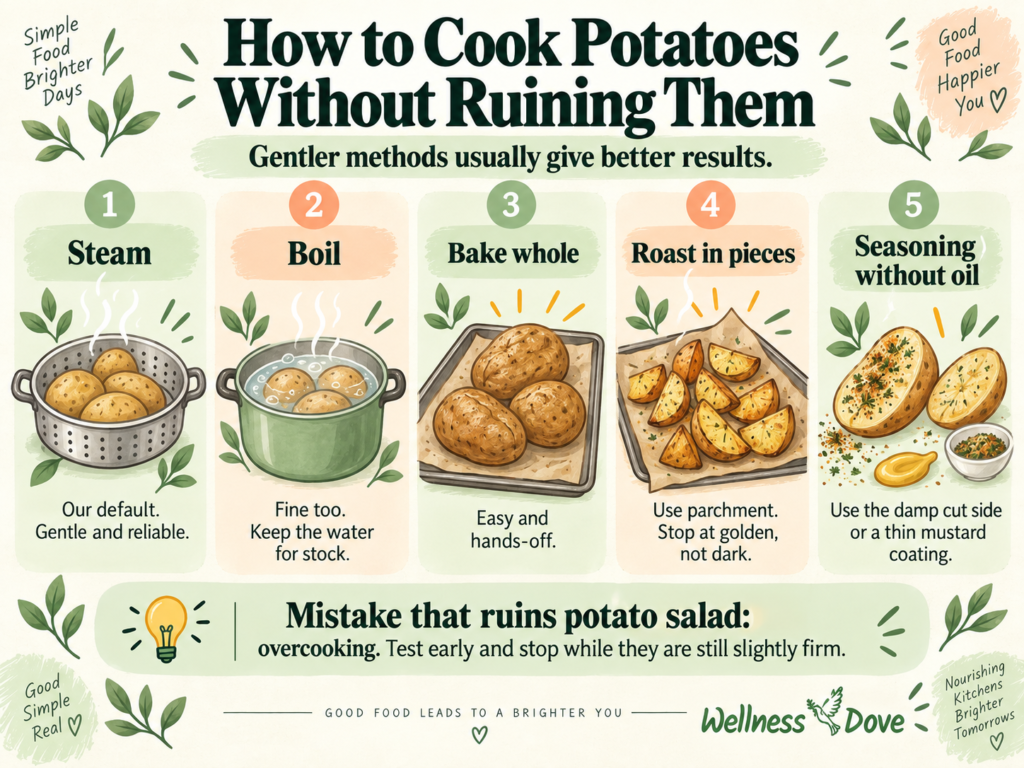
- Steaming. Our default. Fifteen minutes for cubes, and nothing sits in water.
- Boiling. Fine. Some of what leaves the potato ends up in the water, so keep it and use it as stock.
- Baking whole. Forty to fifty minutes at 400°F, pricked with a fork. The least work of anything here.
- Roasting in pieces. Thirty to forty minutes at 400°F on parchment. Browning is where acrylamide forms, so we stop at golden, not dark.
- Frying. We do not.
The mistake that ruins potato salad
Overcooking. As our potato salad recipe puts it, they should be tender and still slightly firm, because past that point they fall apart when you stir them.
Test with a fork at ten minutes, not fifteen. You can always give them two minutes more.
Getting seasoning to stick without oil
Halve them, then press the cut face down into a bowl of dry spices. The damp surface picks up far more than tossing does. Mustard smeared thinly works too.
There is more of this in our guide to cooking without oil.
Potato Recipes Worth Starting With
- Creamy Garlic Potatoes in a Skillet: steamed, then folded through a tahini sauce. The most-read potato recipe we have.
- Oil-free Roasted Potatoes: the press-into-the-spices method.
- Baked Mustard Wedges: what to make when somebody wants chips.
- Potato Salad, No Mayo: cooled deliberately, which is the resistant starch trick in practice.
- Creamy Potato Salad: the richer version, and the one that teaches you not to overcook.
- Creamy Kale Potato Soup: half of it blended, so it thickens itself.
- Bean Stuffed Sweet Potatoes: the easiest dinner on this list.
- Sweet Potato Lentil Curry: one pot, and it improves overnight.
- Sweet Potato and Black Bean Burgers: boiled, mashed and baked into patties.
Venny is a medical doctor and a specialist in Nutrition and Dietetics; Andy holds a master’s degree in psychology. This is general information rather than medical advice.
Where to Start With Potatoes
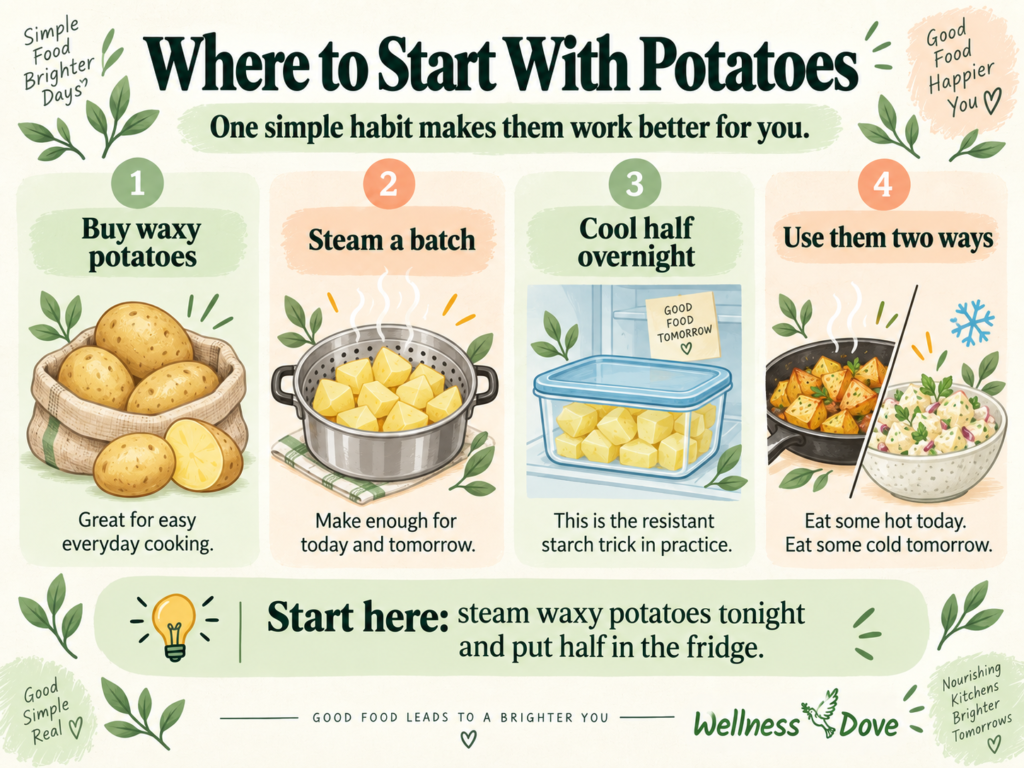
Steam a pan of waxy potatoes tonight and put half in the fridge.
Eat those cold tomorrow in a salad. That is the whole resistant starch idea, and it costs you nothing except deciding to do it a day early.
And, always, seek health consciously.
Read Next
- Cooking Without Oil: What Actually Replaces It
- Bread Without Flour: How It Works, and Which Loaf to Make
- The Four Numbers That Make Plant Food Filling
Sources (23)
- Holt SH, Miller JC, Petocz P, Farmakalidis E. A satiety index of common foods. European Journal of Clinical Nutrition. 1995;49(9):675-690. View
- U.S. Department of Agriculture. FoodData Central, SR Legacy: potatoes, boiled; potato chips. View
- Fuhrman J. Eat to Live. Revised edition. New York: Little, Brown; 2011 (ANDI scores).
- Birt DF, Boylston T, Hendrich S, et al. Resistant starch: promise for improving human health. Advances in Nutrition. 2013;4(6):587-601. View
- Fernandes G, Velangi A, Wolever TM. Glycemic index of potatoes commonly consumed in North America. Journal of the American Dietetic Association. 2005;105(4):557-562. View
- Patterson MA, Fong JN, Maiya M, et al. Chilled potatoes decrease postprandial glucose, insulin, and glucose-dependent insulinotropic peptide compared to boiled potatoes in females with elevated fasting glucose and insulin. Nutrients. 2019;11(9):2066. View
- Kinnear T, Wolever TM, Murphy AM, et al. Effect of preparation method on the glycaemic index of novel potato clones. Food and Function. 2011;2(8):438-444. View
- Giles ED, Brown IL, MacLean PS, et al. The in vivo net energy content of resistant starch and its effect on macronutrient oxidation in healthy adults. Nutrients. 2019;11(10):2484. View
- Patterson MA, Maiya M, Stewart ML. Resistant starch content in foods commonly consumed in the United States: a narrative review. Journal of the Academy of Nutrition and Dietetics. 2020;120(2):230-244. View
- Leeman M, Ostman E, Björck I. Vinegar dressing and cold storage of potatoes lowers postprandial glycaemic and insulinaemic responses in healthy subjects. European Journal of Clinical Nutrition. 2005;59(11):1266-1271. View
- Raatz SK, Idso L, Johnson LK, Jackson MI, Combs GF Jr. Resistant starch analysis of commonly consumed potatoes: content varies by cooking method and service temperature but not by variety. Food Chemistry. 2016;208:297-300. View
- Halton TL, Willett WC, Liu S, et al. Potato and french fry consumption and risk of type 2 diabetes in women. American Journal of Clinical Nutrition. 2006;83(2):284-290. View
- Williams CD, Satia JA, Adair LS, et al. Dietary patterns, food groups, and rectal cancer risk in Whites and African-Americans. Cancer Epidemiology, Biomarkers and Prevention. 2009;18(5):1552-1561. View
- Mousavi SM, Gu X, Imamura F, et al. Total and specific potato intake and risk of type 2 diabetes: results from three US cohort studies and a substitution meta-analysis of prospective cohorts. BMJ. 2025;390:e082121. View
- Henry CJ, Lightowler HJ, Strik CM, Storey M. Glycaemic index values for commercially available potatoes in Great Britain. British Journal of Nutrition. 2005;94(6):917-921. View
- Atkinson FS, Foster-Powell K, Brand-Miller JC. International tables of glycemic index and glycemic load values: 2008. Diabetes Care. 2008;31(12):2281-2283. View
- Foster-Powell K, Holt SH, Brand-Miller JC. International table of glycemic index and glycemic load values: 2002. American Journal of Clinical Nutrition. 2002;76(1):5-56. View
- Henry CJ, Lightowler HJ, Kendall FL, Storey M. The impact of the addition of toppings/fillings on the glycaemic response to commonly consumed carbohydrate foods. European Journal of Clinical Nutrition. 2006;60(6):763-769. View
- Bentley J. Potatoes and tomatoes account for over half of U.S. vegetable availability. Amber Waves, USDA Economic Research Service; 2015. View
- Stott-Miller M, Neuhouser ML, Stanford JL. Consumption of deep-fried foods and risk of prostate cancer. The Prostate. 2013;73(9):960-969. View
- Wilcox K, Vallen B, Block L, Fitzsimons GJ. Vicarious goal fulfillment: when the mere presence of a healthy option leads to an ironically indulgent decision. Journal of Consumer Research. 2009;36(3):380-393. View
- Padda MS, Picha DH. Phenolic composition and antioxidant capacity of different heat-processed forms of sweetpotato cv. ‘Beauregard’. International Journal of Food Science and Technology. 2008;43(8):1404-1409. View
- Vinson JA, Demkosky CA, Navarre DA, Smyda MA. High-antioxidant potatoes: acute in vivo antioxidant source and hypotensive agent in humans after supplementation to hypertensive subjects. Journal of Agricultural and Food Chemistry. 2012;60(27):6749-6754. View