

Processed foods are ubiquitous.
On the supermarket shelves, on the news, on our tables…
We all know they are supposed to be bad for us but do we truly know what processed foods are?
Most people will think of a candy bar or chips.
That is just the top of the pyramid, though.
Any natural food that has parts of it removed or has been chemically altered is a heavily processed food.
Think of sugar beets and sugar. Olives and olive oil.
They have very little in common.
And neither the oil nor the sugar is healthy.
When processed foods become unhealthy
Mashing potatoes is a form of food processing, after all. Or boiling some chickpeas and making a hummus…
Mashed potatoes are in no way bad for you, though, quite the contrary actually.
That is because we have not altered the biochemical composition of these foods. We have not added or removed anything from the actual potatoes or beans. All the fiber, all the vitamins, all the minerals are still there.
Take a whole wheat kernel, remove the bran and the germ, and you lose about three quarters of the fiber and most of the magnesium. That is why American white flour usually has iron and a few B vitamins added back, and nothing adds back the rest.
An olive is a whole fruit, with its fiber, calcium, copper and water. Olive oil keeps the fat and some of the vitamin E and leaves the rest behind, which is how it ends up at about 4,000 calories a pound.
It is the same story with beets. Table sugar is made from the sugar beet, a variety of the same plant as the red beets in your grocery store, and red beet juice carries enough nitrate that a 2017 review of 23 studies found it can improve endurance in athletes. Refining a sugar beet into white sugar strips out the fiber, the minerals and everything else, and keeps only the sucrose.
Here’s more on the importance of micronutrients and why whole plant foods are healthiest!
Processed foods become unhealthy when we arrogantly choose to play god with them and change their natural composition.
Which foods can be considered unhealthy processed foods
Sugar.
Pure simple carbs with no nutritional value. It is pure, white, and highly concentrated.
Table sugar, brown sugar, dextrose, high-fructose corn syrup, corn syrup: sugar goes by dozens of names on a label. It is easy to overeat, but a 2016 review found little evidence that sugar is addictive in people the way drugs are. The bingeing seen in lab rats only happened when they were given sugar on and off. So the industry has found ways to make sugar in so many forms to keep us eating the foods they sell.
You feel that you cannot quit sugar, here’s why you do not need it!
Oil.
Oil is pure fat with very little else in it. Even more, despite what it says on the label, oil tends to go rancid quite quickly. And it is not the heart food it is sold as. In a small 2000 study, a single meal with 50 grams of olive oil reduced the arteries’ ability to relax by 31 percent for hours afterward.
Read more on why oil is damaging your health
White flour
White flour is not sugar, but it behaves more like sugar than the grain it came from. When volunteers ate the same wheat as whole grains, cracked grains or fine flour, their insulin response rose step by step as the pieces got smaller. Even worse, we combine white flour with oil and sugar to create pastries that are caloric bombs that wreak havoc on all our bodily systems and cause disease.
Synthetic chemicals
Some additives have earned their bad reputation. The FDA revoked approval for brominated vegetable oil in 2024 after new safety studies. Others, like MSG, have not: blinded studies of MSG eaten with food have not shown that it causes headaches. The very minimal use of mild preservatives might be OK, but most processed foods have years of shelf life. And the bigger problem with most packaged food is not any one chemical. It is what the food is built from.
Combinations of these foods.
Basically all processed foods are oil, sugar (flour), and some salt.
No matter what complex ingredients are listed on the label, it is that simple.
Processed foods are not on the supermarket shelves (only)
Processed foods are on our tables.
We make them in our kitchens.
Home-made white flour cookies with oil, sugar, and salt.
French fries?
Cooking is basically food processing.
There are good cooking methods and bad cooking methods.
Frying is the worst
It involves putting healthy foods (such as potatoes) in super hot oil.
Frying is hard on oil. At frying temperatures it oxidizes and breaks down, and frying starchy foods like potatoes forms acrylamide, which the International Agency for Research on Cancer lists as a probable human carcinogen, mostly on the strength of animal studies.
Baking is OK
Baking at really high temperatures or for too prolonged periods can produce excessive AGEs (advanced glycation endproducts) which are unhealthy.
That said, baking at reasonable temperatures and with no oil for as little as possible is healthy.
Boiling and steaming are the best.
Boiling our food in water ensures that the temperature does not exceed 212°F/100ºC and the food is not exposed to extreme temperatures.
Steaming is even better as it reduces the chance of nutrients leaching from the food into the water.
When we bake, we often boil some of the ingredients to reduce the time and temperature at which we bake.
Healthy processed foods
We humans use food processing to concentrate calories so that we can eat three times a day and include more nutrition in our meals.
Eating a huge bowl of beans or brown rice will supply you with the calories you need but you will get bored long before you eat it all.
At the same time, that bowl of chickpeas will not supply you with the same nutrition as a chickpea hummus with fresh herbs, nuts, seeds, spices like cumin or coriander on a loaf of whole wheat bread and some salad on the side.
And for that reason the more diverse meal is better tasting, and it has more nutrition and diverse sources of calories.
However, the chickpeas are boiled and finely chopped while the bread is made from ground wheat kernels. These are, in essence, processed foods.
The important distinction is that nothing has been taken out or added. Grinding does make grain digest faster, which is why intact grains and beans are better still, but whole wheat bread keeps all the fiber, vitamins and minerals the wheat started with.
The nutrition they contained in the beginning, is unaltered. For that reason, we do not consider such minimal processing of foods in the definition of processed foods.
More on why we crave processed foods here.
Why is processing foods unhealthy, though?
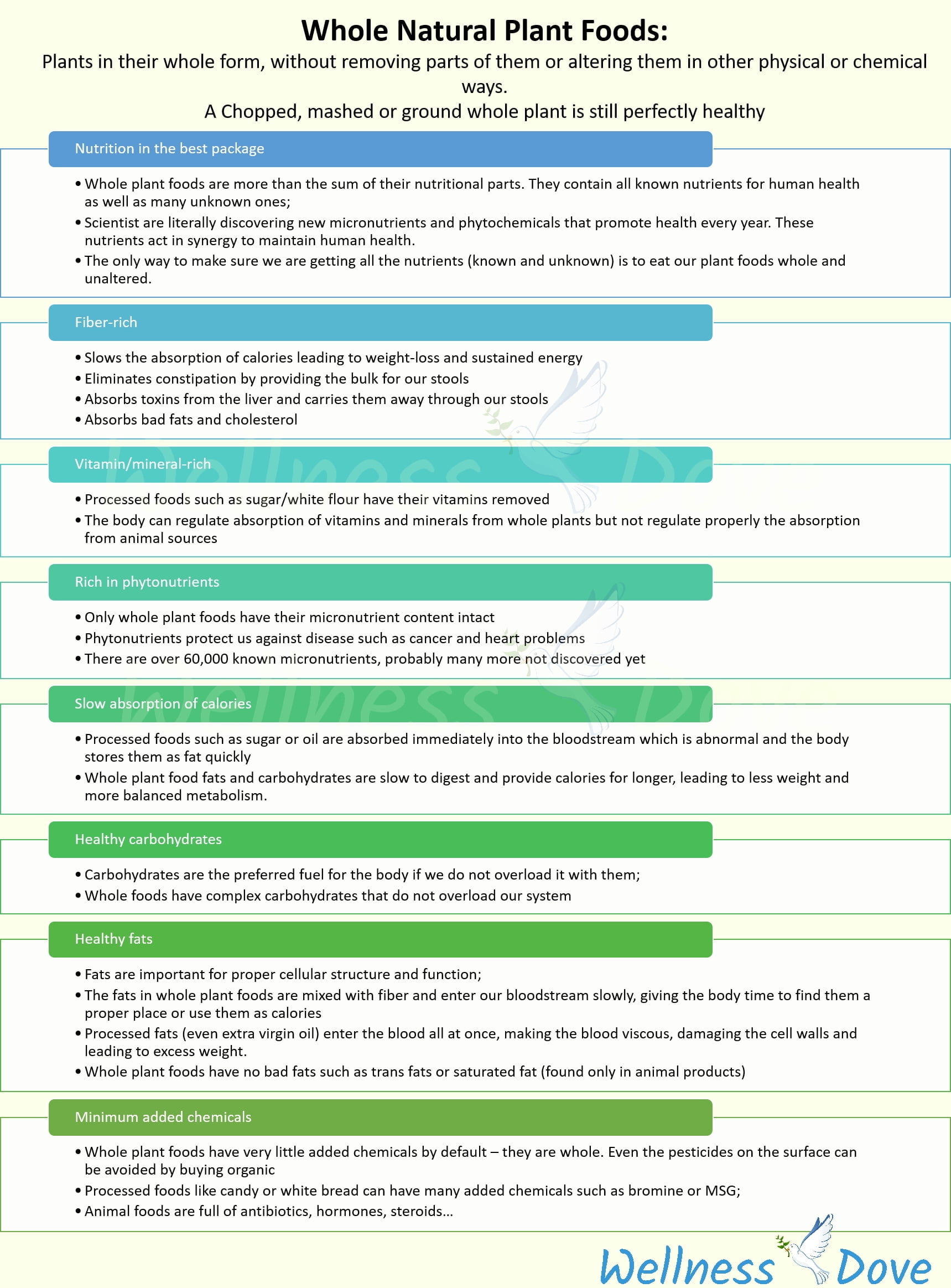
Processed foods lack nutrition
Virtually no fiber, no vitamins, no minerals, no phytonutrients are present in heavily processed foods.
There is no fiber either, and fiber is what slows the absorption of calories and helps carry cholesterol-rich bile out of the body.
Processed foods are absorbed quickly into the blood
When you eat a whole beet, its sugar comes packed inside intact plant cells, along with about 3 grams of fiber per 100 grams.
They contain fiber that is strongly bound to the sugars and slows their absorption even more.
It is the same story with the oils in an olive or a walnut.
When you eat a beet or a walnut, the sugar and fat are released slowly from inside the plant’s cells, and some never get out at all. In a 2016 study, walnuts delivered about a fifth fewer calories than their label predicts.
When you eat oil or sugar on its own, there is nothing to slow it down. After a single high-fat meal, blood fats climb for hours, and in a 1997 study the arteries’ ability to relax was roughly cut in half for up to four hours afterward. A fat-free meal with the same calories had no such effect.
Read more about what happens to your body after you eat processed and whole foods.
Focus on whole natural plant foods, it’s easy
We evolved in an environment where our food was mostly plants and not calorie-rich. That’s why we seek calories and not micronutrients.
Processed foods lure us into consuming them by providing concentrated calories and no nutrition.
More on why we crave processed foods here.
That makes them so addictive and bad for us.
But do not forget that we actually evolved to eat nutrient-rich, whole natural plant foods.
We are built to thrive on that fuel.
The irony is that we need to learn how.
Here’s how to stay satiated on whole plant foods.
Chickpeas, beans, grain, whole wheat bread, brown rice, corn, oats… The list is endless.
Head to our recipe section to get inspired and try some of these healthy recipes.
We think you’ll love the taste.