

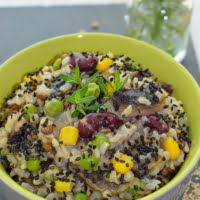
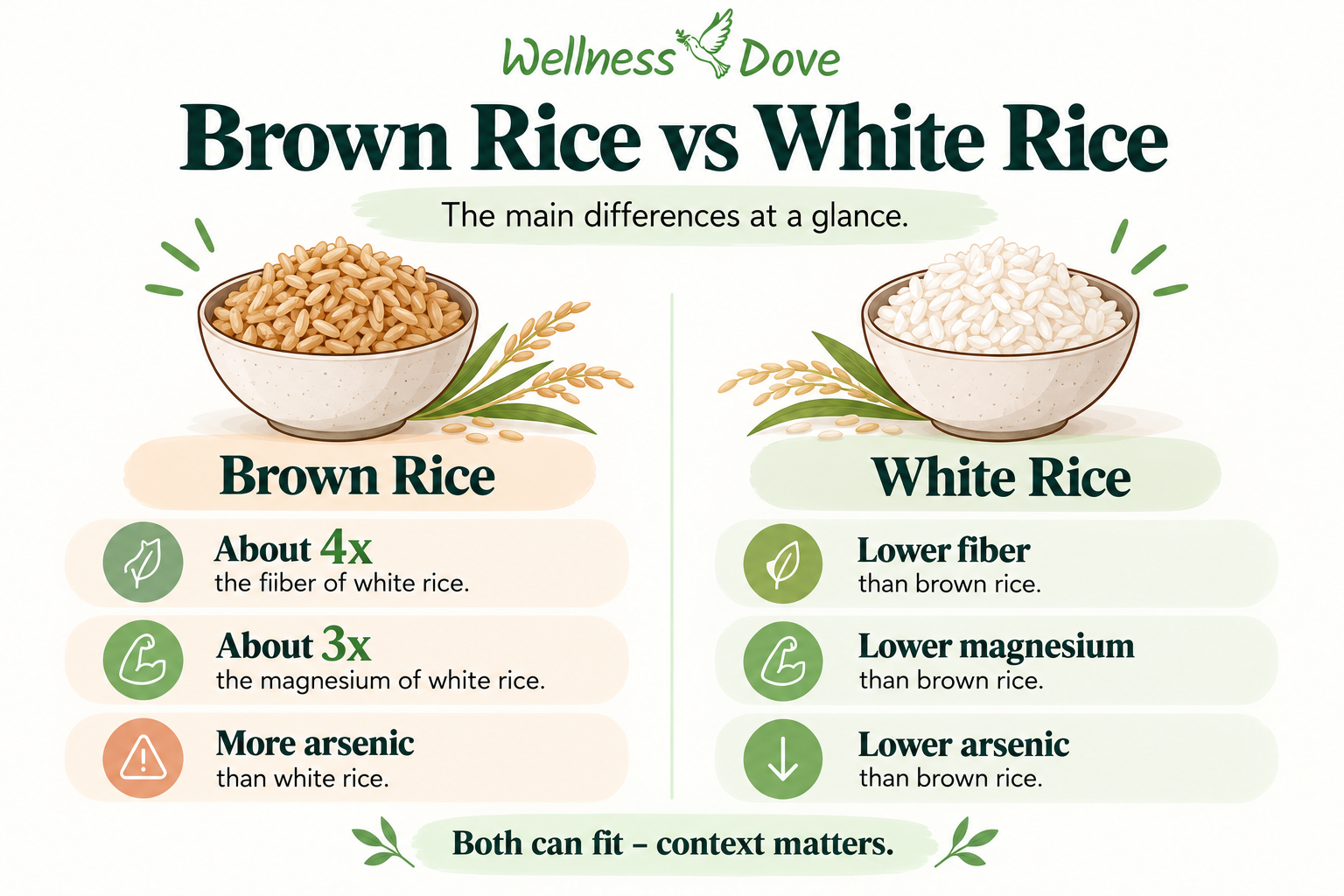
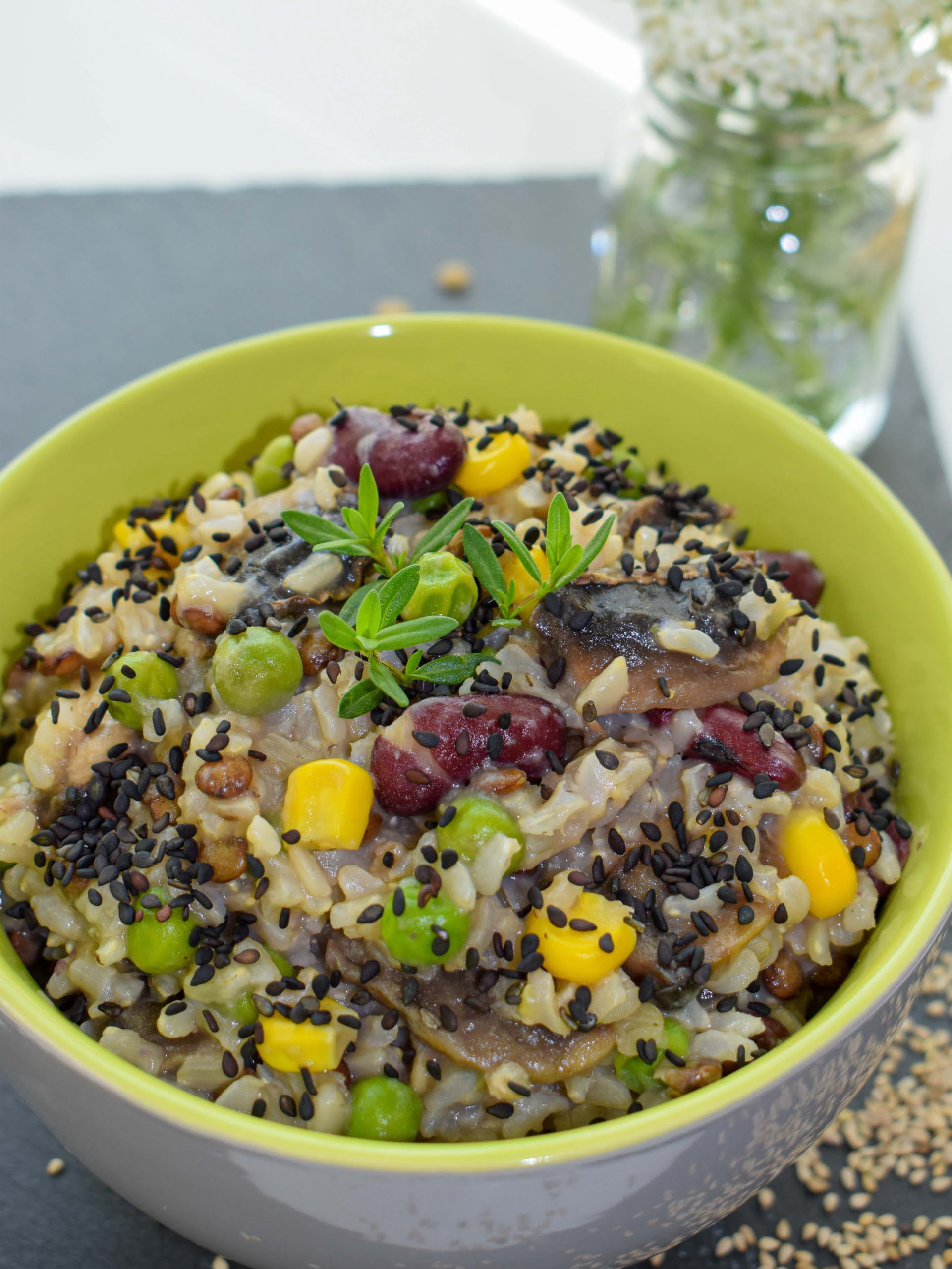
Brown and white rice are the same grain. White rice has had the bran and germ milled off, and with them goes most of the fiber, some of the minerals and some of the arsenic.
So choosing between them is a trade: more fiber and minerals in brown, less arsenic in white, and a smaller blood sugar difference than most people expect.
The short answer: brown rice has about four times the fiber of white and three times the magnesium. Its glycemic index (how fast a food raises blood sugar) is a little lower, 68 against 73. In one large US study, people who ate brown rice twice a week or more got type 2 diabetes about 11% less often. But in trials, swapping white rice for brown didn’t change blood sugar in people who already had diabetes or prediabetes.
Brown rice also carries more arsenic, on average about two-thirds more in FDA testing. For most adults the FDA doesn’t advise changing how much rice you eat. For babies and during pregnancy it advises variety: other grains alongside rice.
Either way, get cooked rice into the fridge within 2 hours.
Rice plays a small part in our kitchen: 4 of our recipes cook it, all with brown rice, and 4 more suggest rice as one way to serve them.
Brown vs White Rice Nutrition
USDA’s figures for cooked long-grain rice, per 100 grams:
| Per 100 g cooked | Brown rice | White rice, enriched |
|---|---|---|
| Fiber | 1.6 g | 0.4 g |
| Magnesium | 39 mg | 12 mg |
| Potassium | 86 mg | 35 mg |
| Manganese | 0.97 mg | 0.47 mg |
| Iron | 0.56 mg | 1.20 mg (added) |
| Folate | 9 µg | 58 µg (added) |
| Carbohydrate | 25.6 g | 28.2 g |
In a cooked cup, that’s about 3 grams of fiber in brown rice against 0.6 grams in white. A cup of brown rice also has a little more carbohydrate, about 52 grams against 45, because a cooked cup of brown rice weighs more.
Enriched white rice carries more iron and folate than brown. They’re added after milling, at levels above what brown rice has naturally: unenriched white rice has just 0.2 mg of iron and 3 µg of folate per 100 grams. Enrichment puts back iron, folate, thiamin and niacin. It doesn’t put back the fiber, the magnesium or the potassium.
Brown Rice vs White Rice and Blood Sugar
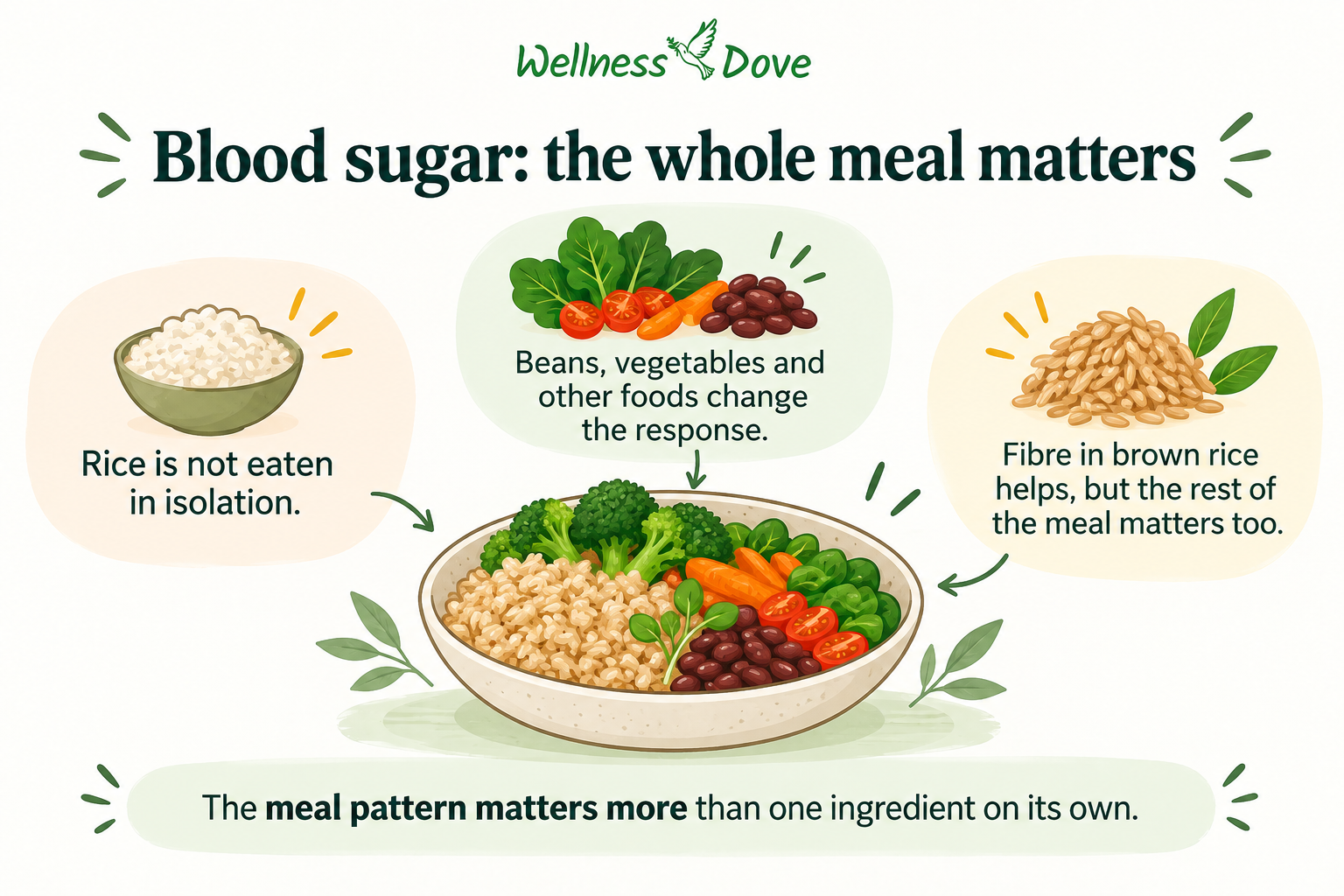
The glycemic index gap is small. In the international tables, boiled white rice scores 73 and boiled brown rice 68, against pure glucose at 100. The tables also note that some white rice varieties score low.
A bigger gap shows up once rice is ground or puffed: in the same tables, rice crackers scored 87 and rice milk 86. Cooked whole grains, brown or white, are digested more slowly than either.
In a 2010 Harvard study of nearly 200,000 American nurses and health professionals, people who ate white rice five or more times a week were 17% more likely to develop type 2 diabetes than people who ate it less than once a month. People who ate brown rice twice a week or more were 11% less likely. The researchers estimated that swapping a third of a serving a day of white rice for brown went with a 16% lower risk.
A 2012 meta-analysis found the link was strongest where rice is the staple. In Chinese and Japanese studies, where people ate three to four servings of white rice a day, the highest eaters had a 55% higher risk of type 2 diabetes than the lowest. In Western studies, eating one to two servings a week, the difference wasn’t significant.
Both are observational studies, and they can’t separate the rice from everything else brown-rice eaters do differently. When trials switched people with diabetes or prediabetes from white rice to brown for weeks to months, their HbA1c (a measure of average blood sugar over about three months) and fasting blood sugar didn’t change.
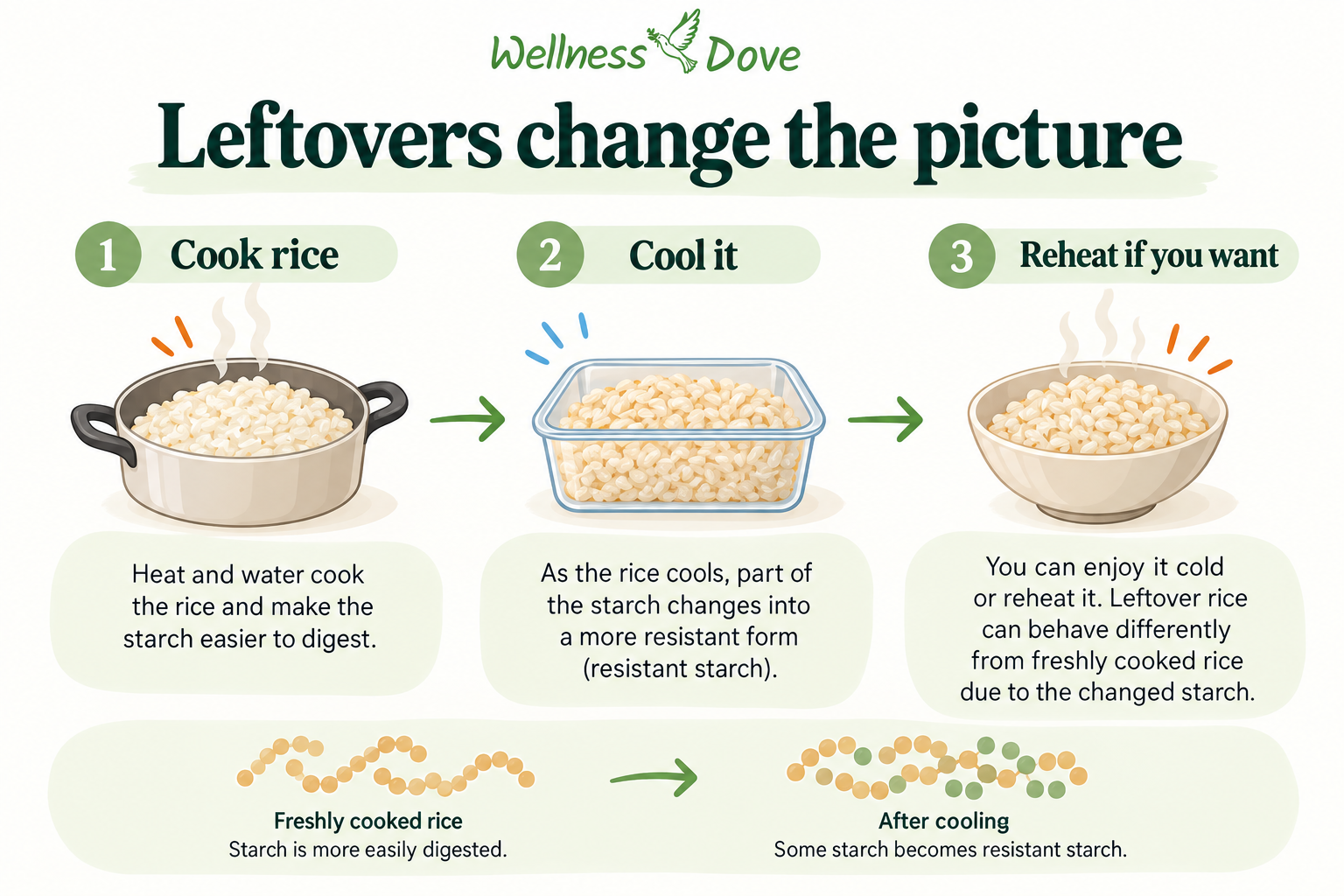
Cooled rice may be a little gentler. In a small 2015 Indonesian trial, analyzed in 14 healthy adults aged 20 to 40, white rice that was cooked, chilled for 24 hours at 39°F and reheated had more resistant starch (starch that escapes digestion and behaves more like fiber) than fresh rice, and it raised blood sugar about 18% less. An earlier Indonesian study found no effect, and this trial used white rice in people without diabetes. Only do this if you cool the rice safely (see below).
Arsenic in Brown Rice vs White Rice
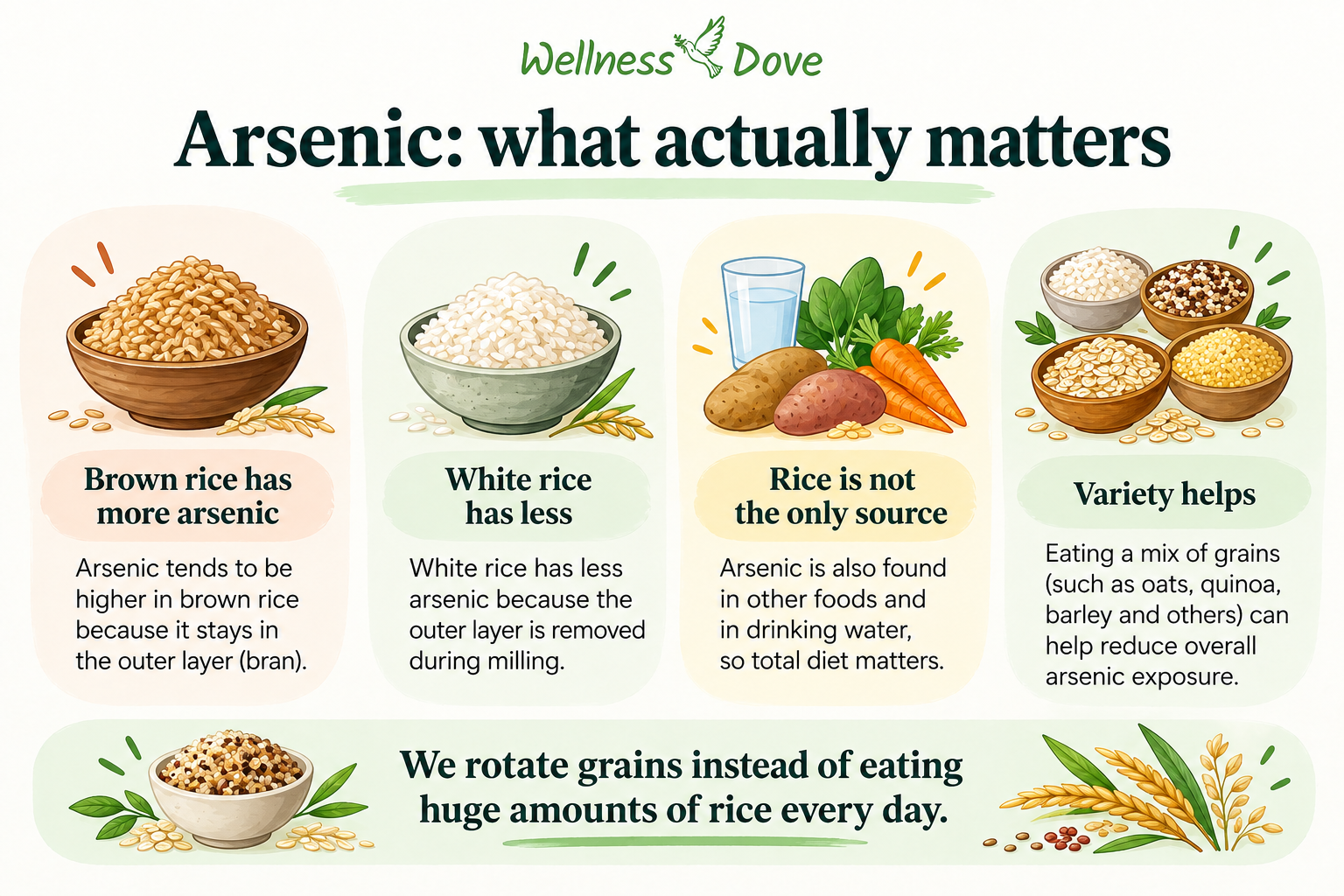
Rice plants tend to absorb more arsenic from their environment than other crops, the FDA says, partly because rice is usually grown in flooded fields. Brown rice keeps the bran layers that milling removes, and in FDA testing it carried more.
In the FDA’s 2016 risk assessment, uncooked brown rice averaged 154 parts per billion of inorganic arsenic, the more harmful form, and white rice 92. Yet most of the arsenic Americans get from rice comes from white rice, because they eat about ten times as much white rice as brown.
The FDA’s advice depends on who’s eating:
- For most adults, no change. The FDA says it isn’t advising the general population to change how much rice they eat because of arsenic. It does advise a varied diet, so that no single food dominates.
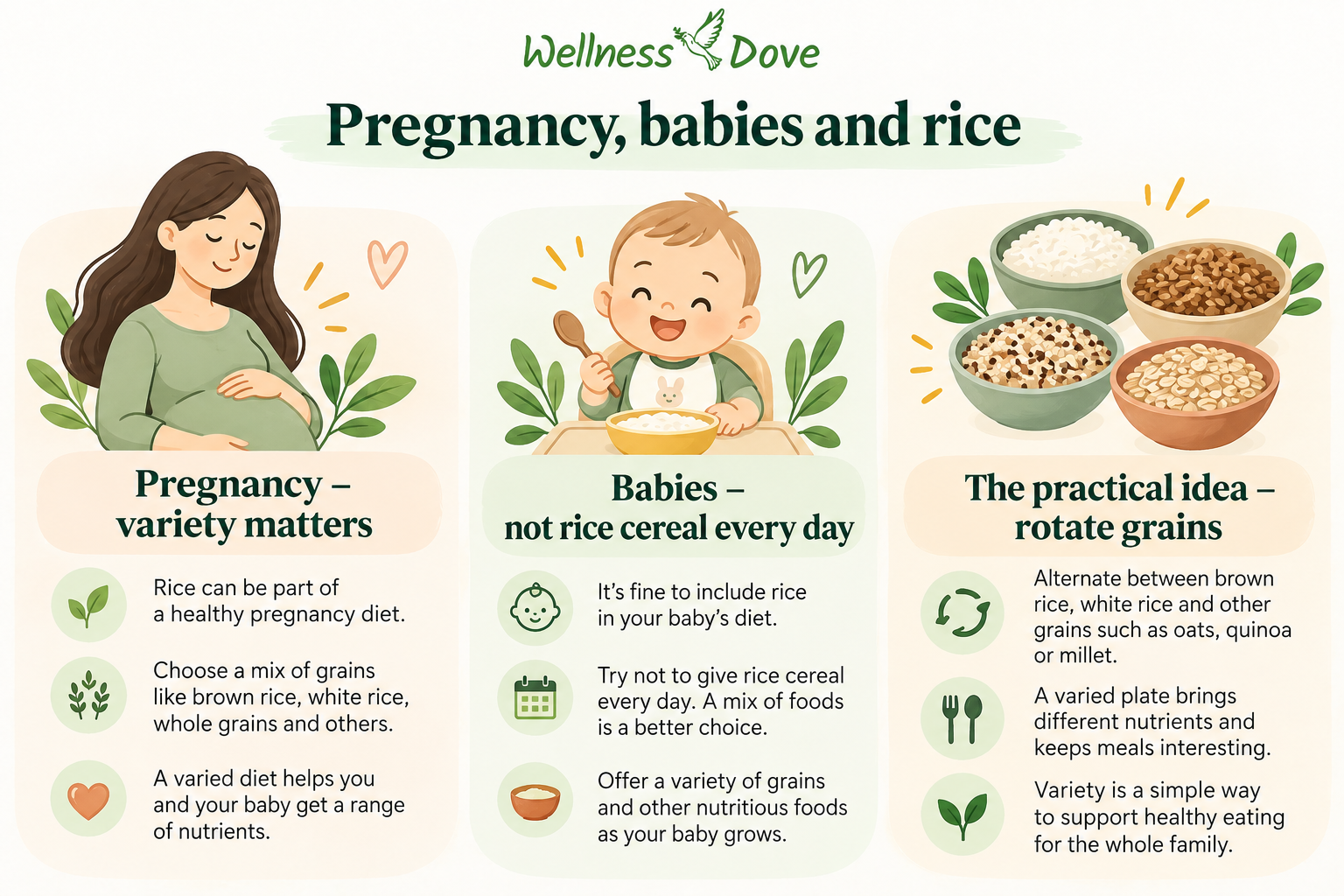
- For babies, variety. Relative to body weight, babies eat about three times as much rice as adults, mostly as infant rice cereal. The FDA advises iron-fortified cereals, and says rice cereal is a good source but shouldn’t be the only one: oat, barley and multigrain infant cereals are alternatives. Since 2020, it has also held manufacturers to a limit, which it calls an action level, of 100 parts per billion of inorganic arsenic in infant rice cereal.
- During pregnancy, varied grains, such as wheat, oats and barley, alongside rice.
Babies and pregnancy get the extra care because of the developing brain: the FDA found that arsenic exposure in pregnancy and infancy can lead to a child doing less well on developmental tests that measure learning.
You can also cook some of it out. FDA scientists found that cooking rice in plenty of water, 6 to 10 parts water to 1 part rice, and draining it like pasta cuts inorganic arsenic by 40 to 60%, depending on the rice: about half for brown rice. Rinsing before cooking barely changed the arsenic. Both draining and rinsing wash away the iron, folate, thiamin and niacin added to enriched white rice, which brown rice doesn’t depend on.
The cooking water matters too, since rice takes up arsenic from it. If your water comes from a private well, have the well tested.
Leftover Rice Safety
Cooked rice can carry spores of Bacillus cereus, which survive cooking. If the rice sits warm, they grow and make a toxin that causes vomiting, usually 30 minutes to 6 hours after eating. The FDA links this vomiting type of illness mostly to rice and other starchy foods, and the toxin survives reheating, so reheating doesn’t make badly stored rice safe.
Four habits keep it safe, all from the USDA’s rules for leftovers:
- Refrigerate cooked rice within 2 hours, or within 1 hour if the room is above 90°F.
- Spread it in shallow containers so it cools quickly.
- Use it within 3 to 4 days, counting from the day the rice was cooked, not the day it went into another dish. Or freeze it for 3 to 4 months.
- Reheat it until it’s steaming hot, to 165°F.

How We Cook Brown Rice
The Whole Grains Council gives 2½ cups of water for every cup of brown rice and 25 to 45 minutes of cooking, for about 3 cups cooked. It also suggests letting grains soak for a few hours to shorten the cooking. Two of our recipes soak the rice overnight, one of them “to cook the brown rice more quickly.”
- Brown rice with vegetables: 1½ cups of soaked brown rice simmered with the vegetables in 3 cups of water for about 40 minutes, then left covered 10 minutes to absorb the rest.
- Brown rice mushroom risotto: soaked overnight with lentils, then simmered about 30 minutes.
- Creamy mushroom soup: a cup of unsoaked brown rice simmered with the vegetables for about 35 minutes.
- Brown rice pudding: a cup of already cooked brown rice, simmered 5 minutes with plant milk, banana and dates. A good use for leftovers.
Four more of our recipes suggest rice as one way to serve them:
- Vegetable tofu stir fry: brown rice, quinoa or noodles
- Red lentil soup: rice, potatoes or whole grain bread
- Lentil meatballs in tomato sauce: mashed potatoes or rice
- Chickpea curry: buckwheat or rice

Brown Rice vs White Rice for Diabetes, Pregnancy and Babies
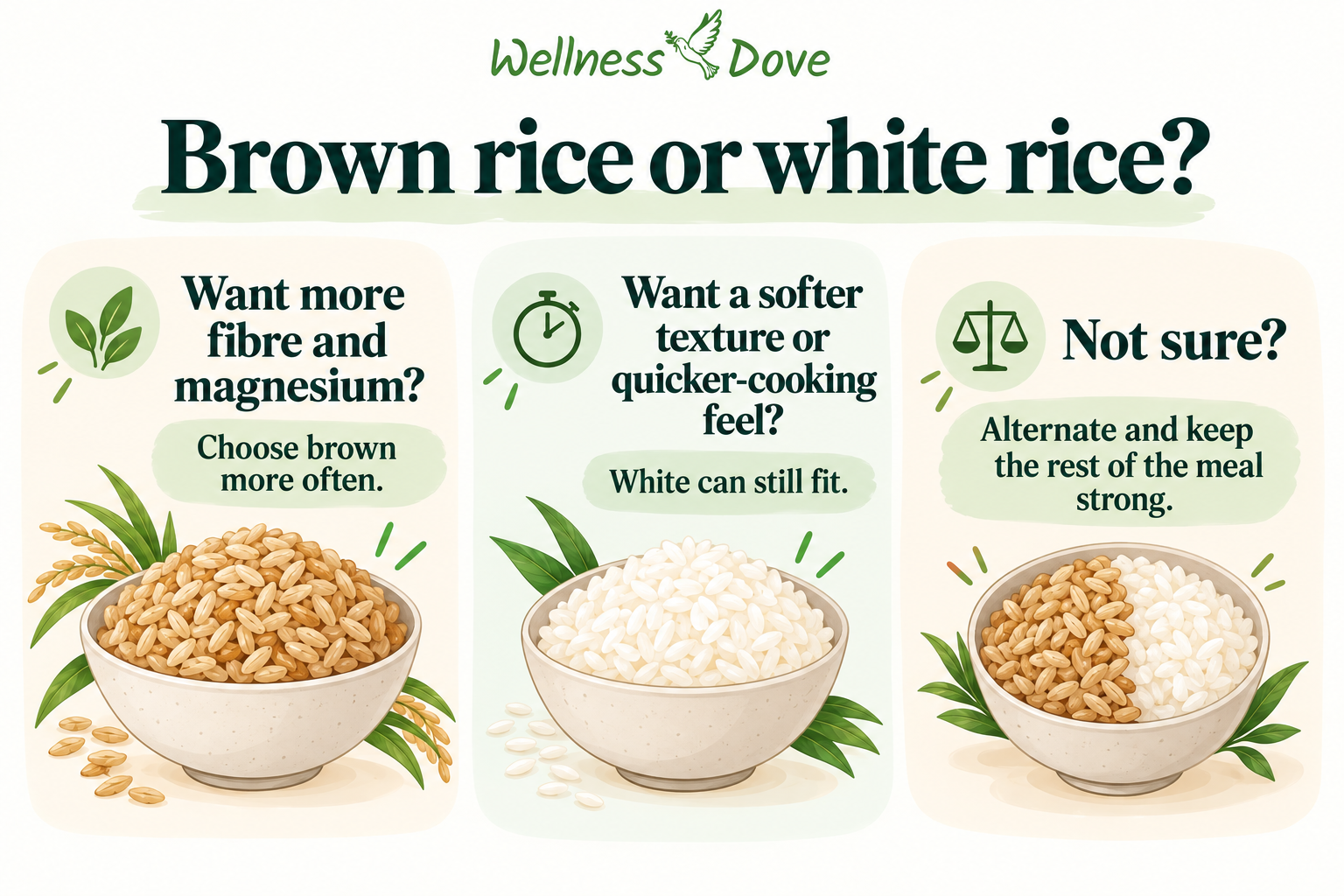
From Venny, a medical doctor and a specialist in Nutrition and Dietetics: for most adults, brown rice is the better everyday choice, and white rice isn’t poison. Rice is a starch, and a plate built on rice, beans and vegetables is a good plate whichever color the rice is. What brown rice adds is fiber and minerals, and in the long-term studies, the people who ate it had less type 2 diabetes.
If you have diabetes or prediabetes, don’t expect the swap alone to move your numbers: in trials, switching from white rice to brown didn’t change HbA1c or fasting blood sugar. What has moved them is changing the whole diet. In a 22-week trial of 99 people with type 2 diabetes, 43% of those on a low-fat vegan diet reduced their diabetes medication, against 26% on the American Diabetes Association’s diet. If you take medication, change your diet together with your doctor, because doses may need to come down.
If you’re pregnant, or feeding a baby, arsenic is a reason to vary your grains, not to fear rice. In pregnancy, eat wheat, oats and barley alongside rice, and remember that draining rice also washes out the folate added to enriched white rice. For a baby, choose iron-fortified cereals and don’t make rice cereal the only one.
Venny is a medical doctor and a specialist in Nutrition and Dietetics; Andy holds a master’s degree in psychology. This is general information rather than medical advice.
Which Rice to Buy for What
| Situation | Choose | Why |
|---|---|---|
| Everyday rice | Brown | Four times the fiber, three times the magnesium |
| Diabetes or prediabetes | Brown, as part of a whole-diet change | Swapping the rice alone didn’t change HbA1c in trials |
| Rice every day | Either, cooked in plenty of water and drained, with other grains alongside | Cuts inorganic arsenic by 40 to 60% |
| During pregnancy | Wheat, oats and barley alongside rice | The FDA’s advice; draining enriched white rice also washes out its added folate |
| A baby’s first cereals | Iron-fortified, rotating rice with oat, barley and multigrain | The FDA’s advice for infants |
| Rice pudding or a quick lunch | Leftover brown rice, stored safely | Our rice pudding starts from cooked rice |
Andy: Which rice you eat is mostly settled at the store. In a Dutch study, people given a free sandwich mostly kept the bun they were offered: 94% kept whole wheat when it was the default, and when white was the default, only about 1 in 5 asked for whole wheat. Both groups felt equally free to choose. It measured choices, not eating, but the lesson carries: make brown rice the one you cook without thinking.
Where to Start With Brown Rice
Cook a cup of plain brown rice in 2½ cups of water, and get what you don’t eat into the fridge within 2 hours. The next morning, a cup of it makes our brown rice pudding in about 10 minutes. Later in the week, soak 1½ cups overnight for our brown rice with vegetables.
And, always, seek health consciously.
Read Next
- Lentils: Which Kind to Buy, and How to Cook Each One
- Dried Beans: How to Cook Each Kind, and Why Kidney Beans Need a Hard Boil
- Rolled, Quick or Steel Cut: Which Oats to Buy for What
- Potatoes: The Most Filling of 38 Foods Tested, and the Case Against Them
- 13 Oil-Free Vegan Dinners, Fastest First
Sources (16)
- U.S. Department of Agriculture. Rice, brown, long-grain, cooked (FDC 169704); Rice, white, long-grain, regular, enriched, cooked (FDC 168878); Rice, white, long-grain, regular, unenriched, cooked without salt (FDC 169757). FoodData Central, SR Legacy. View
- Atkinson FS, Foster-Powell K, Brand-Miller JC. International tables of glycemic index and glycemic load values: 2008. Diabetes Care. 2008;31(12):2281-2283. View
- Sun Q, Spiegelman D, van Dam RM, et al. White rice, brown rice, and risk of type 2 diabetes in US men and women. Archives of Internal Medicine. 2010;170(11):961-969. View
- Hu EA, Pan A, Malik V, Sun Q. White rice consumption and risk of type 2 diabetes: meta-analysis and systematic review. BMJ. 2012;344:e1454. View
- Abdul Rahim AF, Norhayati MN, Zainudin AM. The effect of a brown-rice diets on glycemic control and metabolic parameters in prediabetes and type 2 diabetes mellitus: a meta-analysis of randomized controlled trials and controlled clinical trials. PeerJ. 2021;9:e11291. View
- Zhang G, Pan A, Zong G, et al. Substituting white rice with brown rice for 16 weeks does not substantially affect metabolic risk factors in middle-aged Chinese men and women with diabetes or a high risk for diabetes. Journal of Nutrition. 2011;141(9):1685-1690. View
- Barnard ND, Cohen J, Jenkins DJ, et al. A low-fat vegan diet improves glycemic control and cardiovascular risk factors in a randomized clinical trial in individuals with type 2 diabetes. Diabetes Care. 2006;29(8):1777-1783. View
- Sonia S, Witjaksono F, Ridwan R. Effect of cooling of cooked white rice on resistant starch content and glycemic response. Asia Pacific Journal of Clinical Nutrition. 2015;24(4):620-625. View
- U.S. Food and Drug Administration. Arsenic in rice and rice products risk assessment report. 2016. View
- U.S. Food and Drug Administration. FDA proposes limit for inorganic arsenic in infant rice cereal. April 1, 2016. View
- U.S. Food and Drug Administration. Guidance for industry: action level for inorganic arsenic in rice cereals for infants. August 2020. View
- Gray PJ, Conklin SD, Todorov TI, Kasko SM. Cooking rice in excess water reduces both arsenic and enriched vitamins in the cooked grain. Food Additives and Contaminants Part A. 2016;33(1):78-85. View
- U.S. Food and Drug Administration. Bad Bug Book, 2nd ed. Bacillus cereus and other Bacillus species. View
- USDA Food Safety and Inspection Service. Leftovers and food safety. View
- Whole Grains Council. Cooking whole grains. View
- van Kleef E, Seijdell K, Vingerhoeds MH, de Wijk RA, van Trijp HCM. The effect of a default-based nudge on the choice of whole wheat bread. Appetite. 2018;121:179-185. View