

 Is it not strange that it’s almost impossible to find any tomatoes growing in the wild?
Nor cucumbers, peppers or even apples?
Well, apples yes, but wild crabapples are small and sour.
How is it that we rely on the supermarket or special seeds to grow our food?
And, should it matter at all, for our health or otherwise?
Natural selection at work
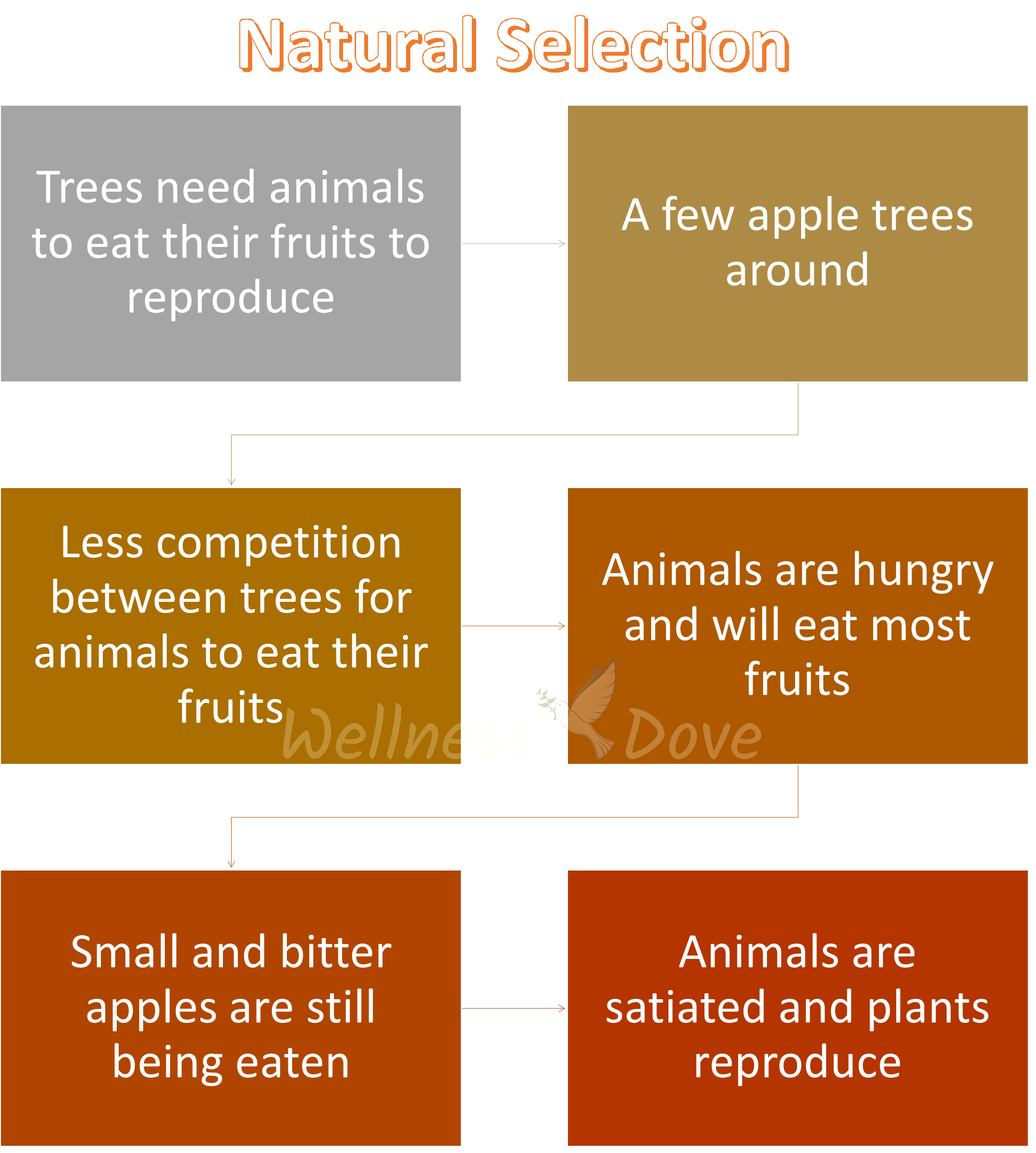
The small and bitter apples on the apple tree are the original apples nature created.
And they make a lot of sense.
Bitter and small fruits spare resources for the plant.
Small means easier for the plant to make. Not very sweet, because the plant does not need to produce many calories (through photosynthesis).
The question is will somebody eat them and help the plant to reproduce?
Before we had agriculture, food was hard to find.
A hungry animal (or human) will eat everything that has a good number of calories in it. Grass is not worth it for us, because we can’t digest the cellulose that makes up most of it.
A bitter apple though, it is sweet enough for us to make the effort to eat it.
 Most likely whole, with the seeds and kernels.
And when the seeds go through our system and exit at the other end, they will reach the ground covered with, well, our excrement that is a nutritious fertilizer for any seed.
And so, another apple is planted.
Or a tomato, or a cucumber, or a banana…
Bananas in the wild are not what’s in the supermarket. They have quite big seeds, actually. And they are nowhere near as sweet.
In an environment of scarcity, where calories are hard to find, bitter, fibrous and small fruits made a lot of sense.
Everybody is better off: the animal (human) is less hungry and the plant successfully reproduces.
The “human” natural selection
Food was scarce for millennia, and it still is for about 1 in 12 people on Earth.
However, about 10,000 years ago humans started to practice agriculture.
What that meant was that we no longer needed to roam vast lands just to find an apple tree.
We could grow an apple tree where we lived. Or a tomato. Or grains and beans…
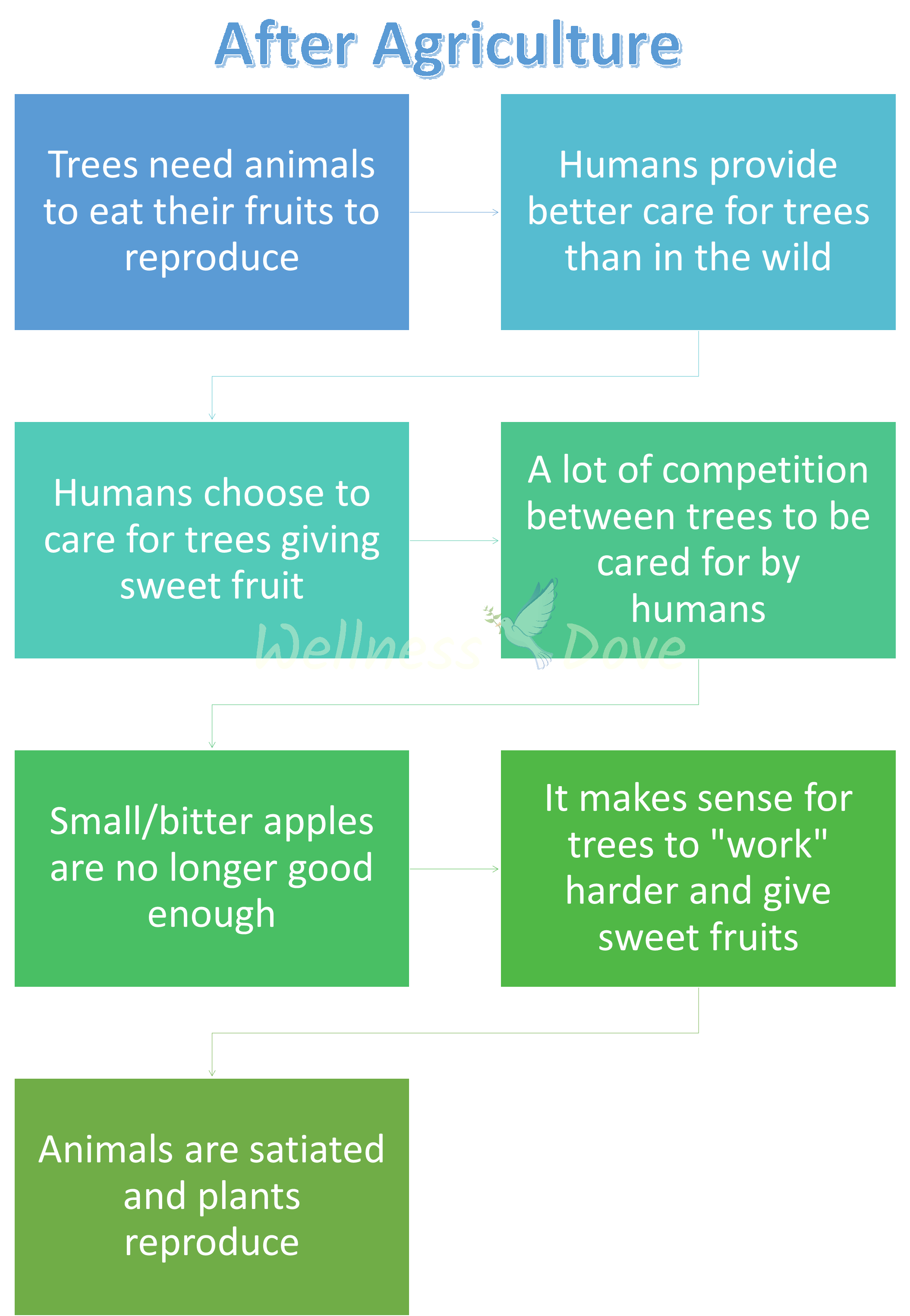 What also happened was that we noticed that some trees had sweeter/bigger fruits or gave a higher yield.
So we kept the tastier plants. Tomatoes were grown from their seeds. Apples, which don’t grow true from seed, were copied by grafting branches of the best trees onto new roots.
The poor tomato no longer thrived just providing some calories, it needed to provide the most calories in order to reproduce. The apple tree was chopped down if it did not give sweeter apples than the next one.
That is how, through the ‘human’ selection the tomatoes from the supermarket can hardly be seen in the wild.
It takes a joint effort, though.
Imagine again, an environment of scarcity.
But not for humans. For plants.
That apple tree needs sunlight, water and good soil to flourish and produce not simply sweet but any apples at all.
And these resources are hard to come by.
In a forest the land is damp but only the highest trees survive and compete vigorously for sunlight.
Out in the open fields the sun might be abundant but the land is dry and barren.
The poor apple tree does not have it all. It struggles yet still manages to grow and give some apples. Bitter apples that our ancestors greatly appreciated.
When humans started to grow their plants, they worked hard to make sure that they had enough water, that they were not crowded and had enough sunlight.
We changed our plants in the sense that they gave better and bigger yields but we also cared for them.
And that is also why we can hardly find big, sweet apples in the wild.
What does all that mean for our health?
On the surface, it’s great.
Mostly, it means we have plenty to eat; it means we no longer survive, we thrive.
Today, the world grows more than enough food to feed everyone.
Even in rich countries hunger hasn’t disappeared: in 2024, about 1 in 7 American households ran short of food at some point in the year.
There are some side effects
The ‘human’ selection has evolved into ‘human creation’.
Modern apples were bred to be bigger and juicier, and whole, they are still a good food.
Literally yesteryear because in the last century we developed the technology to better care for our plants.
More importantly, though, we are now breeding them and not just planting the apples around us that give the sweetest fruit.
Modern apples are bigger and far less sour than wild crabapples, but they are not sugar bombs. A raw apple is about 85 percent water, with roughly 12 grams of sugar and 2 grams of fiber per 100 grams.
The sweetness that matters is in the processed foods, not in the fruit bowl.
Technically, even the sweetest apples won’t make you sick but you should not overeat with them.
The rise of the gluten issue
Read more on the topic: Gluten Is Not as Unhealthy as You Might Think
The most talked-about worry about modern breeding is gluten.
Plant breeders selected wheat above all for yield.
It is often said that modern wheat has far more gluten than the wheat of 100 years ago. The data say otherwise. When researchers grew 60 wheat varieties released between 1891 and 2010 side by side, yields had risen, but total gluten was unchanged and protein had actually gone down.
Modern bread wheat has 42 chromosomes, three sets of 14, because it comes from natural crosses between different wild grasses thousands of years ago. Einkorn has a single set of 14.
A hundred years ago, people were already eating mostly common bread wheat, the same species we eat today. Einkorn and spelt were already old, minor grains.
Today, we have intensively and scientifically created varieties that give a lot higher yields but are no longer ‘natural’.
Einkorn is a lovely old grain, but it is still wheat. Its gluten still sets off the immune reaction in people with celiac disease, so it is not a safe swap for them.
If you do eat wheat, whole einkorn bread is a good choice (here’s why).
Do not worry that much
Eat a colorful and diverse whole foods diet.
Honestly, plant foods will always be great for you.
Bear in mind that whole fruit is good for you, sweet varieties included. In large studies, people who ate more whole apples, grapes and blueberries had a lower risk of type 2 diabetes, while fruit juice went the other way. And unless you have celiac disease or a diagnosed sensitivity, there is no good evidence that the gluten in whole wheat bread is a problem.
Still, the important thing is to eat a variety of foods.
Let legumes, starchy vegetables, rice, corn and some whole wheat bread be the staple of your diet.
Some healthy seeds and nuts. Add a good amount of fruit.
A lot of colorful vegetables. Unlimited greens.
Be grateful for the plants that give you nutrition. Respect and care for them.
The rest is minutiae.
Just, always, seek health consciously.
Read next
- What whole plant foods are: where the modern versions still earn their place, despite the breeding.
- Sprouting at home: seeds are the one part of the food supply breeding has barely touched, and you can grow them in a jar.
- The allure of processed junk foods: what happens when the same selection pressure is applied on purpose, in a factory.