

 Cheese seems to be the favorite food of almost everybody.
People might like or not meat, fish, eggs, broccoli or even cherries but cheese always seems to win hearts.
Why is that?
Is cheese the perfect food, or is it perfectly cunning and tricks us somehow?
Designed to keep us hooked
Cow milk is a perfect food, for baby calves, that is.
Nature designed milk so that it can turn a small calf into a big animal in about a year. It is rich in protein and fat to keep the calf growing fast.
Opiates?
You see, nature does not leave things to chance. Nature does not rely on the baby’s appetite to ensure that it eats well.
When cow’s milk protein is digested, it releases small fragments called casomorphins. In laboratory and animal studies they attach to the same receptors as opioid drugs, which is where the “cheese is like morphine” headlines come from. Whether that happens in any meaningful way in adults has never been shown, and European food safety reviewers found no established link between casomorphins and any disease. The fat and the salt explain cheese’s pull far better.
Built for growth
Cow’s milk is built for an animal that grows fast. A Holstein heifer weighs around 370 pounds at six months and about 660 pounds by her first birthday, and she is past 1,100 pounds at two.
 That is fast growth.
That growth comes from protein, not from extra calories: cow’s milk has about three times the protein of human milk, and cup for cup it is actually slightly lower in calories.
We humans never need to grow that fast, not as babies and not as adults.
Enter human ingenuity
Wait, you might say, were we not talking about cheese?
Cheese, naturally, is made from milk.
Cheese is in essence dehydrated and concentrated milk.
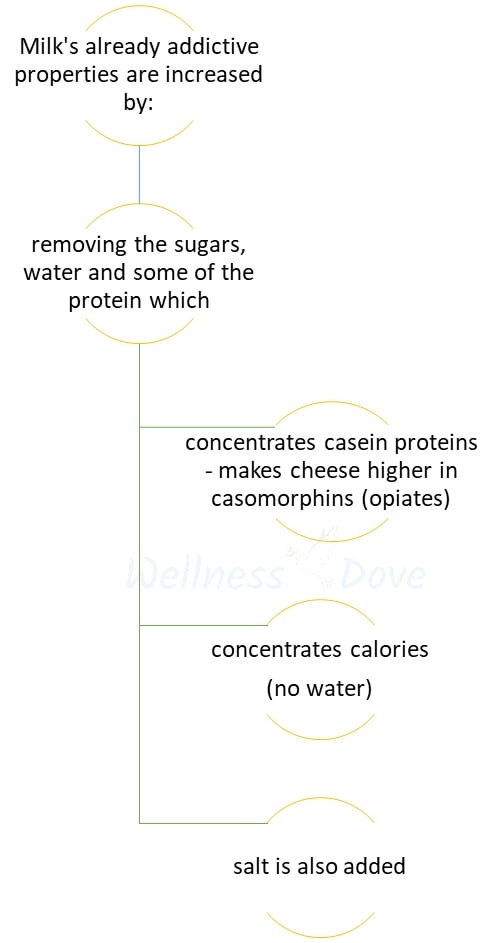 Cheese then is far more calorie-dense than milk, about 400 calories per 100 grams against about 60, and it packs in roughly nine times the casein.
And milk itself is rich to begin with.
Then, however, we add salt to the mix.
Fat, sugar and salt are the holy trinity that makes any food irresistible. Think french fries (oil and salt).
So, milk has fat and sugar (lactose) and protein. Now we remove the water, the lactose and some of the protein and then add salt!
We end up with a super concentrated form of fat and salt, and that is a combination very few people can stop eating.
Irresistible by design.
No wonder everybody loves it.
Or should we say, everybody craves it?
Read next
- Why we crave cheese: a longer version, with the casomorphin evidence weighed rather than repeated.
- The allure of processed junk foods: cheese is one case of a much broader design problem.
- Does dairy help you lose weight: dairy as a health food, checked.