

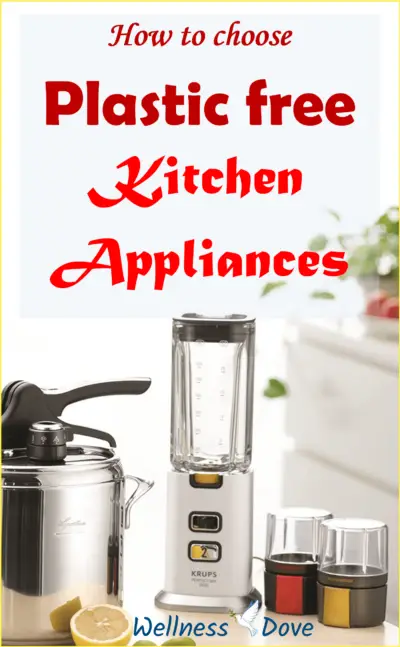
We’ve all heard that plastic is probably not the healthiest material to process and store our food in.
The thing is, though, that most kitchen appliances today are almost exclusively made from plastic.
And that begs the question: should you bother to look for plastic-free options or it’s not that important after all.
It all depends on the appliance and what are you gonna do with it.
Here’s how to choose.
The main considerations:
1. Are you gonna use it with hot food
Heat ages the plastic and makes it more prone to leach toxins into your food.
Basically, if you are going to cook in the appliance or use it with hot food, it is better to look for one made from natural materials such as glass or steel.
2. What kind of plastic is it made from
There is cheap plastic and there is high-quality plastic.
Many cheaper appliances use polycarbonate (PC), a hard, clear plastic that releases BPA, and boiling water made polycarbonate bottles release up to 55 times more of it in one lab study. Skip it. Better appliances use polypropylene (PP) plastic that is OK.
Higher-end appliances often use BPA-free plastics such as Tritan. That’s a step up, but BPA-free doesn’t mean free of every hormone-like chemical: in one 2011 lab study, most plastic products tested, including some labeled BPA-free, released chemicals with estrogen-like activity. So keep plastic away from heat when you can.
1. Electric kettle
The electric kettle is probably the first appliance to get suspicious of.
A plastic kettle makes the water smell… of plastic.
Probably because many people find the smell so alarming, on the market today there is a myriad of choices for glass/metal kettles and their price has fallen to as little as $20.
When buying, though, look for any plastic parts inside, such as structural supports or parts of the handle.
That is why we do not recommend buying the cheapest kettle. Even when you can’t see plastic in the photos, many glass kettles use a silicone seal between the glass and the heating base. Silicone handles heat better than most plastics, and testing shows it releases most of its residues when it’s new. Boil and pour out a few kettles of water before you start drinking from a new one.
Our personal recommendation: Pohl Schmitt kettle. We have been using it for four years at least a couple of times a day and it is a great kettle.
Also, many high-end kettles are not made out of glass because plastic insulates better, which makes these models faster and more efficient. We believe, however, that health is far more important than efficiency or convenience.
Jug blender
It really depends on what you are going to do with the blender.
If you want to use it for hot food or have a smaller budget, it’s better to get a glass blender.
Obviously, heating plastic is not a great idea healthwise, so we prefer a simple glass blender. It doesn’t need to be super powerful for soups also.
With a cheap blender you usually can’t tell what the jar is made of, so glass is the simpler choice.
Most high-power blenders come with a BPA-free plastic jar.
If you’d rather skip plastic, Vitamix has sold a 48-ounce stainless steel container since 2020.
Still, we avoid using them with hot food and we have one simple glass blender and one high-powered one.
Hand blender
Hand blenders should not be plastic.
You are probably going to use them with hot food and stainless steel options are widely available.
We would go for one with all-metal foot such as this Braun but swap the plastic beaker for a tempered glass one.
Mixer
Go for a mixer that has all-metal beaters.
For a countertop, choose one with an all-metal bowl as well as beaters.
Food processor
It’s almost impossible to find a glass food processor these days.
Still, since generally you don’t use your food processor with hot food you shouldn’t worry too much about it being made from plastic.
You can check our guide for choosing a food processor here.
Steam cooker
We believe that there should not be any plastic parts in a steam cooker.
Plastic steamer trays spend the whole cooking time hot and wet, and heat is the main thing that makes plastic release more of its chemicals. That’s why we’d rather steam in steel.
Get a Steamer Pot. You can cook food on multiple levels and enjoy steamed food with the least chance of toxicity.
Get an Instant Pot. It is made from steel, can steam your food and a ton of other stuff.
Juicer
Choosing a non-plastic juicer is quite a challenge.
There are only quite a few options available such as the Breville Die-Cast Juice Fountain Elite Juicer and the Angel Juicer.
However, do you actually need a non-plastic juicer?
Centrifugal (fast) juicers
When choosing a centrifugal juicer, we believe that it is important that the fast spinning parts (the ‘knife’) and the mesh are not plastic.
It is here, where the heat is generated and where your food is in greatest contact with the juicer.
The rest of the juicer only touches the juice briefly, so plastic matters less there. If you can, pick a model whose maker tells you the plastic type, and choose polypropylene (PP) over polycarbonate (PC).
A good example is this lower cost Breville Juice Fountain.
Slow Juicers
Slow juicers come in many sub-types and are generally plastic.
Slow juicers turn far more gently, so they warm the juice less and whip less air into it.
Hence, there is very little danger for toxins to leach into your juice. Simply go for a juicer that is BPA-free.
Our personal recommendation: the Omega VSJ843.
Coffee machine
We have phased out tea and coffee from our diet for a while now. We drink lemon water/fresh juice in the morning and an occasional afternoon green tea, which we prepare with our glass electric kettle.
As far as plastic is concerned, the water tank and all the tubing inside many of the coffee machines we know of, is made out of plastic.
It is alarming for us that hot water travels through plastic tubes.
Inspect the inner tubing of the coffee machine before you buy it.
Also, check the materials the tubes are made out of. If you must buy a unit with plastic tubes, go for safer plastics such as PP (polypropylene).
Breadmaker
Our concern with bread makers is the nonstick pan. PFOA, a chemical once used to make these coatings, was classified as carcinogenic to humans by the World Health Organization’s cancer agency in 2023. US makers stopped using it years ago, so a ‘PFOA-free’ label is now standard rather than a sign of a safer pan.
Deep fryer, grill and sandwich maker:
These have been collecting dust in the cupboard for a while now. We have stopped using these as we went for healthier cooking methods such as steaming or simply oven-baking.
If we were to use a grill, we would go for ceramic coated instead of Teflon coated, as grills tend to reach high temperatures and the ceramic coating does not emit toxins at high temperatures as Teflon does.
There are all-metal stainless steel grills too, but they’re hard to clean, and you don’t want old charred bits ending up on your next meal.
What are your considerations when using kitchen appliances?
Tell us in the comments below.
Read next
- Non toxic cookware: the pans themselves, which see far more heat than any appliance.
- Non toxic kitchen utensils: spatulas, boards and storage, where cheap plastic hides in plain sight.
- The most useful appliance for a plant based kitchen: if you are replacing one thing first, start here.

I know you said to buy a steamer pot, but I don’t have a kitchen or stove so can you tell me about an electric steamer that can steam like veggies and fish ect but has zero plastic in it, it also needs to be able to have easy access to the water reservoir for routine cleaning to prevent mold.
Hi Matthew, I don’t have one specific model with a fully plastic-free interior and reservoir that I’ve personally tested for that exact combination. My best suggestion is an electric pressure cooker like the Instant Pot – the inner pot is stainless steel and it steams beautifully, though the lid and control panel do have some plastic parts. I haven’t found one that ticks every box (zero plastic plus an easy-access reservoir), so if you come across one that works well, I’d love to hear about it!
Thank you for your post! My Cuisinart food processor has a spring that popped out from inside the handle (where it latches). It went down the garbage disposal & I didn’t know it until it was too late. I’ve been trying to replace that spring & Cuisinart doesn’t sell it. Only the WHOLE jar assembly. I was hoping to replace it with glass instead of more plastic but I’m not seeing how this would be possible.
Just a comment on the coffee portion of your post: for coffee drinkers out there, there are several plastic-free options for making coffee besides the traditional drip-style maker. There are glass French presses, many pour-over options, as well as stainless steel espresso (stove-top) espresso makers. Sadly, I spent several hundreds of dollars on a high-end Rialto countertop cappuccino/espresso & it is almost completely made of plastic. That was something I didn’t consider back in the early 2000s when I had more dollars than sense. Even the milk pitcher & steam wand are made of plastic!!
Do you know of any larger appliances that can be 100% plastic free? I’m thinking about a fridge, stove, dishwasher. Everything I see seems to have plastic, is it truly unavoidable?
Hi,
All the larger appliances have plastic in them and I think it’s unavoidable since it will be very difficult for manufacturers to make their appliances from other materials in a cost-effective way.
Honestly, though, these appliances don’t come in direct contact with your food so there is less to worry about.
What I would recommend, though, is to choose more premium brands since they use less plastic and it’s of higher quality (and the appliances will last longer).
Cost-effective is not the only or most important consideration. Pay more, have a fridge (e.g.) for 40 years like we used to, and help reduce climate change. It’s not only about our own food storage and prep. Producing appliances that last 8-10 years if we’re lucky, is planned obsolescence. So self-destructive we are!
It seems you can no longer buy a stick blender without the stupid plastic jug!!??!!!
Hey Heather,
Yeah, it’s such a shame that they always include those plastic jugs that I simply don’t use! Vitamix make a nice immersion blender without any jug, though it’s quite expensive.
Vitamix has plastic in the food end…! Which surprised me.